When it comes to the best binoculars for stargazing, I have found that having the right pair can completely change your night sky experience.
These binoculars offer bright, clear views of stars, planets, and deep-sky objects while being comfortable and reliable for extended observation.
In this guide, I’ll walk you through key features to look for, share my top picks, provide a helpful buying guide, and answer common questions so you can make an informed choice and enjoy exploring the cosmos with confidence.
See summary of the best binoculars for stargazing:
- Celestron SkyMaster 25×70 Binoculars: Best overall
- Vortex Optics Razor UHD 10×50 Binoculars: Best premium option
- Fujinon LB150 15x80mm: Best long-range
- Barska 30x80mm X-Trail Binoculars with Tripod Mount: Best high magnification
- Nikon Monarch M5 8×42 Binoculars: Best compact option
- Nikon AstroLuxe XL 18x70mm Porro Prism Binoculars: Best detailed view
- Celestron Cometron 7×50 Astronomy Binoculars: Best budget
7 Best Binoculars For Stargazing
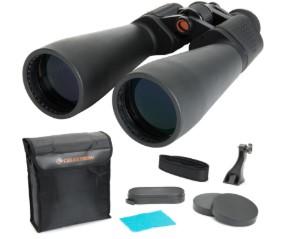
1) Celestron SkyMaster 25×70 Binoculars
Check Price in Amazon
The Celestron SkyMaster 25×70 binoculars are widely recognized as one of the best binoculars for stargazing, offering the kind of magnification and light gathering power that transforms casual night sky viewing into a detailed astronomical experience. With a maximum magnification of 25x and large 70 millimeter objective lenses, these binoculars bring distant celestial objects closer while collecting enough light to reveal stars, clusters, and lunar surface detail that smaller optics often miss.
Low light performance is a major strength. The combination of BaK 4 prisms and a 2.8 millimeter exit pupil helps deliver bright and sharp images even during dusk, dawn, or full nighttime observation. This makes the SkyMaster particularly useful for beginners entering astronomy as well as hobbyists who want a simple alternative to a telescope. Eye relief of 13 millimeters provides reasonable viewing comfort for extended observation sessions, though some eyeglass users may need to adjust positioning to achieve the full field of view.
Because of the powerful magnification and overall size, these binoculars are best used with a tripod. The built in quarter inch twenty adapter allows quick attachment to most standard photo tripods, improving stability and reducing hand fatigue during long viewing sessions. This stability is essential when observing planets, the Moon, or distant terrestrial objects where even slight movement can blur fine detail.
Durability is another advantage. A rubber armored body protects against bumps while also improving grip in cold or damp conditions. The water resistant exterior adds confidence for outdoor use when weather conditions are uncertain. Backed by a limited lifetime warranty and access to technical support, the SkyMaster 25×70 presents a dependable long term option for anyone serious about exploring the night sky with binoculars.
Pros
- Powerful 25x magnification with large 70 millimeter lenses for detailed sky viewing
- Bright and sharp images supported by BaK 4 prism optics
- Tripod compatibility for stable long observation sessions
- Durable rubber armored and water resistant construction
- Lifetime warranty and reliable customer support
Cons
-
Requires a tripod for comfortable extended use
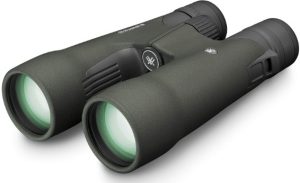
2) Vortex Optics Razor UHD 10×50 Binoculars
Check Price in Amazon
The Vortex Optics Razor UHD 10×50 binoculars earn their place among the best binoculars for stargazing by combining premium optical engineering with a design that supports long, comfortable night sky sessions. With 10x magnification and 50 millimeter objective lenses, they strike an effective balance between light gathering capability and image stability, making them well suited for scanning star fields, viewing constellations, and observing the Moon with impressive clarity.
Optical performance is where these binoculars truly excel. The Abbe Koenig prism design delivers ultra high definition image quality with excellent resolution, sharpness, and color accuracy. Index matched lenses correct color across the full visual spectrum, reducing chromatic distortion and producing a natural, high contrast image. Advanced anti reflective coatings on all air to glass surfaces maximize light transmission, resulting in bright views and strong low light performance that is especially valuable for astronomy and twilight use.
The physical design supports extended use outdoors. A magnesium chassis reduces overall weight while maintaining strength, and the open hinge configuration improves ergonomics and handling. Rubber armor adds grip security and protects against everyday wear. These features make the Razor UHD comfortable to hold during longer observing sessions, even in colder conditions when gloves may be used.
User focused adjustments further enhance the experience. A right eye diopter allows precise focus customization, while the smooth center focus wheel enables quick and fine adjustments. Twist up eyecups provide flexible eye relief positioning, helping both eyeglass and non eyeglass users achieve a comfortable viewing setup. The binoculars are also tripod adapter compatible, which is useful for steady long duration stargazing or shared viewing.
Built for demanding environments, the Razor UHD is argon purged and sealed with o rings for waterproof and fogproof reliability. Lens surfaces are protected by a scratch resistant coating that guards against oil, dirt, and abrasion. The binoculars are backed by an unlimited lifetime warranty that reflects long term confidence in their performance and durability.
Pros
- Exceptional image sharpness and color accuracy with UHD optics
- Strong low light performance ideal for nighttime sky viewing
- Lightweight yet durable magnesium construction
- Comfortable ergonomics with adjustable eyecups and smooth focus
- Waterproof and fogproof with long term warranty support
Cons
-
Premium pricing compared to standard stargazing binoculars
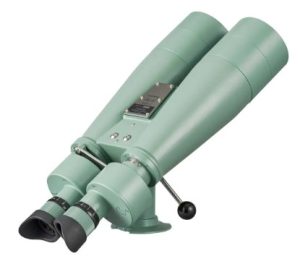
3) Fujinon LB150 15x80mm
Check Price in Amazon
The Fujinon LB150 15x80mm binoculars stand among the best binoculars for stargazing because they combine powerful magnification, large light gathering lenses, and construction designed for demanding outdoor environments. Originally developed for commercial, fishing, and military vessel use, this model delivers the same rugged reliability for serious astronomical observation, allowing clear and confident viewing of the night sky.
With 15x magnification and large 80 millimeter objective lenses, these binoculars collect substantial light for bright and detailed celestial viewing. The 5.3 millimeter exit pupil improves visibility in dark conditions, helping faint stars, clusters, and lunar surface features appear clearer. Multiple layers of electron beam coated optics enhance light transmission and reduce internal reflections, producing a sharp, high contrast image that performs well during dusk, dawn, and full nighttime observation.
Individual eyepiece focusing allows precise adjustment for different eyesight needs, while the wide diopter adjustment range supports fine tuning for visual comfort. Adjustable interpupillary distance and angled eyecups help block stray light and improve long session usability, which is especially valuable during extended stargazing where ambient light can reduce clarity.
Durability is a defining strength. Built to military specification standards and designed to resist water exposure, the LB150 is prepared for harsh outdoor conditions. Its large physical size and heavy construction reflect its ship mounted heritage and powerful optics, making it better suited for supported observation rather than casual handheld use. For dedicated astronomy enthusiasts seeking brightness, stability, and long term reliability, this binocular delivers a professional level viewing experience.
Pros
- Bright and detailed night sky viewing with large 80 millimeter lenses
- Strong low light performance supported by high transmission optical coatings
- Precise individual eyepiece focusing with wide diopter adjustment
- Rugged weather resistant construction for demanding environments
- Comfortable viewing aided by angled eyecups and adjustable interpupillary distance
Cons
-
Very heavy design that usually requires mounted or supported use
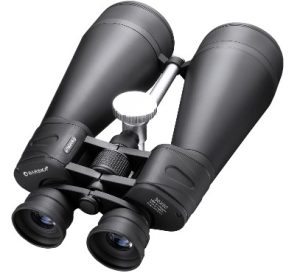
4) Barska 30x80mm X-Trail Binoculars with Tripod Mount
Check Price in Amazon
The Barska 30x80mm X Trail binoculars with tripod mount are a strong contender among the best binoculars for stargazing, offering powerful magnification, large objective lenses, and practical accessories designed for extended observation. Created for adult users who want detailed long distance viewing, this model emphasizes brightness, clarity, and stability for both celestial and terrestrial scenes.
High magnification defines the viewing experience. The powerful zoom capability and wide angle design bring distant stars, the Moon, and far horizon subjects noticeably closer with improved visible detail. Large 80 millimeter objective lenses gather significant light, helping maintain visibility in dim environments such as twilight or nighttime observation. Combined with BaK 4 prism optics, the binocular delivers bright and clear images with solid contrast during low light viewing sessions.
Handling and usability focus on practicality. A smooth central focus knob allows quick sharpening of the image, while the tripod mountable structure improves stability during long sessions where handheld movement would reduce clarity. Shock resistant construction supports outdoor durability, and the included carrying case, lens covers, and cleaning cloth make transport and maintenance simple for regular use.
This binocular is designed as a functional optical instrument rather than a compact travel accessory. Its size and magnification favor supported viewing and careful observation, making it especially suitable for beginners exploring astronomy or anyone seeking an affordable high power option for scanning the night sky.
Pros
- Powerful magnification suitable for celestial and long distance viewing
- Large 80 millimeter lenses that improve brightness in low light conditions
- Clear image quality supported by BaK 4 prism optics
- Tripod mount compatibility for stable extended observation
- Useful accessories included for protection and maintenance
Cons
-
Large and less portable than compact binocular models
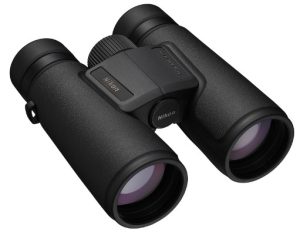
5) Nikon Monarch M5 8×42 Binoculars
Check Price in Amazon
The Nikon Monarch M5 8×42 binoculars are among the best binoculars for stargazing, combining high-quality optics, comfortable handling, and durable construction for extended observation. With 8x magnification and 42 millimeter objective lenses, these binoculars strike a balance between bright, clear images and portability, making them suitable for night sky viewing as well as wildlife observation and outdoor exploration.
Optical performance is a key strength. The extra-low dispersion (ED) glass minimizes chromatic aberration and color fringing, delivering crisp, high-resolution images with accurate colors. Phase-corrected dielectric-coated prisms enhance light transmission for brighter and more natural views, ensuring detail is visible even in low-light conditions such as dusk or dawn. This makes the Monarch M5 effective for observing stars, the Moon, and planets with clarity.
Comfort and usability are central to the design. The large center focusing knob allows smooth, precise adjustments, while the close-focus capability down to 8.2 feet lets users observe nearby objects with detailed accuracy. Twist-up click-stop eyecups provide comfortable eye relief, especially for eyeglass wearers, and the closed-bridge configuration supports a secure grip during prolonged use.
Durability and all-weather performance are built in. The binoculars are nitrogen filled and sealed with O-rings to ensure waterproof and fogproof reliability. A lightweight rubber-armored body adds shock resistance and a secure grip, making them resilient for outdoor adventures or long stargazing sessions. Overall, the Nikon Monarch M5 8×42 offers a versatile, high-quality viewing experience suitable for both astronomy enthusiasts and nature observers.
Pros
- High-resolution, color-accurate images with ED glass lenses
- Bright and natural views supported by dielectric-coated prisms
- Smooth, precise focusing with large center knob and close-focus capability
- Comfortable for extended use with twist-up eyecups and long eye relief
- Durable, waterproof, and fogproof construction with shock-resistant rubber armor
Cons
-
8x magnification may feel limited for deep-sky observation
6) Nikon AstroLuxe XL 18x70mm Porro Prism Binoculars
Check Price in Amazon
The Nikon AstroLuxe XL 18x70mm Porro Prism binoculars are among the best binoculars for stargazing, designed for enthusiasts who want high magnification, bright optics, and durable construction for extended night sky observation. With 18x magnification and large 70 millimeter objective lenses, these binoculars collect substantial light, revealing stars, planets, and lunar features in remarkable detail. Their combination of high resolution and coma corrected lenses makes distant celestial objects appear sharp and well defined.
Optical quality is a major strength. The fully multi-coated lenses maximize light transmission for bright, clear images, while BaK4 prisms and extra-low dispersion glass minimize color fringing and distortion. Individual eye focus allows each viewer to achieve precise clarity, and the 15.4 millimeter eye relief ensures comfortable viewing, even for eyeglass wearers. The 3.9 millimeter exit pupil supports excellent low-light performance, which is essential for stargazing at dusk or nighttime.
Comfort and usability are carefully considered. Turn-and-slide eyecups allow for customized eye positioning, while the center focus system ensures smooth, precise adjustments. The binoculars are tripod adaptable, providing stable viewing for prolonged sessions or high-magnification observation where handheld shake would interfere with clarity. With a field of view of 161 feet at 1000 yards, tracking stars or scanning the night sky is straightforward and fluid.
Durability and reliability are built in. The all-metal construction and rubber armoring provide a secure grip and protection against impact, while waterproof and fogproof design with nitrogen purging ensures performance in wet or humid conditions. For astronomy enthusiasts seeking high magnification, brightness, and precision optics, the Nikon AstroLuxe XL 18x70mm binoculars deliver a professional-quality stargazing experience.
Pros
- High 18x magnification and large 70 millimeter lenses for detailed stargazing
- Bright, sharp images with fully multi-coated optics, BaK4 prisms, and ED glass
- Individual eye focus and comfortable eye relief for extended use
- Tripod adaptable for stable long-duration viewing
- Durable, waterproof, and fogproof construction with rubber armor
Cons
-
Heavy design makes handheld use challenging
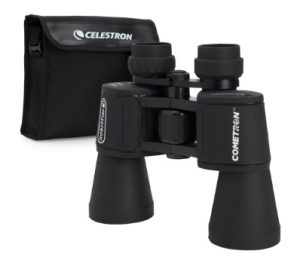
7) Celestron – Cometron 7×50 Astronomy Binoculars
Check Price in Amazon
The Celestron Cometron 7×50 astronomy binoculars are one of the best binoculars for stargazing, especially for beginners looking for an easy and affordable way to explore the night sky. With 7x magnification and 50 millimeter objective lenses, these binoculars provide a wide field of view that makes scanning constellations, the Milky Way, and large celestial objects simple and enjoyable. Their combination of brightness, clarity, and portability makes them suitable for both astronomy and daytime observation.
Optical performance is well balanced for beginners and casual stargazers. The large 50 millimeter objective lenses gather ample light, while multi-coated optics enhance transmission, delivering bright, high-contrast views. The 6.6° angular field of view allows users to take in large sections of the sky at once, making it easier to track comets, star clusters, and satellites. A close focus distance of 26.2 feet also provides versatility for observing terrestrial objects such as birds or scenic landscapes.
Ease of use is a strong advantage. The binoculars are lightweight and comfortable to hold for extended viewing, and they include a tripod adapter socket for stable, shake-free observation during longer sessions. The water-resistant design provides confidence when using the binoculars outdoors, whether in damp conditions or on a clear night under the stars.
Durability and support are backed by Celestron’s reputation. The Cometron 7×50 comes with a limited lifetime warranty and access to U.S.-based technical support, offering long-term reliability and peace of mind for those starting their astronomy journey. These binoculars provide a solid, entry-level option for anyone who wants to explore the cosmos without a steep investment in more advanced equipment.
Pros
- Wide 7x magnification and large 50 millimeter lenses for bright, detailed night sky views
- Multi-coated optics enhance light transmission and contrast
- Wide 6.6° field of view for easy scanning of stars, constellations, and comets
- Lightweight and comfortable with tripod adapter for stable viewing
- Water-resistant design and limited lifetime warranty for reliability
Cons
-
Lower magnification limits detailed views of smaller celestial objects
Factors to Consider When Choosing The Best Binoculars For Stargazing
Magnification
Magnification determines how close celestial objects appear when viewed through binoculars. Higher magnification allows you to see finer details on the Moon, planets, and distant star clusters. However, extremely high magnification can make handheld viewing difficult because it amplifies hand shake and reduces the field of view. A balance between magnification and usability ensures comfortable and stable observation sessions, especially for beginners and intermediate stargazers.
Objective Lens Diameter
The size of the objective lens affects how much light the binoculars can gather. Larger lenses allow more light to enter, producing brighter images and better performance in low-light conditions, which is essential for observing faint stars and deep-sky objects. However, bigger lenses also add weight and bulk, which can impact portability and require the use of a tripod for longer viewing sessions.
Optical Quality
High-quality optics, including prisms and lens coatings, are critical for producing sharp, clear, and high-contrast images. Fully multi-coated lenses and high-index prisms minimize light loss, reflections, and color fringing, delivering bright, natural-looking views. Superior optical design enhances detail visibility, making astronomical observation more rewarding and enjoyable.
Field of View
Field of view refers to the width of the area visible through the binoculars. A wide field of view is helpful for scanning large portions of the night sky, locating constellations, and tracking moving objects like satellites or comets. Binoculars with a narrower field of view are better for focusing on specific objects, but wider views provide a more immersive stargazing experience, especially for beginners.
Eye Relief and Exit Pupil
Eye relief is the distance your eyes can be from the eyepiece while still seeing the full field of view, which is important for eyeglass wearers. The exit pupil, calculated by dividing the objective lens diameter by magnification, affects how bright the image appears in low-light conditions. Comfortable eye relief combined with an appropriate exit pupil ensures extended viewing sessions without eye strain and allows more light to reach the eyes in dark environments.
Durability and Weather Resistance
Stargazing often involves outdoor use in various weather conditions, so durable construction is important. Rubber armor, shock resistance, and water or fogproof design protect the binoculars from accidental bumps, rain, or humidity. Robust construction not only extends the life of the binoculars but also ensures reliable performance during long nights under the stars.
Focus System and Adjustability
A smooth and precise focus system allows users to quickly achieve sharp images. Features such as center focus wheels, individual eyepiece adjustments, and diopter settings enable fine tuning to match the viewer’s eyesight. Adjustable interpupillary distance and twist-up eyecups improve comfort and ensure that both eyes receive a clear, aligned image, which is especially important for detailed observation.
Portability and Mounting Options
Binoculars for astronomy vary in size and weight, and portability can affect how often they are used. Compact models are easier to carry for casual observation, while larger, heavier binoculars often require tripods for stability. Tripod adaptability allows steady, long-duration viewing of distant celestial objects without hand shake, making it a key consideration for high-magnification binoculars.
Best Binoculars For Stargazing FAQs
What magnification is ideal for stargazing?
For most stargazing purposes, a moderate magnification between 7x and 25x provides a balance between detailed views and ease of use. Lower magnification offers a wide field of view, while higher magnification reveals finer details but may require a tripod for stability.
How important is lens size for night sky observation?
Lens size determines how much light the binoculars can gather. Larger objective lenses improve visibility of faint stars, planets, and deep-sky objects, especially in low-light conditions, though they may be heavier and require additional support.
Do I need waterproof or fogproof binoculars for astronomy?
Yes, outdoor stargazing often exposes binoculars to dew, humidity, and light rain. Waterproof and fogproof designs with sealed and nitrogen-purged housings protect the optics and maintain clear views in varying weather conditions.
Can I use these binoculars without a tripod?
It depends on the size and magnification. Lower magnification binoculars with smaller objective lenses are generally handheld-friendly. Larger, high-magnification models benefit from a tripod to reduce hand shake and improve stability during extended observation sessions.
Conclusion
Observing the night sky with quality binoculars can transform stargazing into an engaging and detailed experience. These binoculars deliver bright, sharp, and high-contrast images of stars, planets, and deep-sky objects, making celestial details easier to appreciate.
Durable construction and ergonomic design allow for comfortable, extended viewing, while clear optics ensure vibrant and accurate visuals.
With the right combination of brightness, clarity, and stability, these binoculars provide an enjoyable and immersive way to explore the wonders of the night sky.
See Also: