Searching for the best bow hunting rangefinders with angle compensation can make a major difference when I am judging steep uphill or downhill shots, where the line of sight does not always tell me the true shooting distance.
I look for models that combine accurate angle compensation with fast ranging, clear optics, reliable target detection, and archery specific features such as ballistic calculations or arrow flight information.
In this guide, I will cover the key features, my top picks, a practical buying guide, and FAQs to help me choose a rangefinder that fits my bow hunting style and terrain.
See summary of the best bow hunting rangefinders with angle compensation
- Leupold RX-FullDraw 5 Rangefinder: Best Overall
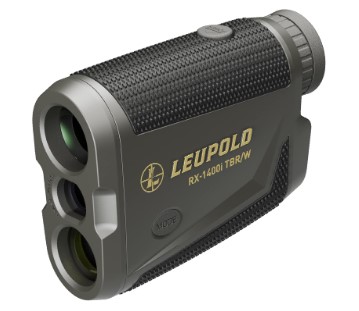
- Leupold RX-1400I TBR/W Gen 2 w/Flightpath Rangefinder: Best for Arrow Flight Analysis
- Leupold RX-5000 TBR/W: Best Long Range
- Bushnell Broadhead Hunting Laser Rangefinder: Best for Archery Accuracy
- Vortex Crossfire HD 1400 Laser Rangefinder: Best Value
- Vortex Sonora HD 1800 Laser Rangefinder: Best Lightweight Long Range
- TIDEWE Hunting Rangefinder: Best Budget Option
7 Best Bow Hunting Rangefinders With Angle Compensation
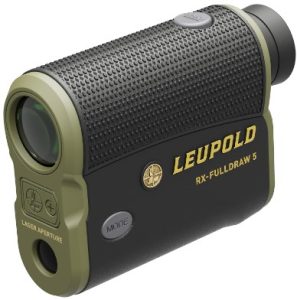
1) Leupold RX-FullDraw 5 Rangefinder
Check Price in Amazon
The Leupold RX-FullDraw 5 is designed specifically with bowhunters in mind, combining angle compensation with bow specific ballistic calculations. Its Archer’s Advantage system considers important setup details such as arrow weight, arrow speed, and peep height to provide more useful distance information when shooting from steep angles or at extended ranges.
A major advantage is Flightpath technology, which uses the bow’s ballistic profile to show the highest point of the arrow’s trajectory. This can help bowhunters identify potential obstacles along the arrow’s path and make more confident shots through tight openings.
The Leupold RX-FullDraw 5 also features a red OLED display with adjustable brightness, making the readout easier to see as lighting conditions change. This is particularly useful during early morning or late evening hunts when visibility can become challenging.
Last Target mode adds another layer of practicality in wooded environments. Rather than being distracted by nearby grass, branches, or other objects, the rangefinder prioritizes the farthest target detected by the laser, helping provide a more reliable distance reading.
Specifications
- Brand: Leupold
- Weight: 7.5 ounces
- Material: Aluminum
- Sport: Hunting and Shooting
- Display: Adjustable red OLED
- Key technology: Archer’s Advantage and Flightpath
Pros
- Bow specific ballistic calculations
- Flightpath helps identify arrow trajectory clearance
- Useful for steep angle and long range shots
- Adjustable OLED display works well in changing light
- Last Target mode helps reduce interference from foreground vegetation
- Lightweight aluminum construction
Cons
- Features are primarily aimed at serious bowhunters
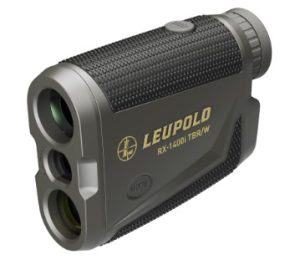
2) Leupold RX-1400I TBR/W Gen 2 w/Flightpath Rangefinder
Check Price in Amazon
The Leupold RX-1400I TBR/W Gen 2 w/Flightpath is a lightweight bowhunting rangefinder built for archers who need more than a basic distance reading. Its combination of angle compensation, ballistic calculations, and Flightpath technology makes it particularly useful when hunting in steep terrain or preparing for longer shots where elevation and wind can influence the shot.
At the heart of the rangefinder is Leupold’s True Ballistic Range and Wind system, which calculates shooting information while accounting for angle and wind conditions. It can provide a wind hold reference based on a 10 mph wind at a 90 degree angle, extending out to 800 yards. This gives experienced archers additional information when evaluating demanding shooting conditions.
The selectable Bow mode works with Flightpath technology to provide angle compensated distances while also helping identify possible obstacles in the arrow’s trajectory. This can be particularly useful when shooting through openings where branches, vegetation, or other obstructions could interfere with the arrow’s path.
With a maximum reflective range of 1,400 yards and the ability to range trees out to 1,200 yards, the Leupold RX-1400I TBR provides plenty of ranging capacity for bowhunting. Its 5.1 ounce aluminum construction also keeps it easy to carry during long hunts.
The adjustable TOLED display uses bright red characters that can be adapted to different lighting conditions. This helps keep readings visible during bright daylight as well as lower light periods when bowhunters are often most active.
Specifications
- Brand: Leupold
- Material: Aluminum
- Weight: 5.1 ounces
- Maximum reflective range: 1,400 yards
- Tree ranging distance: Up to 1,200 yards
- Display: Adjustable red TOLED
- Key technologies: TBR/W and Flightpath
Pros
- Accurate angle compensated ranging
- Dedicated Bow mode
- Flightpath technology for identifying arrow obstructions
- Ballistic wind hold information
- Lightweight 5.1 ounce construction
- 1,400 yard reflective ranging capability
- Adjustable red display
- Useful for steep angle shots
Cons
- Advanced ballistic functions may require some learning
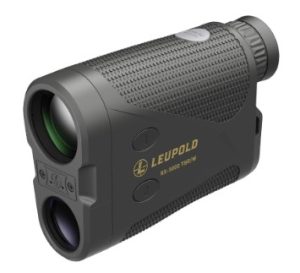
3) Leupold RX-5000 TBR/W
Check Price in Amazon
The Leupold RX-5000 TBR/W is a powerful option for bow hunters who need dependable ranging and ballistic information when terrain, distance, and obstacles make judging a shot more difficult. Its True Ballistic Range / Wind technology accounts for steep angles while providing calculated shooting information, helping hunters make more informed decisions at extended distances.
The Leupold RX-5000 TBR/W also includes a Long Range Mode designed to improve performance on distant targets. By collecting laser pulses over several seconds, it can reach beyond 5,000 yards on trees and deer sized targets. This gives bow hunters and outdoor users considerable range when scouting or evaluating terrain.
Another useful feature is Last Target mode. It prioritizes the farthest target in the laser path, helping reduce interference from grass, twigs, and other nearby objects. This can be especially useful when ranging through vegetation where a closer obstruction could otherwise produce an incorrect reading.
The Leupold RX-5000 TBR/W also adds useful mapping functionality through Pinning and the Leupold Control App. Users can place GPS waypoints on supported digital maps, making it easier to mark boundaries, navigate unfamiliar areas, and keep track of locations associated with recovered game.
Specifications
- Brand: Leupold
- Ranging capability: Over 5,000 yards on trees and deer sized targets
- Technology: TBR/W ballistic range and wind compensation
- Weight: 9.7 ounces
- Color: Black
- Material: Plastic
- Sport: Hunting
Pros
- Excellent long distance ranging capability
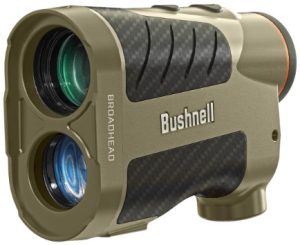
4) Bushnell Broadhead Hunting Laser Rangefinder
Check Price in Amazon
The Bushnell Broadhead Hunting Laser Rangefinder is designed with bowhunters in mind, particularly those who need dependable distance readings on challenging targets. Its Full Spectrum ranging system is built to maintain accuracy even when aiming at dark animals or low reflectivity surfaces, making it useful across different hunting environments.
A key strength is its precision at typical archery distances. The Broadhead can achieve accuracy within 0.3 yards out to 150 yards, and its ranging system has been tested against targets such as 3D archery models and animal hides. This gives bowhunters greater confidence when determining the distance before making a shot.
The ARC angle compensation system is also valuable for hunting in uneven terrain. It measures both the line of sight and the true horizontal distance while accounting for angles with approximately 1 degree of accuracy. This helps provide more useful distance information for uphill and downhill shots.
Another useful feature is the ActivSync display, which automatically changes the reticle and readout between black and red depending on the background. This adaptive display helps maintain contrast when lighting and terrain change. The Broadhead also includes different ranging modes for dealing with clutter. Brush Mode prioritizes background targets while ignoring nearby branches and vegetation, while Bullseye Mode is designed to identify smaller targets without accidentally ranging objects behind them.
Specifications
- Brand: Bushnell
- Sport: Archery and hunting
- Material: Aluminum
- Weight: 5.9 ounces
- Maximum accuracy: ±0.3 yards out to 150 yards
- Angle compensation: ARC technology
- Display: ActivSync adaptive reticle and readout
Pros
- Excellent ±0.3 yard accuracy at archery distances
- Full Spectrum ranging works well on darker, low reflectivity targets
- ARC provides angle compensated distance readings
- ActivSync display adapts to changing backgrounds
- Brush and Bullseye modes improve target selection
- Lightweight aluminum construction
Cons
- Fewer advanced features than some premium ballistic rangefinders
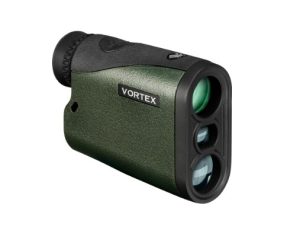
5) Vortex Crossfire HD 1400 Laser Rangefinder
Check Price in Amazon
The Vortex Crossfire HD 1400 is a practical choice for bow hunters who need dependable distance readings without adding unnecessary bulk to their gear. With a maximum ranging capability of 1,400 yards on reflective targets and up to 750 yards on game, it provides plenty of reach for most hunting situations. Its 5x magnification and 21mm objective lens offer a useful balance between target visibility and portability.
For archery, the HCD mode is particularly useful because it provides angle compensated distance information. The LOS mode gives the actual line of sight distance, allowing hunters to choose the measurement that best fits their shooting setup. Three target modes, including Normal, First and Last, also help the rangefinder handle different target situations in the field.
The optical system combines selected glass elements with XR lens coatings to improve resolution, color accuracy and light transmission. This can be especially helpful during early morning and late evening hunts when available light is limited. A red TOLED display keeps ranging information visible across changing lighting conditions.
Durability is another strong point. Protective ArmorTek lens coatings help guard against scratches and debris, while the waterproof and shockproof construction is designed for demanding outdoor use. The compact design also makes it easy to carry in a bow hunting pack, while the included soft case provides additional convenience.
Specifications
- Brand: Vortex
- Maximum Range: 1,400 yards
- Magnification: 5x
- Objective Lens: 21mm
- Weight: 9.6 ounces
- Ranging Modes: HCD and LOS
- Target Modes: Normal, First and Last
- Sport: Hunting
Pros
- HCD mode provides useful angle compensated distance readings
- Long 1,400 yard maximum range on reflective targets
- HD optics deliver clear images and strong color fidelity
- XR coatings improve performance in low light
- Waterproof and shockproof construction
- Compact design suits bow hunting gear
- Red TOLED display remains easy to read in different lighting
- Backed by a transferable lifetime warranty
Cons
- 5x magnification is less powerful than some long range models
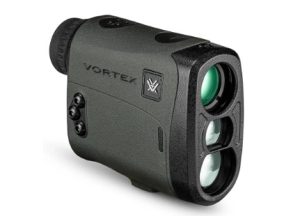
6) Vortex Sonora HD 1800 Laser Rangefinder
Check Price in Amazon
The Vortex Sonora HD 1800 is a capable option for bow hunters who need reliable distance information when terrain and shooting angles become challenging. Its HCD angle compensation system provides horizontal distance readings that account for elevation changes, helping archers make better judgments on uphill and downhill shots. With a maximum range of 1,800 yards on reflective targets and up to 700 yards on game, it also offers plenty of ranging capability for hunting applications.
At the heart of the Sonora HD 1800 is its optical system, which combines 6x magnification with a 21mm objective lens. The HD glass is designed to provide sharp resolution, accurate color reproduction, and reduced chromatic aberration. Fully multi coated lenses improve light transmission, making the rangefinder easier to use when hunting during the lower light conditions commonly found around dawn and dusk.
For bow hunting, the HCD ranging mode is particularly useful because it provides angle compensated distance information rather than relying solely on the straight line measurement. This can make a meaningful difference when judging shots across uneven terrain, where the actual horizontal distance can differ considerably from the line of sight.
Durability is another strong point. The exterior lenses feature ArmorTek protection to help resist scratches, dirt, and oils, while sealed construction helps keep moisture and debris away from the internal components. The rangefinder is designed for waterproof performance and can handle demanding outdoor conditions. It is also compatible with a tripod or car window mount, giving hunters more flexibility when a steady viewing position is useful.
Specifications
- Brand: Vortex
- Magnification: 6x
- Maximum Range: 1,800 yards on reflective targets
- Game Range: Up to 700 yards
- Objective Lens: 21mm
- Item Weight: 6.1 ounces
- Material: Aluminum
- Sport: Archery, hunting, and shooting
Pros
- HCD angle compensation helps with uphill and downhill shots
- 1,800 yard maximum range on reflective targets
- 6x magnification provides a closer view of distant targets
- HD optics deliver clear images and strong color fidelity
- Fully multi coated lenses support low light visibility
- ArmorTek coating helps protect the lenses
- Waterproof construction is suitable for demanding field conditions
- Lightweight design is convenient for bow hunting
- Tripod and car window mounting compatibility adds versatility
- Includes a soft carry case
Cons
- Game ranging distance is considerably shorter than the reflective target rating
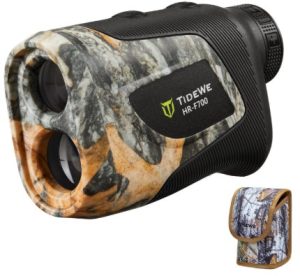
7) TIDEWE Hunting Rangefinder
Check Price in Amazon
The TIDEWE Hunting Rangefinder is a compact and practical option for bowhunters who need quick distance information without carrying a bulky optic. Its 6x magnification combines with several measurement functions, including straight line, horizontal, vertical, and speed readings, giving hunters useful information for evaluating a shot from different positions. The scan mode is also helpful when checking multiple targets or navigating through wooded terrain.
For bowhunting, having more than a simple line of sight measurement can be useful when terrain changes between the hunter and target. The rangefinder provides horizontal and vertical distance readings, allowing you to better understand the shooting angle before releasing an arrow. Its measurement range extends from 3 to 700 yards with accuracy of approximately ±1 yard, while readings can be obtained in as little as 0.46 seconds.
The compact design makes it particularly suitable for mobile hunting setups. At roughly 5.67 ounces, it can be carried in a pocket, attached with the included lanyard, or stored in a hunting pack without adding much weight. The leaf camouflage finish also fits naturally into wooded hunting environments.
Operation is straightforward, with a simple LCD display and physical controls for switching between functions, changing measurement units, adjusting focus, and activating scanning. The rechargeable battery is another practical advantage, providing up to 21,000 measurements on a full charge. This makes it convenient for extended outings without relying on disposable batteries.
Specifications
- Brand: TIDEWE
- Magnification: 6x
- Maximum Range: 700 yards
- Accuracy: ±1 yard
- Weight: 5.67 ounces
- Battery: Rechargeable Li ion
Pros
- Multiple distance measurement modes
- Angle related distance information
- Fast readings in approximately 0.46 seconds
- Lightweight and compact design
- Rechargeable battery with high measurement capacity
- Simple one hand operation
- Useful scan function for multiple targets
Cons
- LCD display may be less advanced than OLED systems
Factors to Consider When Choosing The Best Bow Hunting Rangefinders With Angle Compensation
Angle Compensation Accuracy
For bowhunting, accurate angle compensation is one of the most important features because an uphill or downhill shot can behave differently from a level shot. A good rangefinder should calculate the horizontal or angle adjusted distance so you can make better decisions when shooting from a treestand, hillside, or uneven terrain. Look for systems that provide dependable angle measurements and clearly display the corrected distance.
Effective Hunting Range
Consider how far you realistically need to range targets in your hunting environment. A longer maximum range can be useful for scouting distant objects, while the range on deer sized game or other low reflectivity targets is often more important than the maximum reflective range. For bowhunting, reliable readings at practical shooting distances should take priority over an impressive maximum number.
Bow Specific Ballistic Features
Some advanced rangefinders go beyond basic angle compensation by incorporating information about your bow and arrow setup. Features that account for arrow speed, arrow weight, peep height, or trajectory can provide more useful shooting information for demanding angles and longer distances. These capabilities can help turn a measured distance into information that is more relevant to your particular setup.
Target Acquisition
A rangefinder is only useful if it can consistently lock onto the target you actually want to measure. Brush, branches, grass, and other objects can interfere with laser readings in dense hunting environments. Look for target modes that can prioritize foreground or background objects, along with fast scanning and reliable target locking, particularly when you need to range a small animal quickly.
Optical Quality and Low Light Performance
Bowhunting frequently takes place around dawn and dusk when available light is limited. High quality glass, effective anti reflective coatings, and a bright, adjustable display can make it easier to identify targets and read measurements. Good optical performance also helps when distinguishing an animal from surrounding vegetation before taking a shot.
Size and Weight
A rangefinder should be easy to carry throughout a hunt without becoming another piece of equipment that gets in the way. Compact models weighing only a few ounces are particularly useful for bowhunters who already carry a bow, arrows, binoculars, calls, and other gear. A comfortable grip and controls that can be operated with one hand can also make ranging faster and more convenient.
Durability and Weather Resistance
Hunting conditions can expose a rangefinder to rain, dust, mud, cold temperatures, and accidental impacts. A rugged housing, sealed construction, scratch resistant lens protection, and waterproof or water resistant design can help the device remain dependable in challenging environments. For bowhunting, durability is especially valuable because the rangefinder may spend hours exposed to the elements.
Display and Ease of Use
A complicated interface can slow you down when you need a measurement quickly. Look for a clear display with adjustable brightness and controls that are easy to operate while wearing hunting clothing or gloves. A red OLED or similar high contrast display can be particularly useful in changing light conditions, while simple mode selection allows you to focus more on the shot rather than navigating menus.
Best Bow Hunting Rangefinders With Angle Compensation FAQs
Why is angle compensation important for bowhunting?
Angle compensation helps account for elevation changes between you and the target. When shooting uphill or downhill, the horizontal distance can differ from the direct line of sight. An angle compensated rangefinder provides a more useful distance for judging the shot, which can be particularly important when hunting from elevated positions.
Do I need a rangefinder with a bow specific ballistic calculator?
Not necessarily. A basic angle compensated model can be sufficient for many bowhunters who already understand their equipment and shooting distances. However, a rangefinder with bow specific ballistic functions can provide additional information based on factors such as arrow speed, arrow weight, and trajectory, making it more useful for longer or more challenging shots.
What range should I look for in a bow hunting rangefinder?
The ideal range depends on your hunting environment and typical shooting distances. For bowhunting, reliable performance on actual game is generally more important than the maximum reflective range. A model that provides consistent readings on deer sized targets at practical distances can be more valuable than one that advertises an extremely high maximum range but struggles with low reflectivity targets.
Are lightweight rangefinders better for bowhunting?
Lightweight rangefinders are often more convenient because they add less weight to an already packed hunting setup. A compact model can be easier to carry in a pocket, pouch, or attached to a lanyard. However, weight should be balanced against optical quality, durability, battery life, and the features you actually need in the field.
Conclusion
Bow hunting rangefinders with angle compensation do more than tell you how far away an animal is. They help translate an awkward uphill or downhill shot into useful distance information while giving you the optical clarity and target recognition needed to make that measurement confidently.
The strongest options combine dependable angle compensation with fast target acquisition, clear low light displays, useful bow specific calculations, durable construction, and a lightweight design that will not become a burden during a long hunt.
For serious bowhunters, the real advantage is having reliable distance intelligence available at the exact moment when terrain, lighting, and target position make judging the shot with your eyes alone much harder.
See Also: