Searching for the best Budget Thermal Scopes? The challenge is not simply finding a thermal optic at a lower price. Different models can prioritize viewing distance, image detail, battery life, weight, or useful field features, so the most expensive option is not automatically the right choice for every buyer. A scope that fits one hunting setup may be less suitable for another, especially when the available budget needs to cover the capabilities that matter most.
This comparison takes a practical look at what these scopes offer, where their strengths lie, and what tradeoffs may be worth considering. Beyond the individual reviews, the article also covers the advantages of using a budget thermal scope, the factors worth considering before buying, and common questions that can help put the differences into perspective.
Together, these sections are intended to make the comparison easier to navigate and help you move toward a choice that fits your needs and budget.
Summary of the Best Budget Thermal Scopes:
- AGM Global Vision RattlerV2 25-256 25mm Thermal Imaging Rifle Scope — Best Overall
- AGM Global Vision Rattler-C V2 19-256 1x19mm Thermal Imaging Rifle Scope — Best Clip-On
- ATN LTV 2-6x19mm Thermal Rifle Scope — Best Lightweight Option
- GOYOJO GRS Series Thermal Riflescope — Best Feature-Rich Option
- RIX Storm S2 Thermal Imaging Rifle Scope — Best Compact Option
- SightMark Wraith Mini 2-16x35mm Thermal Rifle Scope — Best Higher-Resolution Option
- DNT Optics Hydra LRF 3-12x25mm Thermal Rifle Scope — Best Multifunctional Option
Best Budget Thermal Scopes
1. AGM Global Vision RattlerV2 25-256 25mm Thermal Imaging Rifle Scope
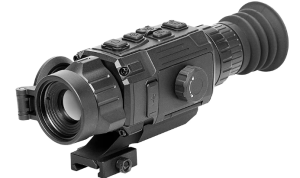
The AGM Global Vision RattlerV2 25-256 25mm Thermal Imaging Rifle Scope makes a strong case as a budget thermal scope by putting useful reach and practical field performance ahead of chasing higher sensor resolution. Its 25mm F/1.0 Germanium lens works with a 256×192, 12 micron VOx thermal sensor and a 3.5x starting magnification, giving it a more focused viewing perspective than the lower magnification RattlerV2 19 256. That combination suits hunters who expect to work at moderate distances while still wanting enough coverage for general scanning. AGM rates its detection range at up to 1,250 yards for a six foot target.
The 50 Hz refresh rate adds another useful advantage at this price level. A faster refresh rate can make moving targets easier to follow, while the 7.0° × 5.3° field of view provides practical coverage for scanning. The 1024×768 OLED display and 1x, 2x, 4x, and 8x digital zoom give the hunter several ways to adjust the view as conditions change. The 3.5x base magnification is particularly relevant here because it gives the 25mm model a more focused viewing perspective without requiring the buyer to move into a higher resolution thermal platform.
Battery endurance also works in the scope’s favor for extended nighttime sessions. Its removable rechargeable Li ion battery can provide up to 11.5 hours of operating time under the manufacturer’s stated conditions, and two batteries are included. USB C external power is also supported. For a budget thermal scope, that combination provides useful flexibility when an outing extends well beyond a few hours.
The RattlerV2 also packs several field oriented functions that add value without changing its fundamental budget positioning. Shot Activated Recording can automatically capture firing events, while onboard video and audio recording, image capture, 16 GB of internal storage, and Wi Fi connectivity provide additional ways to record and review footage. Ten reticle types, four reticle colors, multiple zeroing profiles, digital boresight adjustment, and stadiametric distance measurement give the optic a broad set of practical controls. The raised five button layout is also designed to remain accessible while wearing gloves, which is a useful consideration for nighttime operation.
Specifications
- Manufacturer: AGM Global Vision
- Magnification: 3.5x to 28x
- Objective Lens: 25 mm F/1.0 Germanium
- Thermal Sensor: 256×192, 12 micron VOx
- Refresh Rate: 50 Hz
- Field of View: 7.0° × 5.3°
- Detection Range: Up to 1,250 yards for a six foot target
- Display: 0.39 inch 1024×768 OLED
- Eye Relief: 45 mm
- Digital Zoom: 1x, 2x, 4x, and 8x
- Battery: Replaceable rechargeable Li ion
- Battery Life: Up to 11.5 hours with hotspot off under stated test conditions
- Storage: 16 GB built in EMMC
- NETD: Less than 35 mK
- Weight: 1.08 lb without mount and battery
- Protection: IP67
Pros
- 3.5x base magnification provides a more focused viewing perspective
- 50 Hz refresh rate supports smoother target tracking
- Detection specification reaches up to 1,250 yards for a six foot target
- Up to 11.5 hours of battery life
- Two rechargeable batteries are included
- Shot Activated Recording adds useful field functionality
- Multiple reticle and zeroing options
- Wi Fi connectivity and 16 GB internal storage
- Raised controls are practical when wearing gloves
- Includes a mount and essential accessories
Cons
- 256×192 resolution provides less image detail than higher resolution thermal scopes
- The 1.08 lb body adds noticeable weight compared with lighter thermal optics
2. AGM Global Vision Rattler-C V2 19-256 1x19mm Thermal Imaging Rifle Scope
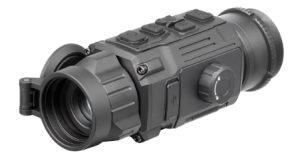
Adding thermal capability does not always mean replacing a daytime optic. The AGM Global Vision Rattler C V2 19-256 1x19mm Thermal Imaging Rifle Scope is designed to sit in front of a compatible day scope, converting an existing optical setup into a thermal imaging system. That gives it a distinct place among the best Budget Thermal Scopes, particularly for buyers who want to add thermal capability while retaining the daytime optic they already use. Its 19mm objective and 1x optical configuration are built around this clip on role rather than functioning as the primary magnified viewing system.
The 256×192 thermal sensor uses a 12 micron high sensitivity detector with a 20 mK NETD specification, while the 50 Hz refresh rate supports responsive thermal imaging. A 1024×768 OLED display provides the viewing interface, and adjustable color palettes give the user different ways to interpret heat signatures. The 19mm lens also provides a 9.3° × 6.9° field of view, giving the clip on a relatively broad viewing perspective. The sensor is designed to maintain useful thermal contrast in difficult conditions such as darkness, fog, smoke, dust, rain, and snow, which supports its role when conventional daytime optics become less effective.
Power management is well suited to longer sessions. The replaceable rechargeable battery system provides up to 11.5 hours of operating time, with two batteries included. When additional runtime is needed, an external 5V power source can be connected through USB C. This gives the Rattler C V2 more flexibility during extended use without requiring the user to depend on a single battery throughout the outing.
The clip on also includes several functions that extend its usefulness beyond basic thermal viewing. Onboard video and audio recording, image capture, 16 GB of built in EMMC storage, and Shot Activated Recording provide options for preserving footage. Wi Fi supports live video streaming and wireless transmission through a mobile application, while the stadiametric rangefinder adds distance measurement capability. Standby mode can also help conserve power when thermal imaging is temporarily not required.
Specifications
- Manufacturer: AGM Global Vision
- Magnification: 1x
- Objective Lens: 19 mm
- Thermal Sensor: 256×192 pixels, 12 micron
- NETD: 20 mK
- Refresh Rate: 50 Hz
- Field of View: 6.9° to 9.3°
- Display Resolution: 1024×768 pixels
- Focus Range: 0.5 m to infinity
- Detection Range: Up to 1,000 m
- Eye Relief: 10 mm
- Exit Pupil: 22 mm
- Battery Life: Up to 11.5 hours
- Battery Quantity: 2
- Storage: 16 GB built in EMMC
- Length: 7.2 in
- Width: 2.7 in
- Height: 2.6 in
- Weight: 1.1 lb
- Water Resistance: IP67
- External Power: USB C compatible
- Color: Black
Pros
- Converts a compatible daytime optic into a thermal imaging setup
- 12 micron high sensitivity thermal detector
- 20 mK NETD specification
- 50 Hz refresh rate supports responsive thermal imaging
- 1024×768 OLED display
- 9.3° × 6.9° field of view suits the 1x clip on configuration
- Up to 11.5 hours of battery life
- Two batteries included
- USB C external power compatibility
Cons
- The clip on configuration requires a compatible host optic and appropriate mounting arrangement
3. ATN LTV 2-6x19mm Thermal Rifle Scope
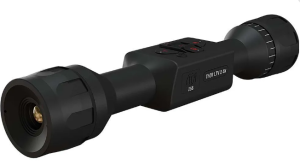
A lightweight thermal scope can be especially useful when the optic needs to complement a setup that is already easy to handle. The ATN LTV 2-6x19mm Thermal Rifle Scope takes that approach with a 19mm objective, 2x to 6x magnification, and a deliberately simplified control system. Rather than loading the scope with numerous advanced functions, ATN concentrates on the core features needed for thermal viewing, aiming, and recording.
The imaging system provides a 256×192 thermal resolution with a 12 micron sensor and a 60 Hz refresh rate. That combination is designed to produce clear thermal imagery with smooth video and limited distortion, while Black Hot, White Hot, and Color modes give the user different ways to distinguish heat signatures. The 2x to 6x magnification range provides room to adjust the view as the distance changes, while the 90mm eye relief gives the shooter generous space behind the optic.
The LTV’s low weight becomes more significant when it is used on platforms where keeping the overall setup manageable matters. ATN designed the ThOR LTV as its lightest thermal scope line, and the optic can be used with rifles, PCP air rifles, and crossbows. That versatility makes it useful for buyers who want one thermal optic that can move beyond a conventional rifle setup without adding unnecessary bulk to lighter platforms.
Ease of operation continues through the sighting and mounting process. One Shot Zero is intended to simplify zeroing by allowing the reticle to be adjusted to the first point of impact, while standard 30mm rings provide a familiar mounting arrangement. Video recording adds the ability to save hunting or target sessions to a micro SD card. The rechargeable battery keeps the scope self contained, while the optional ATN Weapon Battery Pack can extend continuous operating time when longer sessions require additional power.
Specifications
- Manufacturer: ATN
- Magnification: 2x to 6x
- Objective Lens: 19 mm
- Thermal Resolution: 256×192 pixels
- Thermal Sensor: 12 micron
- Refresh Rate: 60 Hz
- Eye Relief: 90 mm
- Image Modes: Black Hot, White Hot, and Color
- Video Recording: Yes, to micro SD card
- Zeroing: One Shot Zero
- Mounting: Standard 30mm rings
- Battery: Rechargeable
- Optional External Power: ATN Weapon Battery Pack
- Compatible Platforms: Rifles, PCP air rifles, and crossbows
- Included Accessories: Lens tissue, eyecup, USB C cable, scope cover, and flip open lens cap
Pros
- Lightweight design suits weight sensitive platforms
- 256×192, 12 micron thermal sensor
- 60 Hz refresh rate
- 2x-6x magnification
- 90mm eye relief
- Simple controls reduce the learning curve
- One Shot Zero simplifies sighting in
- Video recording to micro SD card
- Compatible with rifles, PCP air rifles, and crossbows
- Multiple thermal viewing modes
Cons
- The simplified feature set may not suit buyers looking for advanced onboard functions
4. GOYOJO GRS Series Thermal Riflescope
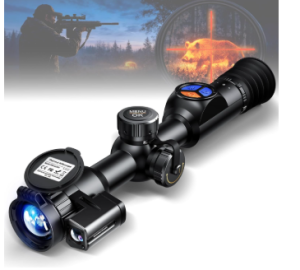
Thermal images do not always look the same from one setting to another. Dense brush, fog, open ground, and changing background temperatures can all affect how easily a heat signature separates from its surroundings. The GOYOJO GRS Series Thermal Riflescope gives the user several ways to adapt the view, combining selectable imaging modes, reticle choices, and automatic image enhancement with a 25mm objective and 256×192 thermal sensor.
That flexibility is supported by a 12 micron VOx detector with less than 35 mK NETD and a 50 Hz refresh rate. A 1440×1080 OLED display provides a high resolution viewing interface, while the 25mm lens produces a 7.0° × 5.3° field of view. The 3.5x optical magnification can be supplemented with 1x to 8x digital zoom, giving the user room to adjust the view as the distance or viewing conditions change. For buyers comparing the best Budget Thermal Scopes, this combination makes the GRS Series particularly relevant when image control matters alongside basic thermal detection.
The scope also provides several ways to tailor the image and aiming interface. Seven selectable imaging modes, ten reticle options, and Auto AI Image Enhancement can help refine thermal contrast and edge definition in complex terrain. Recoil Activated Video automatically records when a shot is fired, while 32 GB of built in storage provides room for saved footage. Wi Fi connectivity adds the option of streaming the view through a mobile application, extending the scope’s usefulness beyond the immediate viewing session.
Durability rounds out the design for demanding outdoor use. The GRS Series is rated for up to 800 g/0.4 ms of recoil and carries an IP67 rating for water and dust resistance. It is also designed to operate from −22°F to 122°F, or approximately −30°C to 50°C, while the battery provides about 7 to 9 hours of operation. That combination gives the scope a stronger argument for difficult environments, where consistent operation can matter just as much as the thermal image itself.
Specifications
- Manufacturer: GOYOJO
- Objective Lens: 25 mm
- Optical Magnification: 3.5x
- Digital Zoom: 1x to 8x
- Thermal Sensor: 256×192, 12 micron VOx
- NETD: Less than 35 mK
- Refresh Rate: 50 Hz
- Display: 1440×1080 OLED
- Field of View: 7.0° × 5.3°
- Eye Relief: 65 mm
- Detection Range: Up to 1,224 yards according to supplied product information
- Image Modes: 7 selectable modes
- Reticles: 10 options
- Storage: 32 GB
- Recording: Recoil Activated Video
- Connectivity: Wi Fi
- Battery Life: Approximately 7 to 9 hours
- Operating Temperature: −22°F to 122°F
- Protection: IP67 waterproof and dustproof
- Recoil Resistance: Up to 800 g/0.4 ms
Pros
- 25mm objective supports a more focused viewing perspective
- 256×192, 12 micron VOx thermal sensor
- Less than 35 mK NETD
- 1440×1080 OLED display
- 50 Hz refresh rate
- Multiple imaging modes and reticle options
- Auto AI Image Enhancement
- 3.5x optical magnification with digital zoom
- Recoil Activated Video
- Wide operating temperature range
Cons
- Digital zoom can reduce usable image detail at higher magnifications
5. RIX Storm S2 Thermal Imaging Rifle Scope
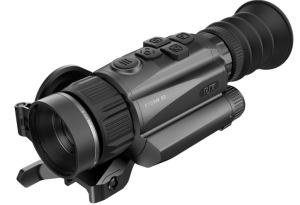
The RIX Storm S2 Thermal Imaging Rifle Scope keeps its physical footprint remarkably small without stripping away the features that matter for thermal observation. At about 0.9 lb, its compact aluminum body is easy to incorporate into a rifle setup, while the 25mm objective and 3.5x base magnification give it a naturally tighter view for observing targets at greater distances. That makes its compact construction more than a convenience because it helps keep the overall optic setup manageable.
Its thermal system combines a 256×192, 12 micron VOx sensor with a NETD below 25 mK and a 50 Hz refresh rate. RIX also incorporates its Resolution Enhancement Technology, which processes the lower resolution sensor output to improve perceived image detail. A 1024×768 OLED display presents that image, while five selectable image modes provide additional control over how thermal information appears in different surroundings.
The 3.5x optical magnification can be extended with 1x to 4x digital zoom, reaching 14x at maximum digital magnification. Its 7.0° × 5.3° field of view complements the base magnification, while adjustable diopter settings and 48mm of eye relief allow the display to be tailored to the user. Picture in Picture functionality also provides a magnified view of a selected area while retaining visibility of the surrounding scene.
Operation is another area where the Storm S2 keeps things straightforward. Its controls are arranged for quick access in darkness and when wearing gloves, while Wi Fi connectivity works with the RIX+ app for video and image capture. The built in 32GB memory provides storage for saved footage, and IP67 protection adds resistance against dust and water. Battery life is rated at about five hours under the manufacturer’s stated conditions, making endurance one of the clearer compromises of this otherwise compact design.
Specifications
- Manufacturer: RIX Optics
- Model: Storm S2
- Thermal Resolution: 256×192 pixels
- Pixel Pitch: 12 micron
- Thermal Sensor: VOx uncooled
- NETD: Less than 25 mK
- Objective Lens: 25mm F/1.0
- Optical Magnification: 3.5x
- Digital Zoom: 1x to 4x
- Maximum Magnification: 14x
- Refresh Rate: 50 Hz
- Field of View: 7.0° × 5.3°
- Detection Range: Up to 1,422 yards
- Display: 1024×768 OLED
- Eye Relief: 48mm
- Diopter Adjustment: −5D to +5D
- Storage: 32GB built in
- Image Modes: 5
- Battery Life: Up to 5 hours under stated test conditions
- Protection: IP67
- Weight: 0.9 lb / 408 g
- Dimensions: 6.0 × 2.8 × 2.4 inches
- External Power: 5V USB C
Pros
- Lightweight 0.9 lb construction
- 256×192, 12 micron thermal sensor with NETD below 25 mK
- RET image enhancement technology
- 3.5x base magnification with digital zoom
- 1024×768 OLED display with Picture in Picture
- 32GB storage with Wi Fi connectivity
- IP67 protection and glove friendly controls
Cons
- Five hour battery life is shorter than several longer running thermal scopes
6. SightMark Wraith Mini 2-16x35mm Thermal Rifle Scope
7. DNT Optics Hydra LRF 3-12x25mm Thermal Rifle Scope
Better Visibility After Dark
Once daylight fades, a conventional optic has less visual information to work with. Thermal imaging takes a different approach by detecting differences in heat, allowing warm targets to remain distinguishable against cooler surroundings. For buyers considering the best Budget Thermal Scopes, this is the fundamental advantage because the technology helps reveal heat signatures rather than simply making a dark scene brighter.
Thermal Capability Without a Premium Price
You do not necessarily have to move into the highest price range to gain useful thermal capability. More affordable scopes can still provide practical detection, responsive imaging, usable magnification, and displays that deliver meaningful information in the field. There may be compromises in resolution, refinement, or advanced features, but those tradeoffs do not make a budget optic incapable. They make it more important to match the scope’s capabilities to the intended use.
More Useful Target Awareness in Difficult Conditions
Darkness is not always the biggest obstacle. Dense vegetation, fog, rain, smoke, and backgrounds with little visual contrast can make conventional target observation more difficult even when some light is available. Thermal imaging adds another form of contrast by emphasizing temperature differences, which can help a hunter maintain awareness when a target does not separate easily from its surroundings.
That information still needs to be usable, however. Image sensitivity, processing, display quality, and refresh rate can all influence how easily a hunter interprets what appears on the screen. A useful thermal scope therefore needs to provide more than an impressive detection claim. The quality of the information available when observing a potential target matters just as much.
More Control Over Different Viewing Distances
A scope that works well for scanning at one distance can feel restrictive when the target moves farther away. A wider field of view can make locating activity easier, while a more focused starting magnification can help when observation shifts toward longer distances. Digital zoom provides another adjustment, although increasing magnification does not create additional native thermal detail. For a budget buyer, useful magnification is therefore about having a practical viewing range rather than simply chasing the highest number on the specification sheet.
More Value From a Single Thermal Optic
Recording, wireless connectivity, ranging, ballistic assistance, and alternative viewing functions can place several useful capabilities inside one device. When those features address genuine field needs, they can reduce the need for additional equipment and make the optic more versatile. At the same time, paying extra for functions that will rarely be used does little to improve a budget focused purchase.
The greater value comes when the optic remains useful across different distances, environments, and hunting conditions. For someone working within a budget, that broader usefulness can matter just as much as the initial savings because the better purchase is the one that continues to justify its place in the setup.
Factors to Consider when Selecting the Best Budget Thermal Scopes
Consider Your Typical Hunting Distance
Start with the distance at which you expect to use the scope most often. A hunter working across relatively open ground may benefit from longer detection capability and a more focused starting magnification, while someone scanning closer terrain may place greater value on a wider field of view. The goal is not to buy the scope with the longest advertised range, but to make sure its useful viewing capability matches the distances you actually encounter.
Compare Sensor Resolution and NETD
Sensor resolution determines how much native thermal information the scope can capture. A 384×288 sensor, for example, has more pixels than a 256×192 sensor and can provide greater image detail when distance and viewing conditions make that additional information useful. However, higher resolution does not automatically make a model the better budget choice. If your typical distances are moderate, a lower resolution sensor may provide sufficient performance while leaving more of the budget available for other useful capabilities.
NETD should be considered alongside resolution rather than on its own. It indicates how sensitive a thermal sensor is to small temperature differences, with a lower figure generally indicating greater sensitivity. That can become particularly useful when the temperature difference between a target and its surroundings is subtle. Looking at both specifications gives you a more complete picture of the sensor’s potential than relying on resolution alone.
Match Magnification to the Hunting Distance
Objective lens size and magnification influence how the thermal scene is presented. A larger lens and more focused base magnification can make sense when observing farther distances is a priority, while a smaller objective and lower starting magnification can provide a broader perspective for scanning closer terrain. Digital zoom adds flexibility, but it should not be confused with additional optical detail. Increasing digital magnification enlarges the existing image rather than giving the sensor more information.
Field of view is equally important. Maximum magnification can look impressive on a specification sheet, but a narrower view can make it harder to scan an area or follow movement. A wider field of view can make locating activity easier, while a more concentrated view can be useful when observing something already located farther away. The right balance depends on whether the optic will spend more time scanning or watching a known target.
Treat Detection Range as a Starting Point
A manufacturer’s detection range can help establish a scope’s potential, but it should not be treated as the distance at which a target will automatically be identifiable. Detecting a heat source, recognizing its general shape, and identifying exactly what it is are different tasks.
For that reason, consider the distance at which you need meaningful detail rather than choosing an optic solely because its headline detection figure is higher. A scope with a shorter advertised range may still be the more practical choice if it provides the level of information you need within your typical hunting distances.
Consider Refresh Rate and Battery Life
Refresh rate becomes more noticeable when the scene or target is moving. A 50 Hz thermal display, which appears across several models in this lineup, can provide smoother image updates that make movement easier to follow. For a buyer who mainly observes stationary targets, refresh rate may be less important than sensor performance or battery life. Those who regularly track moving activity should give it greater weight.
Battery endurance also affects how practical a thermal scope becomes after several hours in the field. Look beyond the headline battery figure and consider whether the optic uses replaceable batteries, accepts external power, or allows spare batteries to be carried easily. Recording, wireless functions, and other active features can affect operating time as well. A scope with dependable endurance may prove more useful than one that offers a longer feature list but requires frequent power management.
Prioritize Features That Solve a Real Problem
Recording, Wi Fi, multiple reticles, weapon profiles, image modes, laser rangefinders, and ballistic calculators can all add value, but only when they fit the way the scope will be used. Someone who wants to review recorded footage may appreciate onboard recording, while another buyer may get more practical benefit from a rangefinder or ballistic calculator.
The best Budget Thermal Scopes are not necessarily the ones with the longest feature list. They are the ones that put the available budget toward functions the buyer is actually likely to use. Paying extra for capabilities that rarely contribute to the intended setup can work against the purpose of buying a budget optic in the first place.
Check Durability, Weight and Mounting Requirements
The electronics are only part of the package. Weight matters when an optic will be carried for long periods, while waterproofing and shock resistance become important in demanding outdoor conditions. Buyers should also confirm the mounting system and whether the required mount is included or must be purchased separately.
These details can affect both the scope’s field practicality and its actual cost once it is ready for use. A lower purchase price is less attractive if additional equipment is needed before the optic can be mounted and used as intended.
Frequently Asked Questions (FAQs)
Are Budget Thermal Scopes Worth Buying?
Yes, provided the scope’s capabilities match the intended use. The best Budget Thermal Scopes can provide useful thermal detection, practical magnification, responsive imaging, and practical field features without reaching premium price levels. The important consideration is understanding where a lower priced model may compromise, such as sensor resolution, image processing, or battery life, and deciding whether those differences matter for the way you plan to use the scope.
What Thermal Resolution Is Best for a Budget Scope?
There is no single resolution that suits every buyer. A 256×192 sensor can provide useful thermal imaging at moderate distances and may offer a strong balance between price and performance. Moving to 384×288 or higher can provide more native image detail, particularly when greater detail is needed at longer distances. However, resolution is only one part of image quality, so the right choice depends on the distances, conditions, and level of detail you actually need.
How Far Can a Budget Thermal Scope See?
The answer depends on the sensor, objective lens, environmental conditions, and how the manufacturer defines detection range. A scope may detect a heat signature from considerable distance without providing enough information to determine exactly what it is. Buyers should therefore focus on the distance at which they need useful target detail rather than relying solely on the largest detection figure advertised.
What Features Matter Most When Choosing a Budget Thermal Scope?
Features that directly affect how you intend to use the scope, including sensor resolution, thermal sensitivity, magnification, field of view, refresh rate, battery life, and durability. Additional functions such as recording, Wi Fi, rangefinding, or ballistic assistance can be valuable when they address a genuine need. For a budget purchase, it usually makes more sense to prioritize the capabilities you will use most often than to pay extra for the longest feature list.
Conclusion
A budget thermal scope does not have to feel like a compromise in every direction. The better approach is to decide which capabilities matter most for the way you hunt and spend the available budget there. One buyer may benefit more from a focused viewing perspective and dependable battery life, while another may place greater value on higher native resolution, lighter construction, or integrated ranging and ballistic functions.
Every model comes with tradeoffs, but those tradeoffs do not carry the same weight for every buyer. A limitation that matters in one setup may be almost irrelevant in another. The best value is not necessarily found at the lowest price, but in the scope whose limitations matter least to you.
Related:
- 9 Best Affordable Thermal Scopes
- 10 Best Spotting Scopes for Wildlife Viewing
- 7 Best Camera Glasses for Vlogging