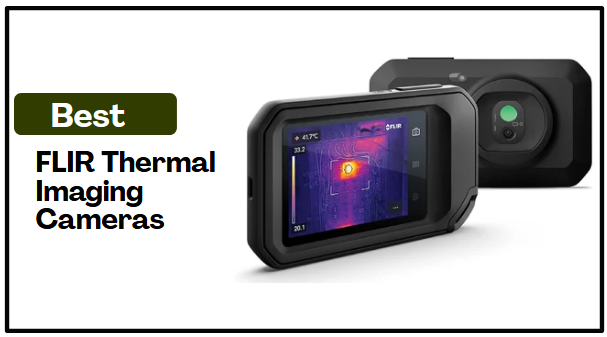
In this guide, I’ll walk you through my top picks for the best FLIR Thermal Imaging Cameras, break down what each model brings to the table and share a practical buying guide. I’ll also answer some common questions to help you decide which camera fits your work.
One hidden hot spot can mean a burned-out motor, a soaked ceiling or a whole weekend spent chasing a fault you simply can’t see. That’s exactly why I looked into the best FLIR Thermal Imaging Cameras. These tools turn invisible heat into clear, readable images within seconds, helping electricians, HVAC technicians, mechanics, home inspectors and even homeowners spot potential problems before they become expensive repairs.
The features worth having are surprisingly consistent. You want sharp thermal resolution, visible edge enhancement to help identify what you’re looking at, and reliable temperature measurements. A rugged body and convenient ways to save and share your findings matter too.
Beyond these essentials, the right choice depends on where you work, how hot your equipment gets and whether you need to prepare reports for clients.
Before we get into the details, here’s a quick snapshot of our top FLIR thermal imaging camera picks:
- FLIR TG165-X Thermal Imaging Camera with Bullseye Laser – Best for Beginners
- FLIR C3-X Compact Thermal Imaging Camera – Best for Client Reporting
- FLIR ONE Pro Thermal Imaging Camera for iOS Smartphones – Best Smartphone Attachment
- FLIR TG268 Thermal Imaging Camera – Best Overall
- FLIR C8 Compact Thermal Imaging Camera – Best Premium Option for Hazardous Environments
Best FLIR Thermal Imaging Cameras
1) FLIR TG165-X Thermal Imaging Camera with Bullseye Laser
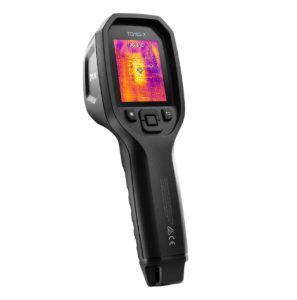
Ever spent an hour guessing which breaker, bearing or duct joint is causing trouble? The FLIR TG165-X replaces that guesswork with a thermal picture, making it a practical starting point for anyone comparing the best FLIR Thermal Imaging Cameras. This handheld, non-contact tool displays hot and cold spots on screen, helping you investigate electrical faults, mechanical problems and potential air or water leaks.
Its 80 × 60 thermal sensor captures 4,800 pixels of temperature data and measures temperatures from -25°C to 300°C (-13°F to 572°F). Accuracy varies across that range, reaching ±1.5°C (±3°F) between 50°C and 100°C. MSX image enhancement adds visible edge details to the thermal view, making components and labels easier to recognise. This is particularly useful when several parts sit close together.
Aiming is straightforward. The bullseye laser indicates the measurement area, helping you target the component you want to inspect. Its 24:1 distance-to-spot ratio also gives you flexibility when measuring from a short distance. You can capture thermal images, review them on the 2.4-inch display and save your findings for later reference.
The build is equally practical. An IP54-rated enclosure protects against dust and water, while the camera is designed to withstand drops of up to 2 metres (6.56 feet). Internal storage holds up to 50,000 images, and the rechargeable lithium-ion battery supports approximately five hours of scanning.
Electricians, HVAC/R technicians, mechanics and building inspectors will get the most from this camera. Homeowners and DIYers can also use it to investigate temperature differences around electrical systems, plumbing and building structures without investing in a more advanced inspection unit.
Specifications
- Thermal resolution: 80 × 60 (4,800 pixels)
- Temperature range: -25°C to 300°C (-13°F to 572°F)
- Accuracy: ±1.5°C to ±3°C, depending on temperature range
- Image enhancement: MSX
- Distance-to-spot ratio: 24:1
- Minimum measurement distance: 0.26 m (0.85 ft)
- Image storage: Up to 50,000 images
- Protection: IP54, designed for 2 m drops
- Battery: Rechargeable lithium-ion
Pros
- MSX enhancement makes components easier to identify
- Bullseye laser helps target measurement areas
- Large internal storage for inspection images
- IP54 housing and 2 m drop protection
- Approximately five hours of scanning time
Cons
-
80 × 60 resolution limits fine thermal detail
2) FLIR C3-X Compact Thermal Imaging Camera
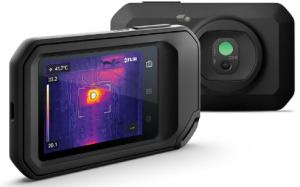
For contractors who spend as much time documenting repairs as finding faults, the FLIR C3-X handles both jobs in a pocket-friendly body. It suits plumbers, electricians, home inspectors and HVAC technicians who visit several sites a day and need to show customers exactly what they found.
Image quality starts with a 128 × 96 thermal sensor, producing 12,288 pixels of thermal data. Paired with FLIR’s patented MSX enhancement, it adds visible outlines to thermal images, making electrical hotspots, air leaks and plumbing problems easier to identify. The camera measures temperatures from -20°C to 300°C (-4°F to 572°F), covering a wide range of building inspection and maintenance tasks.
The C3-X really shines in what happens after the scan. Its Wi-Fi connectivity allows images to upload directly to FLIR Ignite, where you can organise, store and back up files. You can then share images with customers or create professional inspection reports from a mobile device or computer. Automatic firmware updates over Wi-Fi also help keep the camera current.
Small touches add to its practicality. A built-in LED flashlight improves visibility in dark crawl spaces and cramped cabinets, while the 5-megapixel visual camera captures reference photos alongside thermal images. The IP54-rated housing is designed to withstand drops of up to 2 metres, making it suitable for regular use across different job sites.
In short, this is a compact inspection tool built around documentation. It’s a particularly good fit for professionals who need to provide customers with visual evidence and organised reports rather than relying on verbal explanations alone.
Specifications
- Thermal resolution: 128 × 96 (12,288 pixels)
- Visual camera: 5 megapixels
- Temperature range: -20°C to 300°C (-4°F to 572°F)
- Accuracy: ±3°C from 0°C to 100°C; ±3% from 100°C to 300°C
- Image enhancement: MSX
- Field of view: 53.6°
- Connectivity: Wi-Fi and FLIR Ignite
- Software: FLIR Thermal Studio
- Storage: More than 5,000 images
- Protection: IP54, designed for 2 m drops
Pros
- Cloud uploads simplify image storage and sharing
- Professional reporting through FLIR Ignite
- Integrated flashlight helps in dark spaces
- Automatic firmware updates over Wi-Fi
- Slim, pocket-friendly design
Cons
- 300°C ceiling limits high-temperature inspections
3) FLIR One Pro Thermal Imaging Camera for iOS Smartphones
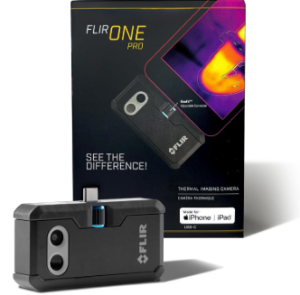
Not every thermal inspection requires a dedicated handheld camera. Sometimes, the smartphone already in your pocket is the most convenient place to start. That’s the idea behind the FLIR ONE Pro, a compact thermal imaging attachment that connects to compatible iPhones and turns their screens into thermal viewfinders.
Resolution is better than its small size suggests. The native 160 × 120 thermal sensor works with VividIR processing to produce enhanced images at 480 × 360. On top of that, MSX adds visible edge details to the thermal view, helping you recognise pipes, wiring and window frames while investigating temperature differences.
The FLIR ONE app handles image capture and inspection workflows. You can take thermal photos and videos, adjust image settings and review temperature measurements. It also supports FLIR Ignite integration for storing and sharing inspection images. For professionals with specialised requirements, compatible third-party applications provide additional options for different inspection workflows.
Who should consider it? Homeowners investigating drafts or potential moisture problems, home inspectors who prefer a lightweight kit, and technicians who need a portable secondary imager will appreciate its convenience. It also offers applications in automotive inspections, machinery maintenance and building diagnostics.
Temperature measurement accuracy is rated at ±3°C or ±5%, whichever applies, under FLIR’s stated operating conditions. Its OneFit connector adjusts to accommodate different phone case thicknesses, reducing the need to remove your case before connecting the camera. The attachment is also designed to withstand drops of up to 1.5 metres, adding some protection during everyday use.
One important purchasing consideration is compatibility. FLIR offers different ONE Pro versions for Lightning and USB-C connections. Make sure you select the iOS version and connector that match your particular iPhone.
Specifications
- Compatibility: iOS models with the appropriate Lightning or USB-C version
- Thermal resolution: 160 × 120 native, 480 × 360 Super Resolution
- Image processing: VividIR and MSX
- Temperature range: -20°C to 120°C and 0°C to 400°C
- Accuracy: ±3°C or ±5%, under stated conditions
- Connector: Adjustable OneFit
- Battery life: Approximately 1 hour
- Cloud integration: FLIR Ignite
- Drop rating: 1.5 m
Pros
- Super Resolution produces enhanced 480 × 360 images
- Smartphone integration makes it highly portable
- Adjustable OneFit connector accommodates different case thicknesses
- FLIR Ignite simplifies image storage and sharing
- Supports thermal photos and video capture
Cons
- Requires a compatible iPhone and connector
- Approximately one hour of battery life
4) FLIR TG268 Thermal Imaging Camera
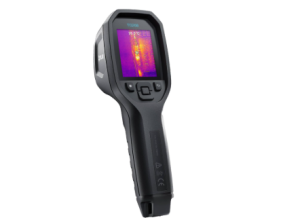
When equipment needs troubleshooting, a thermal camera that combines visual inspection with temperature measurement can make the job considerably easier. The FLIR TG268 brings these capabilities together in a handheld design for electrical, facility maintenance, automotive and HVAC professionals who need more than a conventional infrared thermometer.
Image clarity gets a useful boost from its native 160 × 120 thermal sensor. VividIR Super Resolution enhances images to 320 × 240, while MSX adds visible outlines to the thermal view. Together, these technologies make temperature anomalies easier to locate and identify during inspections.
The TG268 measures temperatures up to 400°C (752°F), with an accuracy of ±2.5°C or ±2.5% across much of its operating range. A bullseye laser helps identify the measurement area, while the 24:1 distance-to-spot ratio supports more targeted readings. The package also includes a Type K thermocouple for contact measurements, giving you another way to investigate temperature problems when thermal imaging alone isn’t sufficient.
Reporting is another useful part of the package. Through the FLIR METERLiNK app, you can capture and compare readings, analyse images and videos, and create reports to share with your team. This makes it easier to document findings and communicate inspection results without relying on handwritten notes.
As for durability, the TG268 carries an IP54 rating and is designed to withstand drops of up to 2 metres. A built-in LED worklight improves visibility in poorly lit areas, while its rechargeable battery supports approximately five hours of continuous scanning.
For technicians who regularly inspect electrical connections, motors, HVAC equipment and other machinery, the TG268 offers a practical combination of thermal imaging, contact measurement and reporting tools.
Specifications
- Thermal resolution: 160 × 120, enhanced to 320 × 240
- Visual camera: Built-in
- Temperature range: -25°C to 400°C (-13°F to 752°F)
- Accuracy: ±2.5°C or ±2.5% across specified ranges
- Field of view: 57° × 44°
- Distance-to-spot ratio: 24:1
- Connectivity: Bluetooth and USB-C
- Software: FLIR METERLiNK
- Extras: Type K thermocouple, bullseye laser and LED worklight
- Protection: IP54, designed for 2 m drops
Pros
- Super Resolution enhances thermal image detail
- Included thermocouple supports contact measurements
- METERLiNK simplifies reporting and data sharing
- 400°C measurement ceiling suits hotter equipment
- IP54 protection and 2 m drop rating
Cons
- Full reporting capabilities rely on a compatible phone and app
5) FLIR C8 Compact Thermal Imaging Camera
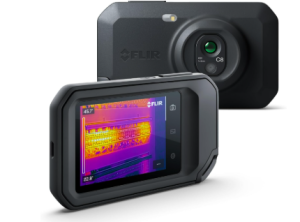
Some inspections demand more image detail than a basic thermal camera can provide. The FLIR C8 addresses that need with a 320 × 240 thermal sensor, giving inspectors more pixels to work with when investigating electrical systems, mechanical equipment and building structures. Its compact design also makes it convenient to carry between inspection sites.
The 76,800-pixel thermal sensor captures detailed temperature information, while its thermal sensitivity of less than 50 mK helps identify relatively small temperature differences. MSX adds visible edge details to the thermal image, making components easier to recognise. You also get picture-in-picture imaging, which places the thermal view over a visual reference image.
Its measurement capabilities are equally useful. The C8 measures temperatures from -20°C to 450°C (-4°F to 842°F), with accuracy of ±2°C between 0°C and 100°C and ±2% between 100°C and 450°C under specified ambient conditions. A selection of measurement tools includes spot readings, maximum and minimum readings within a box, and isotherms that highlight temperatures within selected ranges. Isotherm alarms also help draw attention to temperature conditions that warrant further investigation.
Documentation is another major advantage. Images can upload automatically to FLIR Ignite for secure storage and easier access. The platform also provides inspection templates that help organise findings and prepare standardised reports for customers or colleagues. New C8 purchases currently include a 12-month FLIR Ignite Pro subscription, according to FLIR.
The camera also features a 5-megapixel visual camera, a 3.5-inch touchscreen and Wi-Fi connectivity. Its IP54-rated housing is designed to withstand drops of up to 2 metres, making it suitable for regular inspection work.
Overall, the C8 is a strong option for maintenance professionals, electrical inspectors and building contractors who prioritise thermal image detail, temperature analysis and organised reporting in a compact device. However, its specifications do not list ATEX certification, so it should not be selected on the assumption that it is approved for explosive atmospheres.
Specifications
- Thermal resolution: 320 × 240 (76,800 pixels)
- Thermal sensitivity: Less than 50 mK
- Visual camera: 5 megapixels
- Temperature range: -20°C to 450°C (-4°F to 842°F)
- Accuracy: ±2°C from 0°C to 100°C; ±2% from 100°C to 450°C
- Field of view: 35° × 27°
- Image enhancement: MSX
- Connectivity: Wi-Fi and Bluetooth
- Display: 3.5-inch touchscreen
- Protection: IP54, designed for 2 m drops
Pros
- High 76,800-pixel thermal resolution
- Isotherm alarms highlight selected temperature conditions
- Multiple measurement tools support detailed inspections
- FLIR Ignite simplifies image storage and reporting
- Built-in visual camera and touchscreen
Cons
- Advanced reporting features depend on FLIR Ignite
Check out: 5 Best 18650 Battery for Thermal Scope
Advantages of FLIR Thermal Imaging Cameras
Find Temperature Problems Sooner
The best FLIR Thermal Imaging Cameras help you identify unusual temperature patterns without testing one component after another. An overloaded breaker, a failing bearing or an insulation problem may produce noticeable differences on screen, giving you a useful starting point for further investigation. This can speed up troubleshooting, reduce unnecessary checks and help minimise downtime for you or your clients.
Inspect Without Touching the Surface
Not every inspection requires physical contact with the equipment. Thermal imaging lets you measure surface temperatures on electrical panels, machinery and hot components from a distance.
This is particularly useful when direct contact could expose you to burns or moving parts. However, non-contact measurement does not eliminate electrical hazards, so appropriate safety procedures and working distances remain essential around energised equipment.
Make Sense of What You’re Seeing
Spotting an unusual temperature reading is useful, but identifying where it occurs makes the information much more actionable. FLIR’s MSX technology addresses this by adding visible details and outlines to thermal images.
Instead of looking at an indistinct heat pattern, you can better recognise the surrounding equipment and locate the area that needs attention. This also makes it easier to communicate your findings to clients or colleagues.
Keep Inspection Findings Within Reach
Finding a problem is only part of an inspection. You may also need to save the image, document the reading and share your findings with someone who wasn’t present. Depending on the camera, FLIR’s connectivity and reporting options let you transfer images, use cloud services and prepare inspection reports. This creates a useful record of identified issues and makes it easier to discuss recommended repairs with clients.
Ready for Demanding Inspection Work
Inspection equipment needs to handle more than ideal working conditions. Dust, splashes and accidental knocks are part of everyday fieldwork, particularly when you’re moving between electrical rooms, workshops and building sites.
Selected FLIR cameras offer protective enclosures and tested drop resistance to help withstand these conditions. Check the individual model’s IP rating and drop specification, though, because protection levels are not identical across the range.
One Tool, Different Inspection Needs
Thermal imaging has applications across several trades, which makes it a practical addition to different inspection toolkits. Electricians can investigate unusual heating in electrical components, HVAC technicians can examine temperature patterns across heating and cooling systems, and mechanics can check engines and other equipment.
Building inspectors can also use thermal images to investigate insulation gaps and temperature differences associated with moisture. The range includes dedicated handheld cameras as well as smartphone-based options, giving buyers different ways to approach these tasks.
Protection Beyond the Purchase
A thermal camera is a tool you may rely on for years, so warranty coverage deserves attention alongside its specifications. FLIR offers extended detector coverage on eligible products, but the terms depend on the model and may include registration requirements.
Before purchasing, check what the warranty covers, how long protection lasts and whether any conditions apply. This gives you a clearer picture of the support available after the initial investment.
Factors to Consider When Choosing the Best FLIR Thermal Imaging Cameras
Below are the main considerations to keep in mind when comparing your options.
Thermal Resolution
When comparing the best FLIR Thermal Imaging Cameras, thermal resolution is one of the first specifications to examine. It determines how much detail you’ll see in a thermal image, which matters when inspecting small components or crowded electrical panels.
A higher native pixel count generally captures finer temperature patterns and makes it easier to distinguish nearby targets. Some cameras also use image processing to enhance the displayed resolution, so check the native figure separately rather than treating enhanced resolution as an equivalent increase in sensor detail.
Temperature Range
Think about the hottest and coldest surfaces you’re likely to inspect. A camera with a range reaching around 300°C may cover many routine building, plumbing and electrical applications.
However, examining hotter equipment, engines or industrial processes may call for a higher measurement limit. Don’t choose based on the maximum figure alone, though.
Check whether the camera maintains suitable accuracy across the temperatures you expect to measure.
Measurement Accuracy
A temperature reading is only useful if you can rely on it. Accuracy becomes particularly important when a small difference could influence whether you investigate a component further or consider it within normal operating conditions.
Some cameras specify a tolerance in degrees, while others combine a temperature tolerance with a percentage. These figures may also vary with operating conditions and measurement range, so read the manufacturer’s specifications carefully before deciding whether a camera meets your requirements.
Field of View and Working Distance
Consider how much of the target you need to capture in one image. A wider field of view helps when inspecting large surfaces, walls or ceilings, while a narrower view concentrates the image on a smaller area.
Working distance matters just as much. If you regularly examine small components from several feet away, check the camera’s distance-to-spot ratio to establish whether it can measure the target accurately from that position.
Form Factor and Compatibility
How you plan to carry and operate the camera can influence your choice as much as its imaging specifications. Dedicated handheld units provide an independent inspection tool, while smartphone attachments offer a smaller alternative that uses your phone as the display and interface. The latter can be convenient when portability matters, but compatibility is essential. Confirm support for your exact phone model, operating system and charging port before purchasing.
Connectivity and Reporting
The best FLIR Thermal Imaging Cameras don’t all offer the same connectivity and reporting capabilities. If you share inspection findings with clients or managers, wireless image transfer and cloud storage can make documentation easier.
Some models also work with companion software for organising images and preparing reports. Consider how you currently handle inspection records and choose a camera whose available tools fit that workflow rather than paying for connectivity features you may rarely use.
Durability and Safety Ratings
A camera used regularly in workshops or on building sites should offer suitable protection against dust, moisture and accidental drops. Check its IP rating and the manufacturer’s stated drop-test performance instead of assuming every model has the same level of protection.
Hazardous environments require even more care. If you work around potentially explosive gases or combustible dust, verify that the camera carries certification appropriate to the area’s classification.
An ordinary IP rating does not replace ATEX or other relevant hazardous-area certification.
Helpful Extras
The right extras can make inspections more convenient and expand how you use the camera. A laser pointer helps indicate the area being measured, while a built-in flashlight is useful when working in poorly lit spaces. Some models also support Type K thermocouples, allowing you to supplement thermal imaging with contact temperature readings. Consider which additions would genuinely help with your routine tasks rather than treating a longer specification list as an automatic advantage.
Warranty Coverage
Finally, look beyond the camera’s purchase price and check the protection that comes with it. Find out how long the manufacturer covers the camera and detector, what the warranty includes and whether registration is required.
Extended detector coverage can add value, but eligibility and conditions vary between models. Reviewing the applicable warranty terms before buying helps you understand the support you can expect over the camera’s working life.
Best FLIR Thermal Imaging Cameras FAQs
What are FLIR thermal imaging cameras used for?
They detect temperature differences and display them as thermal images. Common applications include investigating electrical hotspots, examining mechanical equipment, checking HVAC systems, identifying insulation gaps and finding temperature patterns associated with moisture or plumbing problems. The exact applications depend on the camera’s measurement range, resolution and available features.
What is MSX, and why does it matter?
MSX stands for Multi-Spectral Dynamic Imaging. It combines visible details from a camera’s built-in visual sensor with its thermal image, adding outlines and edges that make surrounding objects easier to recognise. This helps you understand where an unusual temperature pattern occurs and makes inspection images easier to interpret and share.
How much thermal resolution do I really need?
It depends on the size of the targets you’re inspecting and how far away you’ll be working. A lower-resolution camera may be sufficient for general troubleshooting and broad surface checks.
However, examining small components or crowded electrical panels calls for greater image detail. Compare native resolution first, then consider any enhanced resolution offered through image processing.
Conclusion
Now that you’ve explored the different options, their capabilities and what to look for when buying one, choosing a suitable thermal camera should be much easier. The best FLIR Thermal Imaging Cameras offer different combinations of thermal resolution, temperature measurement ranges, image enhancement, connectivity and durability. Some prioritise straightforward troubleshooting, while others provide more advanced imaging and reporting capabilities.
As you make your final decision, consider the type of inspections you’ll perform most often, the level of detail you need and the working conditions you’ll encounter. Pay attention to measurement accuracy, native thermal resolution and useful extras rather than choosing based on specifications alone. The right camera is ultimately one that fits your work, simplifies your inspections and delivers dependable value over time.
See more: 7 Best Rangefinders With Slope for Golf