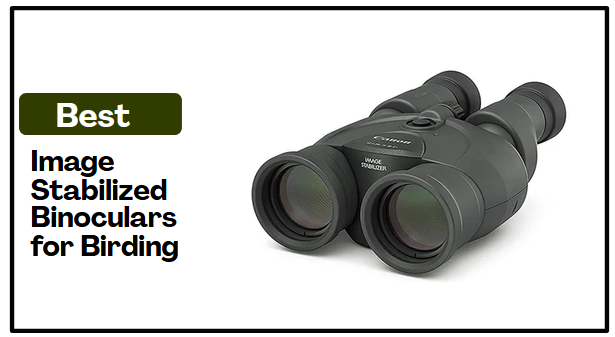
This guide explores the best Image Stabilized Binoculars for Birding, covering the key features of each model, my top picks and a practical buying guide. Beyond that, it answers some of the most common questions birders ask before settling on a stabilized pair. As you read through, you will know which pair suits the birds you chase, the way you watch them and the places you find them.
Few things are more frustrating than finally spotting a rare warbler, raising your binoculars and watching it dance around in a shaky blur. I’ve been there more times than I can count, and that is what led me to stabilized optics. They cancel out hand tremor, wind and even the roll of a boat, so eye rings, wing bars and bill shapes hold still long enough to confirm an identification. Better still, they make 12x or 16x magnification usable by hand, provided you pick the right balance of lens size, stabilization range, weather protection, battery life and eye relief.
Before we dive deeper, here is a quick look at the best Image Stabilized Binoculars for Birding and the category each one fits best:
- Canon 10×30 Image Stabilization II Binoculars – Best Overall
- SIG SAUER ZULU6 HDX PRO 18x50mm FDE Image Stabilized Binoculars – Best Long-Range
- Canon 12×36 Image Stabilization III Binoculars – Best Compact High-Power
- Fujinon Techno Stabi TS1440 14×40 Image Stabilization Binoculars – Best for Boat and Pelagic Birding
- Nikon STABILIZED 12×25 Binoculars – Best Pocket-Sized
- Kite Optics APC Stabilized 16×42 Binoculars – Best Battery Life
- Canon 10×42 L IS WP Image Stabilized Binoculars – Best Premium Option
Best Image Stabilized Binoculars for Birding
1) Canon 10×30 Image Stabilization II Binoculars
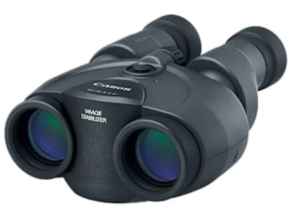
Press one button and watch a fidgety warbler suddenly settle on its branch. That moment is what this compact 10x pair delivers. Its stabilizing system draws on the same optical technology Canon developed for its EF camera lenses, so the hand tremor that usually blurs fine plumage fades away. Instead of chasing a shaking image, you get time to study wing bars, eye rings and bill shapes, which are often the details that settle an identification.
The 30mm objectives work alongside Porro II prisms that limit light loss and keep resolution high. A doublet field flattener keeps the image crisp right out to the edges. That matters when a bird hops away from the centre of the frame and you would rather not lose it in soft, distorted margins. The lenses also use lead-free glass.
Comfort gets equal attention. With 14.5mm of eye relief, glasses wearers can see the full field without pressing their lenses against the eyecups. Canon has also improved power efficiency, so one set of batteries lasts further across a weekend of fieldwork.
Meanwhile, the non-glossy front cover and low-reflective exterior are thoughtful choices for birding, since a flash of reflected sunlight can scare off a wary subject before you get a proper look.
If you are trying Image Stabilized Binoculars for Birding for the first time and want something easy to carry for hours, this pair keeps things light and straightforward.
Best suited for: Birders who cover long trails, travellers, and glasses wearers looking for a light stabilized pair for woodland, garden and park species.
Specifications
- Magnification: 10x
- Objective lens diameter: 30mm
- Prism type: Porro II
- Eye relief: 14.5mm
- Optics: Doublet field flattener, lead-free glass
- Stabilization: Canon optical Image Stabilization
- Power: 2 AA batteries
- Exterior: Low-reflective, non-glossy finish
Pros
- Light and easy to carry all day
- Sharp view across the whole field
- Generous eye relief for glasses
Cons
- Smaller 30mm lenses gather less light at dawn and dusk
2) SIG SAUER ZULU6 HDX PRO 18x50mm FDE Image Stabilized Binoculars
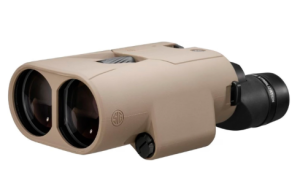
The SIG SAUER ZULU6 HDX PRO is built for serious reach. At 18x, it brings birds that ordinary glass would leave as specks into identifiable view: raptors circling a distant ridge, waders spread across a far mudflat, or ducks rafting in the middle of a lake. That much power is nearly impossible to hold steady by hand, which is where the OmniScan OIS system comes in.
Rather than applying one fixed level of correction, OmniScan reads your movement through a digital accelerometer. Hold the binoculars almost still, and it stabilizes more strongly. Pan to follow a bird in flight, and it eases off so tracking feels natural instead of sluggish.
On the optical side, the HDX PRO lens system cuts ambient glare, improves light transmission and sharpens colour accuracy. SpectraCoat anti-reflection coatings boost brightness, while LensArmor coatings resist scratches and abrasion. Together with the large 50mm objectives, these coatings give a strong twilight factor, which helps during the early morning and late evening hours when many birds are most active.
Handling has also been refined. The battery compartments sit on opposite sides of the body, and both the diopter ring and focus wheel carry an upgraded texture for surer control, even with cold fingers. Two included AA batteries provide up to 40 hours of runtime.
The durable thermoplastic frame is wrapped in rubber armour for grip and impact protection, and the IPX-7 waterproof and fog-proof rating means a sudden downpour won’t cut your session short. You also get a foam case and neck strap, and the binoculars can be mounted on a tripod for long watches.
Best suited for: Birders who scan open country, coastlines and large wetlands where birds tend to stay far away.
Specifications
- Magnification: 18x
- Objective lens diameter: 50mm
- Stabilization: OmniScan OIS with digital accelerometer
- Coatings: SpectraCoat anti-reflection, LensArmor abrasion resistant
- Weather protection: IPX-7 waterproof, fog-proof
- Power: 2 AA batteries (included)
- Runtime: Up to 40 hours
- Housing: Thermoplastic frame with rubber armour
- Mounting: Tripod capable
Pros
- Huge reach for distant birds
- Stabilization adapts to how you move
- Long battery runtime
- Weatherproof, rugged build
Cons
- Larger 50mm body adds bulk on long hikes
3) Canon 12×36 Image Stabilization III Binoculars
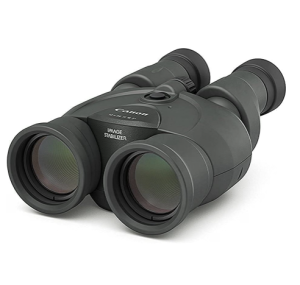
A bird that refuses to come any closer is where the extra step from 10x to 12x really shows. This compact Canon gives you that added reach without turning into a heavy load, and its Image Stabilization, based on the same technology used in Canon EF lenses, keeps the higher magnification steady enough to enjoy handheld.
The 36mm objectives let in more light for clear, bright, high-resolution images, which is a real help when you are trying to pick out a sandpiper’s leg colour or the streaking on a distant hawk’s chest. Porro II prisms reduce light loss and support fine detail, while a doublet field flattener delivers sharp images that stay virtually free of distortion from edge to edge. As a result, scanning across a flock feels clean rather than blurry at the margins.
Glasses wearers are well looked after too, thanks to 14.5mm of eye relief. Canon has also improved power efficiency and battery consumption, so you can keep the stabilizer running through longer outings. The low-reflective exterior helps you stay unnoticed, and the environmentally friendly lead-free glass is a welcome detail.
For birders weighing up the best Image Stabilized Binoculars for Birding, this model makes sense when 10x feels a little short but full-size, heavy optics feel like too much.
Best suited for: Birders who want more magnification for shorebirds, raptors and canopy species while keeping a compact, portable pair.
Specifications
- Magnification: 12x
- Objective lens diameter: 36mm
- Prism type: Porro II
- Eye relief: 14.5mm
- Optics: Doublet field flattener, lead-free glass
- Stabilization: Canon optical Image Stabilization
- Power: 2 AA batteries
- Exterior: Low-reflective finish
Pros
- Extra reach in a compact body
- Bright, high-resolution view
- Comfortable for glasses wearers
Cons
- Not designed for wet weather
4) Fujinon Techno Stabi TS1440 14×40 Image Stabilization Binoculars
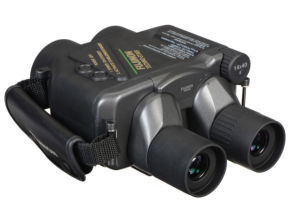
Fujinon designed the Techno Stabi TS1440 for one of the hardest viewing situations of all: watching from something that moves. Pelagic trips, ferry crossings and coastal drives usually make 14x binoculars unusable, as the deck rolls and the image jumps all over the place. Here, ±5° of vertical stabilization lets you lock onto a shearwater skimming the waves or a tern hovering offshore and keep a steady view at high magnification.
Optically, the binoculars use Fujinon’s patented EBC coating for excellent light transmission, along with phase-coated prisms for crisp contrast. Combined with 40mm objectives and 14x power, they give a detailed look at birds sitting well beyond comfortable range. Focusing is handled by a centre wheel, so adjustments stay quick when a new bird appears.
The body is made from fiberglass-reinforced, high-durability plastic and is both waterproof and fog-proof, which matters when sea spray and sudden temperature changes are part of the outing. Rubber armour gives a firm grip in wet hands, and the flotation strap means a slip over the rail doesn’t have to be a total loss. Four AA batteries power the stabilizer.
In the box, you also get a rugged mil-spec hard carrying case, eyepiece covers, a strap and a cleaning cloth, so the binoculars are ready for travel straight away.
Best suited for: Birders on boats and pelagic trips, or anyone observing from moving vehicles and exposed coastal spots.
Specifications
- Magnification: 14x
- Objective lens diameter: 40mm
- Stabilization: ±5° vertical
- Coatings: EBC lens coating, phase-coated prisms
- Focus: Centre focus
- Body: Fiberglass-reinforced plastic with rubber armour
- Weather protection: Waterproof, fog-proof
- Power: 4 AA batteries
- Extras: Hard case, flotation strap
Pros
- Steady views from boats and vehicles
- Waterproof with a floating strap
- Tough, travel-ready case
Cons
- Needs four batteries to run
5) Nikon STABILIZED 12×25 Binoculars

Some of the best birding happens on hikes where every gram counts, and that is the gap this pocket-sized 12x pair fills. A slim roof prism design and dual-hinge body let it fold small enough for a jacket pocket. Despite that size, Nikon’s electronic stabilization cuts image shake by up to 80 percent, correcting movement before it reaches your eyes.
That steadiness pays off in two ways. Firstly, following a bird as it moves through scrub becomes much easier, and fine details stay readable at full magnification. Secondly, less shake means less eye fatigue, so you can keep watching a feeding flock for longer without strain.
The lenses are multicoated to cut glare and boost contrast, while a high-reflectivity silver alloy coating on the prisms sends more light to your eyes for bright views with natural colour. The field of view measures 236 feet at 1,000 yards. A large, textured centre focus wheel allows quick, precise adjustments, and the turn-and-slide eyecups set the right eye relief whether or not you wear glasses. In addition, the closed-bridge design keeps the focusing mechanism stable and balanced in the hand.
Power management is simple. Two AA batteries give up to 12 hours of stabilization, and once switched on, it stays active for up to 60 minutes before shutting off automatically to save power. If the batteries run out mid-walk, you can still use the binoculars with stabilization turned off. A case, neck strap, eye caps and batteries come in the box.
Best suited for: Hikers and travelling birders who want the smallest, lightest stabilized pair for open areas and shorelines.
Specifications
- Magnification: 12x
- Objective lens diameter: 25mm
- Prism type: Roof prism with silver alloy coating
- Lens coating: Multicoated
- Field of view: 236 ft at 1,000 yd
- Shake reduction: Up to 80%
- Power: 2 AA batteries, up to 12 hours
- Auto shutoff: After 60 minutes
- Eyecups: Turn-and-slide
Pros
- Folds small enough for a pocket
- Still usable with stabilization off
- Smooth, easy centre focus
Cons
- Small 25mm lenses limit brightness in low light
6) Kite Optics APC Stabilized 16×42 Binoculars
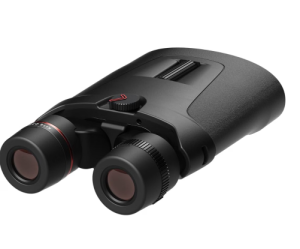
Kite Optics took a different approach with the APC 42, packing stabilization into the popular 42mm roof prism format while keeping it about as compact and light as a traditional roof prism pair. At 16x, it reaches well beyond standard birding glass, yet the image stays calm thanks to stabilization with 2° and 3° correction angles. That correction holds up in strong wind, on boats and even in vehicles, which makes it a strong partner for windswept hawk watches and seawatching sessions.
Inside, the ultra-compact KDGS-1 suspension uses second-generation accelerometers to track the movement of the roof prisms precisely. In practice, birds that would be a trembling blur at 16x appear steady, revealing details that even very good unstabilized binoculars can miss.
Power is where this model really changes the routine. The APC mode puts the binoculars to sleep when you lower them and wakes them the moment you raise them again, with no buttons to press. Two active AA batteries plus two spares stored onboard provide at least 120 hours of continuous viewing, so you may only change batteries once or a few times a year.
The focus wheel sits right under your fingertips for fast adjustments as birds move. For durability, the IPX7 rating allows submersion to 1 meter for 30 minutes, and nitrogen filling keeps the internal optics from fogging in humid forests or cold coastal air.
Best suited for: Seawatchers, hawk watchers and birders who spend time in windy, exposed locations or on boats.
Specifications
- Magnification: 16x
- Objective lens diameter: 42mm
- Prism type: Roof prism
- Stabilization: 2° and 3° correction angles, KDGS-1 suspension
- Power mode: APC automatic sleep and wake
- Batteries: 2 AA active plus 2 AA spare
- Runtime: At least 120 hours continuous
- Waterproofing: IPX7, submersible to 1 m for 30 minutes
- Fog protection: Nitrogen filled
Pros
- No buttons, automatic power saving
- Exceptional battery life
- Steady in wind and on boats
- Fully waterproof and fog-proof
Cons
- High power also magnifies heat shimmer on hot days
7) Canon 10×42 L IS WP Image Stabilized Binoculars
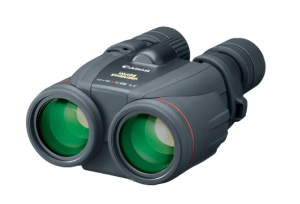
Low light is where many birding sessions are won or lost, and this full-size Canon is built with those moments in mind. Its 4.2mm exit pupil is the largest in Canon’s IS range, so the view stays bright at first light when warblers start moving and at dusk when owls begin to stir. Add Canon’s Image Stabilizer, activated with a single touch, and you get a calm, shake-free image even after a brisk climb to a lookout.
Optical quality comes from Canon’s L series. Each side carries two Ultra-low Dispersion elements that correct chromatic aberration, which is especially useful when you are looking at a dark bird against a bright sky and want to avoid colour fringing around its edges. Doublet field flattener lenses keep the image sharp and distortion-free from edge to edge. Meanwhile, the 65° apparent angle of view gives a wide, comfortable picture that makes scanning a reedbed or treeline easier.
This was also Canon’s first waterproof IS binocular, and the metallic coating on body components helps prevent fogging. As a result, rain, marsh mist and early morning dew are far less of a worry. The distinctive grip design feels secure in the hand during long sessions.
Individuals who want the best Image Stabilized Binoculars for Birding in poor light and wet weather, this pair brings premium glass and dependable protection together. The package includes a padded case with strap, a neoprene strap, an eyepiece rainguard, a push-on objective cap and two AA batteries.
Best suited for: Dedicated birders who head out at dawn, dusk or in wet conditions and want premium optics with stabilization.
Specifications
- Magnification: 10x
- Objective lens diameter: 42mm
- Exit pupil: 4.2mm
- Apparent angle of view: 65°
- Lens: L series with 2 UD elements per side
- Optics: Doublet field flattener
- Weather protection: Waterproof, anti-fog body coating
- Stabilization: One-touch Image Stabilizer
- Power: 2 AA batteries (included)
Pros
- Bright view in poor light
- Excellent colour fringing control
- Waterproof build
- Wide, comfortable view
Cons
- Full-size 42mm body is less pocketable than compact models
More for you: 6 Best Swarovski Binoculars
Advantages of Image Stabilized Binoculars for Birding
Clearer Detail for Confident Identification
Many identifications come down to small features: a faint eye ring, the pattern on the undertail, or the exact shade of a bill. With ordinary binoculars, natural hand tremor makes these details shimmer and blur. Stabilization holds the image steady, so you can study markings properly and confirm what you are seeing rather than guessing.
Higher Magnification Becomes Practical
Powers of 12x, 14x and above usually need a tripod, because every small movement is magnified along with the bird. Stabilized optics remove much of that shake, which means you can use stronger magnification handheld. As a result, distant shorebirds, raptors and waterfowl become far easier to identify without carrying extra support gear.
Less Eye Strain on Long Sessions
A constantly shifting image forces your eyes and brain to work harder, and that effort adds up over a morning in the field. When the view stays calm, you can watch a feeding flock or a nesting pair for much longer without tired, aching eyes. This makes a real difference during migration counts or long stakeouts.
Easier Tracking of Moving Birds
Following a bird as it flits through branches or glides across the sky is challenging at high power. Stabilization smooths out the jerky motion that comes with panning, so it is easier to keep the subject in view. Some systems even adjust the level of correction as you move, which keeps tracking natural.
Steady Views From Boats, Vehicles and Windy Spots
Seabirds are often watched from a rolling deck, raptors from a gusty ridge, and wetland species from a car window. In these conditions, regular binoculars can be nearly useless. Stabilized models counter both your own movement and the motion around you, opening up birding locations that would otherwise be frustrating.
Helpful for Less Steady Hands
Not everyone can hold binoculars perfectly still, whether because of age, fatigue or simply the cold. Stabilization levels the playing field, giving every birder a clear, steady image regardless of how firmly they can grip the binoculars.
Factors to Consider When Choosing the Best Image Stabilized Binoculars for Birding
Magnification
Magnification decides how close a bird appears, but more is not always better. Around 10x to 12x suits woodland, garden and general birding, where birds are relatively close and you need to find them quickly. Higher powers such as 14x to 18x shine on coastlines, lakes and open country, although they narrow the view and make small, fast birds harder to locate.
Objective Lens Size and Low-Light Performance
The objective lens diameter controls how much light reaches your eyes. Larger lenses, such as 42mm or 50mm, give brighter images at dawn and dusk, when many birds are most active. Smaller lenses keep the binoculars compact, yet they can look dimmer in shade or poor light. A larger exit pupil also helps the view stay bright as daylight fades.
Stabilization System and Correction Range
Stabilization systems differ in how they work and how much movement they can handle. Some correct mainly for hand tremor, while others offer a wider correction range suited to boats and vehicles. Adaptive systems that adjust correction based on how you move can make panning feel more natural. Think about where you bird most, then match the system to those conditions.
Size and Portability
If you hike long trails or travel often, a compact, light pair will spend more time around your neck and less time left in the car. Folding, pocket-sized designs are ideal for casual outings, while larger, heavier models make more sense for stationary watching from a hide, a boat or a vantage point.
Weather Resistance
Birding rarely waits for perfect weather. Waterproof and fog-proof construction protects the optics from rain, spray and sudden temperature changes. Ratings such as IPX7 indicate that a pair can survive submersion, which matters for coastal and boat use. If a model has no stated waterproof rating, treat it as a fair-weather companion.
Battery Life and Power Management
Stabilization needs power, so runtime is worth checking. Battery life among stabilized binoculars ranges widely, from around 12 hours to well over 100 hours. Automatic shutoff and sleep modes help conserve power, and models that still work with stabilization turned off offer a useful backup when batteries run low in the field.
Eye Relief and Comfort
Glasses wearers need enough eye relief to see the full image without removing their spectacles. Look for generous eye relief and adjustable eyecups. Comfortable grip, well-placed controls and a smooth focus wheel also make a big difference during long sessions.
Optical Quality and Coatings
Good glass and coatings determine how sharp, bright and true to colour the image looks. Multicoated lenses reduce glare, prism coatings improve light transmission, and features such as field flatteners and low-dispersion elements keep edges sharp and limit colour fringing. These details matter when you are judging subtle plumage shades.
Explore: 7 Best Image Stabilized Binoculars
Best Image Stabilized Binoculars for Birding FAQs
Can I use stabilized binoculars when the batteries run out?
Many models still work as regular binoculars with stabilization switched off, although you lose the steadying effect. It is still wise to carry spare batteries, and some designs even store spares onboard.
How long do the batteries last?
It varies a lot by model. Some run for around 12 hours on a pair of AA batteries, while others last 40 hours or more than 120 hours, helped by automatic sleep or shutoff features.
Are all image stabilized binoculars waterproof?
No. Some carry full waterproof and fog-proof ratings, while others have no stated weather protection. If you bird in rain, near water or from boats, choose a model with a clear waterproof rating.
Can I wear glasses while using them?
Yes, as long as the binoculars offer enough eye relief and adjustable eyecups. Long eye relief lets glasses wearers see the full field of view comfortably.
Which are the best Image Stabilized Binoculars for Birding from a boat?
Look for models with a wide stabilization correction range and solid waterproofing. These handle the constant rolling motion of a boat far better than designs aimed mainly at correcting hand tremor.
Conclusion
The best Image Stabilized Binoculars for Birding turn a shaky, frustrating glimpse into a detailed view you can actually learn from. They let you push magnification further, follow birds in motion and enjoy longer observation sessions, whether you are on a forest trail, a windy headland or the deck of a boat.
Each pair in this guide offers a different combination of portability, optical reach, weather resistance and battery endurance. Some prioritize lightweight handling for mobile birding, while others provide the reach and durability needed for demanding outdoor conditions.
Before settling on a pair, consider your typical viewing distances, preferred magnification, lens size and the environments where you bird. The right combination will help you pick out subtle plumage patterns, wing bars and eye rings with greater clarity.