The Best Motorized Telescope can turn stargazing into an easier and more rewarding experience by helping locate celestial objects and keep them in view. I’ll explore options with computerized GoTo systems, automatic tracking, quality optics, and user-friendly controls to suit different levels of experience. Whether observing the Moon, planets, or distant deep-sky objects, the right telescope can make exploring the night sky more convenient and enjoyable. This guide covers the key features to consider, reviews the top picks, explains what to look for before buying, and answers common questions to help you choose the right motorized telescope.
Our Top Picks at a Glance
- Celestron NexStar 8SE Computerized Schmidt Cassegrain Telescope: Best Overall
- Celestron NexStar 127SLT Maksutov Cassegrain Computerized GoTo Telescope: Best for Planetary Views
- Celestron CGEM II 11 Inch Schmidt Cassegrain Telescope with GoTo EQ Mount: Best Premium Option
- UNISTELLAR Odyssey PRO Smart Telescope: Best for Shareable Live Views
- Celestron NexStar 6SE Schmidt Cassegrain Telescope: Best Portable Mid Size Option
- ZWO Seestar S30 Pro Smart Telescope: Best for Beginner Deep Sky Photography
- Celestron NexStar 130SLT Newtonian Computerized GoTo Reflector Telescope: Best Starter Reflector
- Dwarf Mini Smart Telescope: Best Budget Pick
- Sky Watcher EQ6 R Fully Computerized Telescope: Best Mount for Heavy Imaging Setups
- Celestron NexStar 5SE Schmidt Cassegrain Computerized Telescope: Best for Entry Level Imaging
Best Motorized Telescope
1)Celestron NexStar 8SE Computerized Schmidt-Cassegrain Telescope
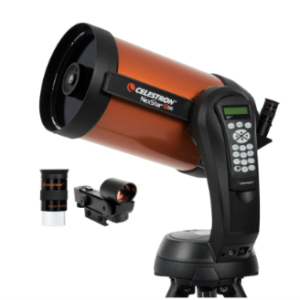
The Celestron NexStar 8SE Computerized Schmidt-Cassegrain Telescope is a powerful motorized telescope designed for astronomers who want detailed celestial views and convenient automated navigation. It combines an 8-inch Schmidt-Cassegrain optical system with a computerized GoTo mount, making it suitable for exploring planets, galaxies, nebulae, and star clusters. Its recognizable orange optical tube also provides a relatively compact design for a telescope with this aperture.
The 8-inch aperture (203.2mm) gathers substantial light, helping reveal fine details across different celestial targets. Its 2,032mm focal length and f/10 focal ratio make it particularly useful for lunar and planetary observation while retaining the ability to explore deep-sky objects. The included StarBright XLT optical coatings improve light transmission, supporting bright and detailed views. Users can observe lunar craters, Jupiter’s cloud bands, and Saturn’s rings under suitable viewing conditions. The supplied 25mm Plossl eyepiece provides 40x magnification for general observations.
Navigation is handled by the computerized altitude-azimuth GoTo mount, which uses dual DC servo motors and encoders to locate and follow selected objects. The NexStar+ hand controller provides access to more than 40,000 celestial targets, including stars, planets, galaxies, nebulae, and clusters. Once aligned, the telescope automatically tracks its selected target, reducing the need for constant manual adjustments. Users can also make positioning changes through the hand controller when necessary.
Celestron’s SkyAlign technology simplifies the alignment process by allowing users to center three bright stars or planets without identifying them by name. The system uses these reference points to calculate the telescope’s position and align it with the night sky. However, alignment can be challenging in areas with significant light pollution or limited visibility of bright celestial objects. Beginners may need some practice to achieve consistent results.
Despite its advanced electronics, the NexStar 8SE remains reasonably portable, weighing approximately 23.9 pounds. Its steel tripod provides support, while the quick-release design makes assembly and disassembly more convenient. It also supports optional accessories, including wireless control and automatic alignment upgrades. Celestron includes a two-year US warranty and unlimited access to technical support.
Best Suited For:This motorized telescope is particularly suitable for intermediate and advanced stargazers interested in detailed planetary viewing, lunar observation, and deep-sky exploration. It is also a good choice for backyard astronomy enthusiasts who want automated object location and tracking, provided they have suitable conditions for alignment and an adequate external power source for extended sessions.
Specifications
- Optical design: Schmidt Cassegrain
- Aperture: 8 inches (203mm)
- Focal length: 2,032mm at f/10
- Mount: Computerized altitude azimuth single fork arm
- Database: More than 40,000 objects
- Alignment: SkyAlign with three bright objects
- Included: 25mm eyepiece and StarPointer finderscope
- Weight: 23.9 pounds
- Warranty: 2 years with US based support
Pros
- Bright, detailed views of planets and the Moon
- Automatic slewing and tracking
- Large database of more than 40,000 objects
- Quick alignment without star charts
- No collimation needed
- Compact tube and manageable weight
- Planetarium and PC control software included
- Two year warranty with unlimited technical support
Cons
- Alignment can fail under light polluted or restricted skies
2)Celestron NexStar 127SLT Maksutov-Cassegrain Computerized GoTo Telescope
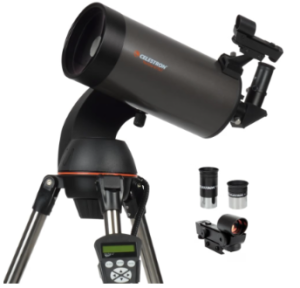
The Celestron NexStar 127SLT Maksutov-Cassegrain Computerized GoTo Telescope is designed for stargazers who want detailed planetary views and convenient computerized navigation. It combines a 127mm (5-inch) aperture with a motorized GoTo mount, allowing users to explore thousands of celestial objects without relying entirely on manual positioning. Its compact optical tube and relatively lightweight construction also make it suitable for backyard astronomy, camping trips, and outdoor observing sessions.
The Maksutov-Cassegrain optical design features a 1,500mm focal length and an f/11.8 focal ratio. This configuration is particularly useful for observing the Moon and planets, where magnification and image contrast are important. Users can examine lunar craters, Jupiter’s cloud bands, and Saturn’s rings under suitable viewing conditions. The telescope can also reveal brighter deep-sky objects, including the Orion Nebula and globular clusters. Its fully coated optics support light transmission, while the included 25mm and 9mm Kellner eyepieces provide different magnification options for observing various targets.
Navigation is handled by a computerized Alt-Azimuth GoTo mount equipped with DC servo motors and encoders. The NexStar+ hand controller provides access to a database containing more than 40,000 celestial objects, including stars, galaxies, nebulae, planets, and clusters. After selecting an object, the motorized mount moves the telescope toward it and automatically tracks its position. This feature makes locating and following celestial targets more convenient, particularly for observers who are still learning to navigate the night sky.
Celestron’s SkyAlign technology further simplifies setup by allowing users to center three bright celestial objects in the eyepiece. The system then calculates the telescope’s position and aligns it for computerized operation. Although the process can be completed quickly when conditions are favorable, some users report alignment difficulties and inconsistent tracking. The included StarPointer red-dot finderscope also helps with initial object positioning.
Portability is another practical advantage. The telescope weighs approximately 18.1 pounds and has a 27-inch optical tube, making transportation and storage relatively manageable. It comes with an adjustable steel tripod, a 90-degree star diagonal, and free Starry Night Special Edition astronomy software. However, the tripod has received criticism for wobbling, which can make focusing and observing less comfortable. An external power source is also recommended for longer sessions.
Best Suited For: The Celestron NexStar 127SLT is particularly suitable for beginner and intermediate astronomers interested in lunar and planetary observation, automated tracking, and portable stargazing. It is also useful for families exploring astronomy together, provided they are prepared to work through occasional alignment challenges and address the tripod’s stability limitations.
Specifications
- Optical design: Maksutov Cassegrain
- Aperture: 127mm (5 inches)
- Focal length: 1,500mm at f/11.8
- Mount: Computerized altitude azimuth single fork arm
- Database: More than 40,000 objects
- Alignment: SkyAlign with three bright objects
- Included: 25mm and 9mm eyepieces, StarPointer finderscope
- Weight: 18.1 pounds
- Warranty: 2 years with US based support
Pros
- Clear views of the Moon, Saturn, and Jupiter
- Automatic slewing and tracking
- Database of more than 40,000 objects
- Quick alignment without star charts
- Easy setup with pre assembled parts
- Compact and portable for travel and camping
- Two eyepieces and Starry Night software included
- Two year warranty with unlimited technical support
Cons
- Tripod feels flimsy and wobbly for many owners
3)Celestron CGEM II 11″ Schmidt-Cassegrain Telescope with GoTo EQ Mount
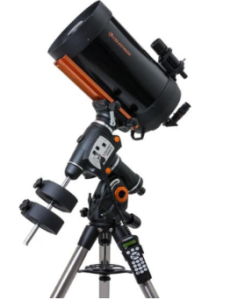
The Celestron CGEM II 11″ Schmidt-Cassegrain Telescope with GoTo EQ Mount is one of the best motorized telescope options for experienced astronomers. It pairs an 11 inch Schmidt Cassegrain tube with a computerized equatorial mount. So it targets serious visual observers and imagers rather than first time buyers. Also, it rewards patience with bright, sharp views.
The 11 inch aperture measures 279mm, and StarBright XLT coatings improve light transmission and contrast. Because of that, owners describe sharp planets and bright deep sky objects. One reviewer said faint targets needed less averted vision. In addition, the telescope reaches up to 660x magnification with compatible eyepieces. The tube stays fairly compact at 24 inches, and it weighs 27.5 pounds.
The NexStar+ hand control searches a database of more than 40,000 objects. After alignment, the dual servo motors slew to targets and track them automatically. You can also enter celestial coordinates to find objects outside the database. Users say it locates thousands of targets reliably once set up correctly.
The German style equatorial mount suits astrophotography. It removes field rotation, so long exposures stay cleaner. Meanwhile, an autoguider port supports imaging gear, and a steel tripod adds stability. Large adjustment knobs also make polar alignment easier.
However, this telescope has a steep learning curve. Alignment takes practice, and some owners report GPS alignment errors. So beginners may feel frustrated. The mount uses softer aluminum, which means you should avoid overtightening knobs. In addition, screws can loosen over time, so you should check them often.
Best Suited For:This telescope suits experienced hobbyists who want deep sky views, planetary detail, or long exposure imaging. It works best from a dark site with time to set up carefully. Because AA batteries last only one to two hours, you will need external power.
Specifications
- Optical design: Schmidt Cassegrain
- Aperture: 11 inches (279mm)
- Focal length: 2,800mm at f/10
- Mount: Computerized German style equatorial
- Database: More than 40,000 objects
- Alignment: All Star Polar Alignment
- Included: 25mm eyepiece, 9×50 illuminated finderscope
- Optical tube weight: 27.5 pounds
- Warranty: 2 years with US based support
Pros
- Bright, sharp views of planets and deep sky objects
- Reaches up to 660x magnification
- Accurate GoTo once aligned
- Coordinate entry for objects outside the database
- Equatorial mount suits long exposure imaging
- Sturdy steel tripod and compact tube
- Autoguider port supports imaging gear
- Two year warranty with unlimited technical support
Cons
- Steep learning curve for new observers
4)UNISTELLAR Odyssey PRO Smart Telescope
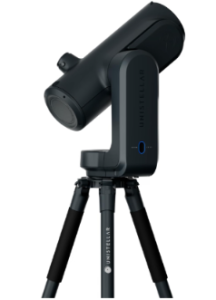
The UNISTELLAR Odyssey PRO Smart Telescope earns a place among the best motorized telescope picks by turning a phone and a clear night into a live window on Saturn. You skip the usual learning curve. Instead, you set it down, connect the app, and start observing.
An 85mm reflector with a 320mm focal length does the optical work. Multi Depth Technology lets nearby planets and distant galaxies share one session. Meanwhile, Stellar Autofocus handles focusing for you. The Nikon electronic eyepiece shows digitally enhanced images, and live image stacking adds detail the longer you watch. As a result, owners report vivid shots of planets, nebulas, and star clusters.
Finding targets takes little effort. Smart Star Finder reads the sky through its own camera and locates catalog objects. Then motorized tracking keeps them centered. You need no polar alignment and no collimation. Also, users describe setup as a matter of minutes.
The UNISTELLAR app runs on Android 10 or newer, and on iOS 18 or newer. It links to the telescope through its own WiFi, so routine sessions work offline. However, downloads and updates still need internet. Deep Dark Technology also helps reduce the effects of light pollution, which helps in suburban yards.
Portability is a clear strength. The telescope weighs 8.8 pounds, and the tripod adds 5.5 pounds. A rechargeable battery lasts up to five hours, though cold weather and heavy use can shorten that. The box also includes a dust cap, eyepiece cap, charging cable, and adjustment tools.
Best Suited For:This telescope suits beginners, families, and travelers who want fast results without star charts. It works well for backyard viewing, campsite sessions, and casual astrophotography. But the small aperture limits clarity on faint, distant objects. So you will see the best results under dark skies.
Specifications
- Optical design: 85mm reflector
- Focal length: 320mm at f/3.8
- Eyepiece: Nikon electronic eyepiece
- Targeting: Smart Star Finder with motorized tracking
- Sensor: Sony IMX415
- Storage: 64GB internal
- Battery: Up to 5 hours, USB-C charging
- Weight: 8.8 pounds telescope, 5.5 pounds tripod
- Warranty: 2 years limited
Pros
- Very easy setup and operation
- Automatic target finding and tracking
- No polar alignment or collimation
- Live image stacking builds detail as you watch
- Views share to a phone or tablet
- Light enough for camping and travel
- Rechargeable battery lasts up to five hours
- Stellar Autofocus removes manual focusing
Cons
- High price for the aperture size
5)Celestron NexStar 6SE Schmidt-Cassegrain Telescope
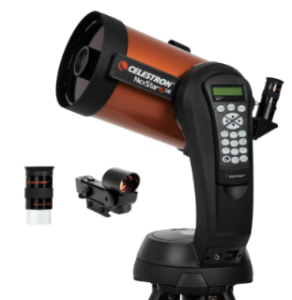
The Celestron NexStar 6SE Schmidt-Cassegrain Telescope is one of the best motorized telescope options for hobbyists who want portability without giving up aperture. A 6 inch Schmidt Cassegrain tube sits on a computerized single fork arm mount. So you get automated targeting without hauling a bulky rig.
The 150mm aperture and StarBright XLT coatings produce bright, sharp images. Owners report fine lunar detail, clear views of Jupiter and its moons, and good clarity on Saturn. With compatible eyepieces, the telescope reaches up to 300x magnification. In addition, the 16 inch tube and 21 pound weight make it easy to carry to a dark site.
The NexStar+ hand control searches a database of more than 40,000 objects. After you choose a target, the mount slews to it and tracks it automatically. Some users returned two hours later and found their target still centered. However, tracking depends on a precise alignment, and feedback on this point is mixed.
SkyAlign aims to make setup quick. You center any three bright objects, and the system aligns itself within minutes. Many owners call setup easy, and they like the no tool assembly. But others struggle with alignment, and a few report finderscope problems. So practice and a carefully aligned StarPointer finder help a great deal.
The kit includes a 25mm eyepiece, a StarPointer finderscope, a star diagonal, and a steel tripod. Compatible Celestron accessories let you add power, wireless control, or location accuracy later. Meanwhile, a two year warranty and US based support back the purchase.
Best Suited For:This telescope suits intermediate stargazers and motivated beginners who want a portable GoTo scope. It works best for lunar and planetary viewing from a backyard or dark site. Because AA batteries last only one to two hours, you should plan on external power.
Specifications
- Optical design: Schmidt Cassegrain
- Aperture: 6 inches (150mm)
- Focal length: 1,500mm at f/10
- Mount: Computerized altitude azimuth single fork arm
- Database: More than 40,000 objects
- Alignment: SkyAlign with three bright objects
- Included: 25mm eyepiece, StarPointer finderscope
- Weight: 21 pounds
- Warranty: 2 years with US based support
Pros
- Bright, sharp views of the Moon and planets
- Automatic slewing and tracking
- Database of more than 40,000 objects
- Easy assembly without tools
- Compact tube and manageable weight
- Accepts Celestron accessory upgrades
- Steel tripod and starter eyepiece included
- Two year warranty with unlimited technical support
Cons
- Alignment can frustrate some owners
6)ZWO Seestar S30 Pro Smart Telescope
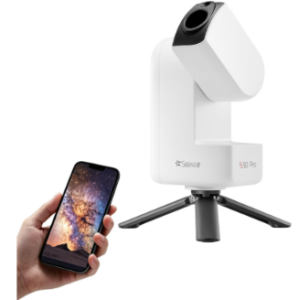
The ZWO Seestar S30 Pro Smart Telescope, App-Controlled Astrophotography is a compact motorized telescope designed to simplify astrophotography for beginners and experienced hobbyists. It combines dual-camera imaging, automatic object recognition, and smartphone control to make capturing the night sky more accessible. Users can select celestial targets through the companion app, while the telescope automatically locates and tracks them. Its lightweight construction also makes it convenient for backyard astronomy, camping, and outdoor photography.
The telescope features a dual-camera system designed for different imaging situations. Its 30mm telephoto lens uses a four-element apochromatic optical design with ED glass to reduce color distortion and produce sharper star images. The accompanying wide-angle camera captures broader views of the night sky, including the Milky Way and surrounding landscapes. Both cameras use Sony 8.3MP sensors and support 4K-quality imaging. This arrangement allows users to capture detailed deep-sky subjects alongside wider astronomical scenes.
Image processing is another important part of the Seestar S30 Pro’s design. Automatic image stacking combines multiple exposures to build detail, while AI enhancement helps reduce image noise and improve overall clarity. Its automatic mosaic stitching feature also joins multiple images to create wider views of celestial objects. Additionally, the built-in light pollution filters help improve imaging conditions in urban and suburban locations. Users can capture nebulae, galaxies, star clusters, star trails, and the Milky Way through dedicated one-tap imaging modes.
For navigation, the motorized Alt-Azimuth mount uses automatic GoTo positioning and tracking to locate selected targets. The companion smartphone app guides alignment, identifies celestial objects, and provides live viewing during observation sessions. Equatorial mode is also available for users interested in longer-exposure imaging. However, the telescope is primarily designed for deep-sky astrophotography rather than detailed planetary observation.
Portability makes this telescope practical for outdoor use. It weighs approximately 3.64 pounds and includes an aluminum tripod, making transportation straightforward. Its rechargeable 6,000mAh battery supports up to six hours of operation, while 128GB of internal storage provides space for captured images. Built-in anti-dew protection also helps maintain performance during extended observing sessions.
Best Suited For:The ZWO Seestar S30 Pro is particularly suitable for beginner astrophotographers, casual astronomers, and travelers who want automated deep-sky imaging without complicated manual adjustments. However, its limited aperture and specialized imaging design make it less appropriate for users seeking traditional planetary viewing or extensive manual control.
Specifications
- Telephoto camera: 30mm apochromatic lens at f/5.3
- Focal length: 160mm
- Wide angle camera: 3.4mm at f/1.75
- Imaging: Dual camera 4K class capture
- Targeting: Automatic GoTo with tracking
- Control: App over built in WiFi
- Battery: Up to 6 hours, USB-C charging
- Storage: 128GB internal
- Weight: 3.64 pounds
Pros
- Very easy setup and operation
- Automatic target finding and tracking
- One tap imaging for deep sky targets
- AI noise reduction and mosaic stitching
- Dual cameras cover close detail and wide scenes
- Light pollution filters help in urban skies
- Light and portable with a tripod included
- Battery lasts up to six hours
Cons
- Not suited to planetary viewing
7)Celestron NexStar 130SLT Newtonian Computerized GoTo Reflector Telescope
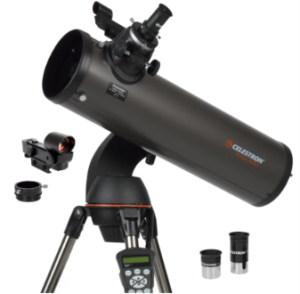
The Celestron NexStar 130SLT puts the largest aperture in its SLT family on a GoTo mount, making it one of the best motorized telescope picks for adults and kids who want to observe together. A 130mm Newtonian reflector gathers plenty of light. So you can view the Moon, planets, and brighter deep sky objects from a backyard or campsite.
The f/5 optics suit wide, bright views. Owners report clear views of Saturn’s rings, Jupiter’s bands, and fine lunar detail. In addition, users describe good results on Messier objects. The tube measures about 25 inches long, and the whole telescope weighs roughly 14 pounds. So it travels easily to dark sites.
The NexStar+ hand control uses a database of more than 4,000 objects. After you pick a target, the mount slews to it and tracks it automatically. Some owners returned two hours later and found their target still centered. However, others report drift after about an hour, and they needed to realign.
SkyAlign handles setup. You center any three bright objects, and the system aligns itself, so you need no constellation knowledge. Many owners call assembly quick, and some started observing within 30 minutes. But alignment frustrates others. Also, the red dot finderscope must be set precisely for good results.
The kit includes a 25mm eyepiece, a 9mm eyepiece, a StarPointer finderscope, and a steel tripod. A free Starry Night download helps you plan sessions. Meanwhile, a two year warranty and US based support back the purchase.
Best Suited For:This telescope suits beginners and families who want a capable first GoTo scope. It works well for lunar and planetary viewing, weekend camping, and casual deep sky sessions. However, it asks for some care. The tripod can shake in wind, the focus knob is coarse, and Newtonian mirrors need occasional collimation.
Specifications
- Optical design: Newtonian reflector
- Aperture: 130mm (5.1 inches)
- Focal length: 650mm at f/5
- Mount: Computerized altitude azimuth single fork arm
- Database: More than 4,000 objects
- Alignment: SkyAlign with three bright objects
- Included: 25mm and 9mm eyepieces, StarPointer finderscope
- Weight: About 14 pounds
- Warranty: 2 years with US based support
Pros
- Clear views of the Moon, Saturn, and Jupiter
- Automatic slewing and tracking
- Largest aperture in the SLT family
- Quick assembly without tools
- SkyAlign needs no constellation knowledge
- Compact and portable for camping
- Two eyepieces and Starry Night software included
- Two year warranty with unlimited technical support
Cons
- Alignment can fail or frustrate some owners
8)Dwarf Mini Smart Telescope
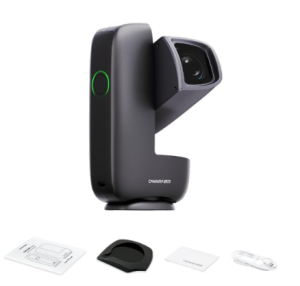
The Dwarf Mini Smart Telescope is an ultra-compact motorized telescope designed to make astrophotography accessible to beginners, families, and outdoor enthusiasts. Weighing just 1.85 pounds, it offers a portable way to explore the night sky without carrying bulky equipment. Its automated targeting, smartphone app control, and image-processing capabilities simplify celestial photography, allowing users to select objects from an interactive star map and capture images with minimal manual adjustments.
The telescope features a 30mm telephoto lens with an f/5 focal ratio, supported by a high-sensitivity Sony IMX662 image sensor. Its apochromatic optical design and anti-reflection coating help reduce color distortion while maintaining image clarity. A secondary wide-angle camera provides broader views for capturing the Milky Way and night landscapes. This dual-camera arrangement makes the Dwarf Mini useful for different types of astronomical photography, particularly when traveling to dark-sky locations.
Automated navigation is another useful feature. The Auto GoTo system identifies selected celestial targets through the DWARFLAB companion app and moves the telescope into position. Its motorized base provides 360-degree rotation, while the adjustable pitch range allows flexible positioning across the sky. Users can also select Equatorial (EQ) Mode for improved tracking during longer exposures. This mode supports single-frame exposures of up to 90 seconds, providing more opportunities to capture details in nebulae, galaxies, and star clusters.
For image enhancement, the Dwarf Mini combines automatic image stacking with integrated cloud processing. These tools help reduce noise and improve captured images without requiring extensive editing knowledge. Built-in light pollution filters also assist with observations from suburban and urban environments, although darker skies remain preferable for faint celestial targets. Automatic and manual focusing options provide additional flexibility when adjusting images.
Portability is a major advantage, as the telescope measures approximately 7.23 inches long and weighs only 1.85 pounds. Its rechargeable battery provides up to four hours of operation, while USB-C charging makes power management convenient. The companion app offers live previews, target selection, and remote control through a smartphone or tablet. However, the device does not support computer-based operation, and a tripod must be purchased separately.
Best Suited For:The DWARFLAB Dwarf Mini is best suited to beginner astrophotographers, families, campers, and travelers interested in capturing deep-sky images with minimal setup. Its small aperture limits detailed planetary observation, while occasional activation and calibration difficulties may require troubleshooting. Nevertheless, its portability, automated imaging, and EQ tracking make it a practical entry-level option for exploring astrophotography.
Specifications
- Telephoto lens: 30mm apochromatic at f/5
- Focal length: 150mm
- Sensor: Sony IMX662
- Longest exposure: 90 seconds in EQ mode
- Mount: Motorized, 360 degree rotation and 225 degree pitch
- Control: App on a phone or tablet
- Battery: About 4 hours, USB-C charging
- Weight: 1.85 pounds
- Warranty: 2 years limited
Pros
- Pocket sized and easy to carry
- Automatic GoTo targeting and tracking
- Simple app with an interactive star map
- 90 second exposures in EQ mode
- Built in light pollution filter
- Cloud processing improves raw images
- Good value for a first imaging setup
- Suits beginners, kids, and families
Cons
- Not suited to planetary viewing
9)Sky-Watcher EQ6-R Fully Computerized Telescope
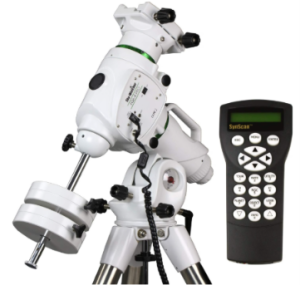
The Sky-Watcher EQ6-R Fully Computerized Telescope is one of the best motorized telescope setups for imagers who care about tracking precision, although it is a mount and not a complete telescope. You add your own optical tube. So the real question is whether you want a sturdy, accurate platform for visual work and astrophotography.
Belt driven stepper motors move the mount quietly and keep periodic error low. Slewing reaches 3.4 degrees per second. Owners report accurate GoTo, and some track targets for about four minutes without guiding. With an autoguider, users report ten minute exposures. In addition, a PEC training feature helps reduce tracking errors.
The all metal build carries 44 pounds. That range handles many large reflectors and catadioptric tubes. However, imagers often limit loads to about half that figure for stability. The package includes two 11 pound counterweights, a steel tripod with 2 inch legs, and a built in carrying handle. Also, the retractable counterweight bar makes transport easier.
The SynScan hand control holds a database of more than 42,000 objects. An ST-4 autoguider port supports guiding, while a USB port connects to a computer for control through compatible software. An illuminated polar finderscope handles polar alignment. Meanwhile, the mount runs on 12V power with at least 4 amps.
Best Suited For:This mount suits experienced observers and serious astrophotographers who want room to grow. It works best at a regular observing site or a dark site you can reach by car. But it is not a quick start tool. Polar alignment frustrates many owners, and the instructions confuse some. So you should plan time to learn the setup.
Specifications
- Mount type: Computerized German equatorial
- Payload: 44 pounds
- Motors: Belt driven stepper motors
- Slew speed: Up to 3.4 degrees per second
- Hand control: SynScan with more than 42,000 objects
- Ports: ST-4 autoguider and USB
- Included: Two 11 pound counterweights, steel tripod
- Power: 12V DC, 4 amps minimum
- Warranty: 2 years limited
Pros
- Accurate tracking and GoTo
- Quiet, smooth slewing
- High payload capacity
- Rock solid build and tripod
- Autoguider port and computer control
- Illuminated polar finderscope
- PEC training reduces periodic error
- Built in handle aids transport
Cons
- Polar alignment frustrates many owners
10)Celestron NexStar 5SE Schmidt-Cassegrain Computerized Telescope
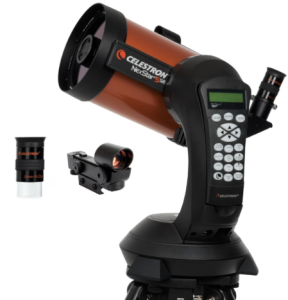
The Celestron NexStar 5SE Schmidt-Cassegrain Computerized Telescope combines a 5-inch optical system with a motorized GoTo mount, making it easier to locate and follow celestial objects. Its familiar orange optical tube houses 127mm Schmidt-Cassegrain optics, providing a useful balance between light-gathering ability and portability. The telescope is designed for observers who want computerized assistance without moving to a much larger setup.
With a 1,250mm focal length and f/10 focal ratio, the NexStar 5SE is particularly suited to lunar and planetary observation. It can reveal craters and surface details on the Moon, Jupiter’s cloud bands, and Saturn’s rings under suitable viewing conditions. Its optics also support observations of brighter deep-sky targets, including globular clusters and galaxies, although faint objects benefit from darker skies. StarBright XLT optical coatings are included to improve light transmission.
The computerized mount uses the NexStar+ hand controller, which provides access to a database containing more than 40,000 celestial objects. After alignment, the telescope can automatically slew toward selected targets and track them as they move across the sky. SkyAlign simplifies the initial process by allowing users to center three bright stars or planets without knowing their names. However, customer experiences with alignment and tracking are mixed, so beginners may need patience and practice to achieve consistent results.
Another useful addition is the built-in wedge, which allows polar alignment for basic astrophotography. A camera control cable is also included for timed DSLR exposures. Nevertheless, the alt-azimuth mount and wedge arrangement have limitations for extended deep-sky imaging, making this telescope better suited to visual observing and shorter imaging sessions than demanding long-exposure work.
The package includes a steel tripod, red-dot finderscope, NexStar+ controller, and two listed Kellner eyepieces. Its compact optical tube and approximately 28-pound total setup weight make it manageable for transporting to suitable observing locations. However, the motorized system runs on eight AA batteries, with an estimated two to four hours of operation. An external power supply is worth considering for longer sessions, although it is not included.
Best Suited For:The NexStar 5SE is a good option for beginners and intermediate observers interested in automated viewing, lunar details, planetary observation, and introductory astrophotography. Its 2-year warranty and unlimited US-based technical support add reassurance. However, reported alignment difficulties, inconsistent reliability, and additional power costs should be considered before purchasing.
Specifications
- Optical design: Schmidt Cassegrain
- Aperture: 5 inches (127mm)
- Focal length: 1,250mm at f/10
- Mount: Computerized altitude azimuth fork arm with built in wedge
- Database: More than 40,000 objects
- Alignment: SkyAlign with three bright objects
- Included: Two eyepieces, StarPointer finderscope
- Weight: About 28 pounds with tripod
- Warranty: 2 years with US based support
Pros
- Clear views of the Moon and planets
- Automatic slewing and tracking
- Built in wedge for polar alignment
- Quick assembly and easy SkyAlign setup
- DSLR camera control cable included
- Compact tube suits travel
- Planetarium software included
- Two year warranty with unlimited technical support
Cons
- Alignment problems appear in some reviews
You may also like to read:4 Best Point and Shoot Cameras under $300
Advantages of Using Motorized Telescope
Automatic target finding
A computerized mount finds objects for you. You choose a target from a database or an app, and the telescope slews to it. So you skip star charts and slow manual searching. This saves time on every session. It also helps new observers see more objects in a single night.
Continuous tracking
The sky moves as Earth turns, so objects drift out of view. Motorized mounts correct for this and keep your target centered. As a result, you can watch a planet or cluster without touching the scope. This also lets you share the view with family and friends. Nobody needs to rush before the object slips away.
Quick setup and alignment
Many models align in minutes. Some ask you to center a few bright objects, and others use a camera to recognize the sky. Because of that, you can start observing soon after you step outside. Quick setup also means you will use the telescope more often. A scope that takes five minutes to prepare usually gets more nights under the stars.
Friendly for beginners
You do not need to know the constellations to get good results. The mount and software handle the hard parts. So beginners can focus on the view instead of the navigation. Families and kids also enjoy the simple controls. This lowers the barrier to a hobby that once felt intimidating.
Portable designs
Motorized telescopes come in compact tubes and light frames. Some even fit in a backpack. So you can carry one to a campsite, a dark sky site, or the backyard. Smaller scopes also store easily in a closet or car trunk. Portability matters because darker skies often sit far from home.
Large databases and planning tools
Hand controls hold thousands of stars, galaxies, nebulae, and clusters. Companion apps and software add star maps and session planning. In addition, tour modes suggest objects worth viewing. These tools help you learn the sky as you observe. Over time, you build knowledge without needing a separate guidebook.
Imaging and upgrade options
Many motorized telescopes support photography. Some include dual cameras and live image stacking, while others accept a camera on a stable mount. Accessories can also add wireless control, GPS, or better power. As your skills grow, the same system can grow with you. That makes the purchase easier to justify over several years.
Factors to Consider When Choosing the Best Motorized Telescope
Aperture and optics
Aperture controls how much light the telescope gathers. A larger opening shows fainter objects and finer planetary detail. However, bigger tubes weigh more and cost more. Optical design also matters. Some designs fold the light path for a compact tube, while others favor wide, bright views. So you should match the optics to what you want to see.
Mount type
Altitude azimuth mounts move up and down and side to side. They set up quickly and suit visual observing. Equatorial mounts follow the sky’s rotation more naturally, so they suit long exposure photography. But they need careful polar alignment. Therefore, you should choose the mount that fits your main goal and your patience for setup.
Alignment and control
Alignment tells the mount where it points. Some systems need three bright objects, while others use cameras and automatic sky recognition. You also choose between a hand control and an app. A phone app feels familiar, but it needs a compatible device. A hand control works without one. Consider which method you will actually enjoy using.
Power and battery life
Motors need steady power. Some telescopes run on AA batteries for only a few hours. Others use rechargeable packs that last up to a night. External power packs and AC adapters often cost extra. So you should check what comes in the box. Cold weather can also shorten battery life, which matters for winter sessions.
Weight and portability
A telescope you cannot carry will stay at home. Check the weight of the tube, mount, and tripod, and consider how you will transport them. Compact designs travel well, but they may limit aperture. Heavier setups offer more power and stability. Think about where you plan to observe, and choose a size you can handle alone.
Visual use or imaging
Decide whether you want to look through an eyepiece, take photos, or do both. Some smart telescopes excel at deep sky imaging but struggle with planets. Traditional designs give strong planetary views. Imaging also raises extra needs, such as a stable mount, guiding gear, and processing skills. Knowing your goal early prevents disappointment later.
Stability and build quality
A shaky tripod ruins a good view. Vibration makes focusing harder, especially at high magnification. Look for sturdy legs and a solid mount. Owner feedback helps here, because reviews often mention wobble or loose parts. Weights and vibration pads can help, but they add cost. A stable base also protects your investment over the years.
Budget, warranty, and support
Prices range from affordable starter scopes to premium imaging systems. Remember that accessories add cost. You may need a power source, better eyepieces, or a tripod. Also check the warranty and the quality of customer support. Reliable support helps when alignment or electronics cause trouble. A fair total budget gives you a better experience than a low price alone.
FAQs
Are motorized telescopes good for beginners?
Yes, they suit most beginners well. Automatic targeting and tracking remove the need for star charts. Setup also takes minutes on many models. However, alignment can frustrate some new users, so you should follow the instructions carefully. Starting from a dark, open site also improves your success.
Can motorized telescopes take astrophotography images?
Many can. Smart telescopes capture deep sky objects with one tap, and some mounts support DSLR cameras. However, results depend on the mount type, exposure length, and sky conditions. Some imaging focused models do not show planets well. So you should pick a telescope that matches your photo goals.
How long do batteries last, and what are my power options?
Runtime varies widely. AA battery packs often last one to four hours, while rechargeable batteries can last up to six hours. Cold weather shortens both. For longer sessions, use an AC adapter or an external power pack. You should also check whether the box includes power accessories.
Conclusion
The best motorized telescopes make the night sky easier to enjoy. They find targets automatically, track them smoothly, and cut setup time. As a result, beginners and experienced observers can spend more time observing. Compact designs travel well, while larger mounts and apertures serve serious users. Many options also support imaging and later upgrades. However, alignment, battery life, and stability need attention, so you should match the telescope to your goals and budget. With the right choice, a motorized telescope delivers rewarding views for years.