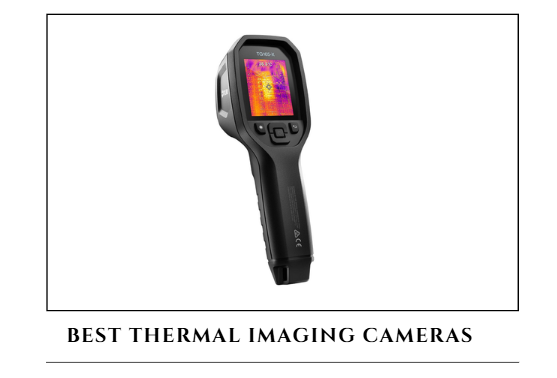
In this guide, I’ll walk you through the best Thermal Imaging Cameras available today, tools that have genuinely transformed how professionals and homeowners approach inspections. What makes these cameras so impressive is their ability to visualize temperature differences in real time, giving you insights that would otherwise be impossible to see with the naked eye.
Whether you are an HVAC technician, an electrician, an automotive enthusiast or simply a homeowner who wants to stay on top of maintenance, there is a thermal imaging camera here that fits your needs and budget.
I’ll break down the standout features of each top pick, highlight what sets them apart and then guide you through the key buying factors including thermal resolution, temperature range, battery life, and durability so you can make a well-informed decision. I have also included a comprehensive FAQ section to answer the most common questions.
By the end of this guide, you will know exactly which thermal imaging camera deserves a place in your toolkit.
Quick Overview of the Best Thermal Imaging Cameras:
- Fluke TC01A 25Hz iSee Mobile Thermal Camera — Best for Mobile Use
- HF96V Thermal Camera — Best Overall
- MILESEEY TR10 Thermal Imaging Camera — Best for Durability
- FOXWELL RT280 Thermal Imaging Camera — Best for Home Inspections
- TOPDON TC004 Mini Thermal Imaging Camera — Best Budget Option
- Flagfront Thermal Camera — Best for Wide Field of View
- Klein Tools TI250 Rechargeable Thermal Imaging Camera — Best for Electrical Inspections
- Handheld Thermal Camera 512×384 X³IR — Best Premium Option
- TOPDON TC002C Duo Thermal Camera — Best for Portability
- FLIR TG165-X Thermal Imaging Camera — Best for Quick Inspections
Best Thermal Imaging Cameras
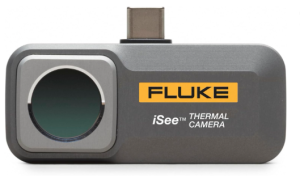
1) Fluke TC01A 25Hz iSee Mobile Thermal Camera
Check Price in Amazon
The Fluke TC01A iSee Mobile Thermal Camera offers professional-level thermal imaging in a compact design that works with Android smartphones. It is ideal for inspections of electrical cabinets, HVAC systems, and underfloor heating. Despite its small size, the camera delivers detailed images that rival high-end thermal devices, allowing precise diagnostics in the field.
The camera produces smooth thermal video at 25 frames per second and has a resolution of 256×192 pixels. Spot, line, and area measurement tools allow accurate temperature readings on different surfaces and equipment. The temperature range goes up to 550°C (1022°F), which makes it suitable for industrial and professional use.
Portability is a key benefit. The Fluke iSee fits in a pocket or toolkit and is ready to use within seconds. Real-time image sharing allows instant communication with team members or remote experts, which is useful when making quick decisions or collaborating on inspections.
Pros
- Detailed thermal imaging comparable to professional cameras
- Wide temperature range up to 550°C (1022°F)
- Real-time image sharing and communication
- Compact and portable design
- Smooth video recording at 25 frames per second
Cons
- Limited to mobile use and cannot function as a standalone device
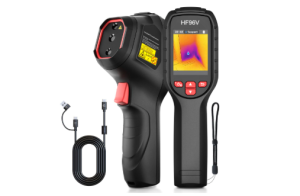
2) HF96V Thermal Camera
Check Price in Amazon
The HF96V Thermal Camera combines advanced imaging with user-friendly controls for both professionals and homeowners. It features dual cameras: a 96×96 infrared sensor and a 640×480 visible camera. Users can switch between Fusion, Thermal, and Visual modes, while seven color palettes allow easy adaptation to different inspection scenarios.
IntellFault technology automatically recognizes problems such as water leaks and insulation gaps. This reduces guesswork and speeds up the inspection process. Firmware updates are available online, keeping the device current with the latest features.
The HF96V also functions as a thermometer and has a built-in laser pointer for accurate targeting. Its 50° field of view covers large areas efficiently, while high and low temperature alarms help monitor critical spots. Live Super Resolution enhances image clarity from 96×96 to 240×240 in real time. Thermal sensitivity is below 50 mK, and measurement accuracy reaches ±3.6°F within a -4°F to 1022°F range.
Durability is another strong point. The battery lasts up to 11 hours, and internal storage supports over 30,000 images and 14 hours of video. IP54 protection and a 6.6-foot drop test ensure reliable performance in harsh conditions. A tripod mount allows stable imaging when needed.
Pros
- Dual infrared and visible cameras with three image modes
- Intelligent scene recognition for water leaks and insulation gaps
- Thermometer, thermal camera, and laser pointer in one device
- Wide field of view with automatic hot, cold, and center spot detection
- Live Super Resolution enhances clarity to 240×240
- High measurement accuracy with fine-tuning for different materials
- Durable design with long battery life and ample storage
Cons
- Device size may feel bulky for pocket use
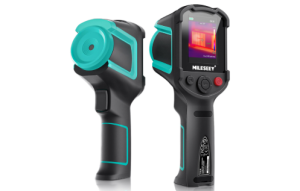
3) MILESEEY TR10 Thermal Imaging Camera
Check Price in Amazon
The MILESEEY TR10 provides high-definition thermal imaging for professionals and hobbyists. Its 192×192 infrared sensor produces clear images, while a 25Hz refresh rate ensures smooth real-time visuals. This makes inspections of equipment, structures, and surfaces faster and more precise.
Temperature measurement is accurate and dependable. The camera has a thermal sensitivity of NETD <50 mK and measures from -4°F to 1022°F with ±2°C accuracy. Maximum, minimum, and center-point temperatures are automatically displayed, helping users identify hot spots and anomalies efficiently. High and low temperature alarms provide instant alerts for abnormal readings. Adjustable emissivity allows precise measurement on different materials.
The TR10 is built for durability and long operation. A recessed lens and a 6.6-foot drop test protect the device, while the 3000mAh battery supports up to eight hours of continuous use. Internal storage of 8GB holds over 30,000 images. It is widely used in automotive inspections, HVAC system checks, and electrical diagnostics.
Pros
- High-definition 192×192 thermal imaging with 25Hz refresh rate
- Accurate temperature measurement from -4°F to 1022°F
- High and low temperature alarms for quick anomaly detection
- Adjustable emissivity for diverse surfaces and materials
- Durable design with recessed lens and 6.6-foot drop protection
- Long battery life and 8GB internal storage
- Reliable for automotive, HVAC, and electrical inspections
Cons
- Advanced settings may require learning for first-time users
4) FOXWELL RT280 Thermal Imaging Camera
Check Price in Amazon
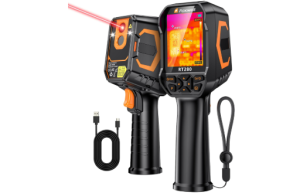
The FOXWELL RT280 delivers precise thermal imaging for inspections in homes, vehicles, and machinery. Its 2.8-inch 320×240 LCD screen shows smooth, detailed visuals. TISR technology increases effective thermal resolution from 120×90 to 240×180, making small temperature differences visible. The 50°x38° field of view and 25Hz frame rate ensure clear images.
Images can be transferred to a Windows PC for advanced analysis. Software supports point, line, and area temperature measurements, 2D and 3D thermal imaging, and automatic report generation. The 8GB storage can hold over 20,000 images and videos, keeping inspection data secure and accessible.
Temperature measurement ranges from -4°F to 1022°F with ±3.6°F accuracy. High and low temperature alarms alert users to anomalies, such as overheating or insulation gaps. Nine color palettes, a built-in laser pointer, and an LED light make it easy to visualize and locate hotspots even in dark or confined spaces.
The RT280 is rugged and portable. It passes a 6.6-foot drop test and has an IP54 dust and water resistance rating. Its ergonomic design fits comfortably in hand or a toolkit. Professionals can rely on this device for accurate inspections in demanding environments.
Pros
- Clear thermal imaging with enhanced resolution
- 50°x38° field of view with 25Hz smooth frame rate
- 8GB storage holds over 20,000 images and videos
- Accurate temperature measurement with high and low alerts
- Nine color palettes with laser targeting and LED light
- Portable, ergonomic, and durable design with IP54 rating
Cons
- Advanced analysis features are limited to Windows PCs
5) TOPDON TC004 Mini Thermal Imaging Camera
Check Price in Amazon
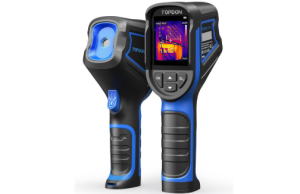
The TOPDON TC004 Mini delivers high-clarity thermal imaging in a pocket-friendly design. Its 128×128 thermal sensor is enhanced to 240×240 resolution using TISR technology. A 40°x30° field of view and 25Hz refresh rate produce smooth, accurate images, making home, electrical, and machinery inspections easier.
The camera provides smart alerts when temperatures exceed preset limits. It automatically captures photos for documentation and supports manual photography. The built-in 512MB storage holds up to 8,000 images. Temperature measurements range from -4°F to 842°F, and five color palettes allow clear visualization of thermal patterns.
Battery life is impressive at 15 hours, with automatic shut-off options to extend use. The ergonomic design is comfortable to hold, and the device can survive drops of up to two meters. IP54 water and dust resistance ensures reliable operation. A downloadable electronic manual and lifetime support from TOPDON make using the device straightforward.
Pros
- High-clarity thermal imaging upgraded from 128×128 to 240×240
- Smart alerts and automatic photo capture for efficient inspections
- Five color palettes for clear thermal patterns
- Long battery life with automatic shut-off options
- Durable, ergonomic, and water-resistant with IP54 rating
Cons
- Charging head is not included in the package
6) Flagfront Thermal Camera
Check Price in Amazon
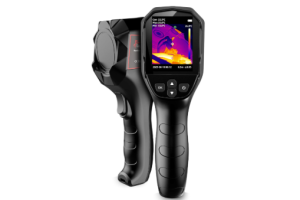
The Flagfront Thermal Camera offers clear and detailed imaging with 240×240 super-resolution technology. A 25Hz refresh rate ensures smooth, real-time visuals. This makes it suitable for home, automotive, and electrical inspections.
A built-in temperature alarm detects high and low temperatures automatically. Maximum, minimum, and center-point readings are displayed, helping users track heat sources in real time. Temperature measurements range from -4°F to 1022°F with ±2% accuracy. Distance and emissivity can be adjusted for precise readings.
The camera is durable and portable. It withstands drops up to 6.6 feet and has IP54 dust and water resistance. Multiple imaging modes and five color palettes provide flexibility for different inspection scenarios. The 50° field of view covers a wide area efficiently, making problem detection faster and easier.
Disclosure: I may earn a commission if you buy through this affiliate link.
Pros
- 240×240 super-resolution imaging with smooth 25Hz refresh rate
- Built-in temperature alarm for high and low alerts
- Adjustable distance and emissivity for precise readings
- Durable and portable with IP54 dust and water resistance
- Wide 50° field of view
- Five color palettes for flexible visualization
Cons
- Some features may require a short learning period for new users
7) Klein Tools TI250 Rechargeable Thermal Imaging Camera
Check Price in Amazon
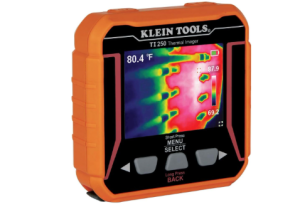
The Klein Tools TI250 provides clear thermal images with over 19,200 pixels. Its large LCD display makes it easy to identify hot and cold spots, while three color palettes highlight specific thermal events. It is ideal for electrical, HVAC, and mechanical inspections.
Temperature measurement is precise. Emissivity can be adjusted from 0.01 to 0.99, and high and low alarms alert users to temperature deviations. The device measures from -4°F to 752°F. Crosshairs allow accurate pinpointing of temperature points for detailed analysis.
Images can be stored and shared via USB-C, making reporting simple. The rechargeable lithium-ion battery ensures continuous use without frequent replacements. The package includes a carrying case, charging cable, and instructions for immediate portability.
Pros
- High-resolution thermal imaging with over 19,200 pixels
- Adjustable emissivity for accurate readings
- USB-C support for storing and sharing images
- User-selectable high and low temperature alarms
- Three color palettes to highlight thermal events
- Rechargeable battery for continuous use
- Includes carrying case and accessories
Cons
- Advanced analysis is limited compared to PC software
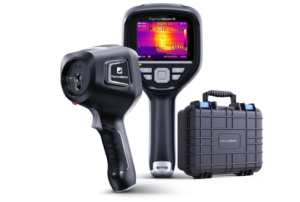
8) Handheld Thermal Camera 512×384 X³IR
Check Price in Amazon
The Handheld Thermal Camera 512×384 X³IR combines high-resolution thermal imaging with a 2MP visible camera. Its 3.5-inch 640×480 IPS display and X³ IR technology enhance thermal resolution from 256×192 to 512×384. A 25Hz refresh rate and 40mK sensitivity deliver fast and detailed inspections for electrical, HVAC, and mechanical applications.
Temperature measurement is accurate from -4°F to 1022°F with ±3.6°F accuracy. Emissivity settings can be customized, and six measurement points provide more informative diagnostics. The camera supports USB and WiFi connections for real-time image transfer and analysis.
Battery life is up to 10.5 hours with 18W fast charging. Laser positioning aids precise aiming, while automatic high and low temperature alarms enhance safety. The rugged device is IP54 rated and can survive drops up to two meters. A 4.3mm lens with 4X digital zoom extends detection range for close-up and wide-area inspections.
Disclosure: I may earn a commission if you buy through this affiliate link.
Pros
- High-resolution thermal imaging with 512×384 and X³IR technology
- Smooth 25Hz refresh rate and 40mK sensitivity
- Customizable emissivity and six-point temperature measurement
- USB and WiFi connectivity for flexible image transfer
- Long battery life with fast charging
- Rugged IP54 design with laser positioning and temperature alarms
Cons
- Device may be heavy for extended handheld use
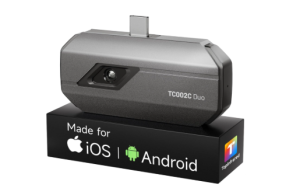
9) TOPDON TC002C Duo Thermal Camera
Check Price in Amazon
The TOPDON TC002C Duo offers clear thermal imaging enhanced from 256×192 to 512×384 using TISR technology. With a 25Hz refresh rate and 40mK sensitivity, the device provides smooth real-time heat tracking for home and professional inspections.
It measures temperatures from -4°F to 1022°F with ±2% accuracy. Users can monitor real-time temperature changes via waveform displays and set custom limits. Photo and video recording make documentation straightforward.
The camera works with most USB-C smartphones and tablets including iOS, Android, and Windows. Compact and lightweight, it measures 2.8×1.7×0.55 inches and weighs just 1.1 ounces. This makes it easy to carry for inspections anywhere. The TopInfrared App provides seamless control.
Pros
- High heat sensitivity of 40mK for smooth thermal tracking
- Customizable temperature limits with waveform visualization
- USB-C compatibility with iOS, Android, and Windows devices
- Compact and lightweight for portable use
- Supports photo and video recording
Cons
- Small screen size may limit visibility without a connected device
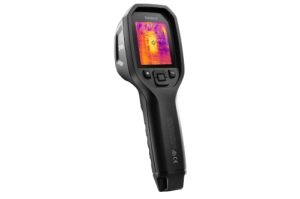
10) FLIR TG165-X Thermal Imaging Camera
Check Price in Amazon
The FLIR TG165-X is a simple and effective thermal camera for quick inspections. Its 4,800-pixel infrared sensor captures temperatures from -13°F to 572°F. MSX technology adds visual details to thermal images in real time, making it easier to interpret temperature differences.
A built-in laser pointer helps identify the measurement area accurately. The rugged IP54-rated device is drop-tested to withstand daily use. Internal storage holds up to 50,000 images, and the rechargeable battery provides long-lasting power.
This camera is useful for electrical, automotive, mechanical, manufacturing, and building inspections. It allows users to detect hot and cold spots efficiently, saving time during troubleshooting. The included carry pouch and simple controls make it ready for field use immediately.
Pros
- Clear thermal imaging with 4,800-pixel IR camera
- MSX technology adds visible details for better clarity
- Laser pointer for accurate targeting
- Rugged IP54 design with drop-tested durability
- Internal storage for up to 50,000 images
- Rechargeable battery and carry pouch included
Cons
- Limited advanced software features for detailed analysis
See more: 6 Best 10×50 Binoculars Under $500
Advantages of using Thermal Imaging Cameras
Enhanced Accuracy in Temperature Measurement
One of the main advantages of using the best Thermal Imaging Cameras is their ability to provide highly accurate temperature readings. These devices can measure a wide range of temperatures with minimal error, allowing professionals to detect hot or cold spots that would otherwise go unnoticed. Adjustable emissivity and multiple measurement points further enhance precision, making these cameras indispensable for HVAC inspections, electrical diagnostics, and mechanical maintenance. Accurate temperature measurement reduces the risk of errors and ensures safer and more efficient operations.
Quick Identification of Problems
Thermal Imaging Cameras help users identify problems faster than traditional inspection methods. By visually highlighting heat differences, these cameras allow immediate detection of issues such as overheating electrical components, water leaks, or insulation gaps. This capability saves time, reduces the need for trial-and-error checks, and allows professionals to respond promptly to potential hazards. Quick identification of problems improves overall workflow efficiency and reduces the risk of costly equipment damage or downtime.
Versatile Applications Across Industries
Another advantage of the best Thermal Imaging Cameras is their versatility. These devices can be used in a wide range of fields including home inspections, automotive diagnostics, electrical system monitoring, HVAC maintenance, and industrial equipment checks. Their portability and compact design allow professionals to carry them easily between different work environments. Versatile applications make thermal imaging cameras a valuable investment for both commercial and personal use, providing practical solutions for diverse inspection needs.
Real-Time Monitoring and Analysis
Thermal imaging cameras provide the advantage of real-time monitoring and analysis. Users can observe temperature variations instantly on the screen, allowing for immediate interpretation of data. Some cameras even support live image transfer to smartphones or computers, enabling remote analysis and documentation. Real-time monitoring ensures that critical issues are addressed immediately, reducing potential damage and improving overall safety during inspections.
Early Detection of Equipment Failures
Using Thermal Imaging Cameras allows for early detection of equipment failures. Thermal cameras reveal abnormal heat patterns that signal potential malfunctions before they escalate into major problems. This is especially useful for preventive maintenance in electrical systems, machinery, and HVAC units. Early detection helps extend the life of equipment, minimizes repair costs, and ensures consistent performance, making these cameras essential tools for proactive maintenance strategies.
Enhanced Safety During Inspections
These devices allow users to detect hot or cold spots from a safe distance without physically touching equipment that could be dangerous. For example, electrical panels or mechanical parts that are too hot to touch can be assessed visually, reducing the risk of burns or accidents. Enhanced safety not only protects professionals but also ensures compliance with workplace safety standards.
Clear Visualization for Better Decision Making
Finally, one of the top advantages of using the best Thermal Imaging Cameras is their ability to provide clear, easy-to-interpret images. Features such as high-resolution sensors, color palettes, and image enhancement technologies help users visualize temperature differences accurately. This clear visualization supports better decision-making in inspections, maintenance, and troubleshooting. Professionals can identify issues confidently, report findings effectively, and make informed recommendations, improving overall operational efficiency and reliability.
Factors to Consider when Choosing the Best Thermal Imaging Cameras
Thermal Resolution
Thermal resolution determines how clearly a camera can detect temperature differences across a surface. Higher resolution cameras capture more detailed images, allowing users to identify small hot or cold spots that could indicate underlying issues. When selecting a thermal imaging camera, consider one that provides sufficient resolution for your intended applications, whether it is electrical inspections, HVAC diagnostics, or automotive maintenance. Better resolution improves accuracy and makes it easier to interpret complex thermal patterns.
Temperature Measurement Range
The range of temperatures a camera can measure is a key factor for its usefulness. Different applications require different ranges, such as low-temperature detection for HVAC systems or high-temperature monitoring for industrial machinery. Choosing a camera with an appropriate range ensures that all critical areas can be assessed accurately. It also reduces the need to switch between devices for different tasks, streamlining inspection processes.
Accuracy and Emissivity Settings
Accurate temperature readings are essential for reliable diagnostics. Cameras that allow adjustment of emissivity can measure temperatures on a variety of materials with precision. This is particularly important when inspecting surfaces with different reflective properties, such as metal, painted surfaces, or glass. High accuracy combined with customizable emissivity settings ensures that measurements reflect real conditions rather than estimates, which is crucial for safety and troubleshooting.
Frame Rate
Frame rate affects how smoothly a thermal camera captures changes in temperature over time. Cameras with higher frame rates display real-time temperature variations more effectively, which is useful for moving targets or dynamic systems. A sufficient frame rate ensures smooth video transitions during inspections, making it easier to track anomalies and interpret thermal patterns without lag. Professionals should select a camera with a frame rate that meets the demands of their specific tasks.
Portability and Ergonomics
Thermal imaging cameras are often used in field inspections, so portability and ergonomics are important. A lightweight and compact design allows users to carry the device comfortably for extended periods, and an ergonomic grip makes operation less tiring. Portability ensures that inspections in tight spaces or hard-to-reach areas are feasible, while a well-designed interface allows for intuitive navigation and faster assessments.
Battery Life and Storage
Battery life is a critical factor when using thermal imaging cameras for extended inspections. Longer-lasting batteries reduce downtime and eliminate the need for frequent recharging, which is especially important during fieldwork. Adequate internal storage or expandable memory allows users to save large numbers of images and videos for analysis or reporting. Cameras that combine long battery life with generous storage options increase efficiency and convenience.
Software and Connectivity Options
Connectivity and software support enhance the usefulness of a thermal camera. Devices that allow image transfer to computers or smartphones enable advanced analysis, reporting, and sharing with colleagues or clients. Software features such as 2D and 3D analysis, automated reports, and customizable measurement tools provide deeper insights and improve decision-making. Selecting a camera with strong software integration ensures that collected data can be effectively utilized.
Durability and Environmental Protection
Thermal imaging cameras are often used in challenging environments, so durability is essential. Devices with drop resistance, dust and water protection, and robust housing can withstand harsh conditions without compromising performance. This factor is especially important for industrial, automotive, and construction applications. A durable camera ensures reliability over time, protects your investment, and allows inspections to be carried out safely under a variety of conditions.