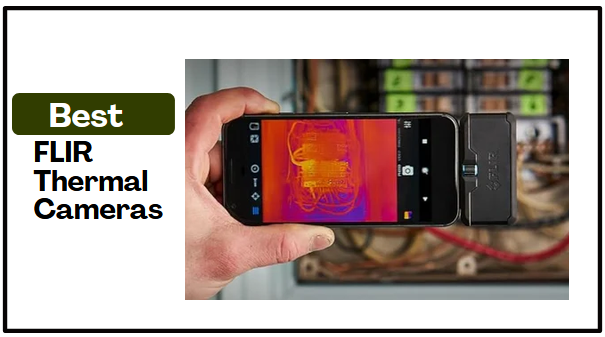
This guide breaks down the best FLIR Thermal Cameras for different inspection needs, from straightforward troubleshooting to more detailed professional work. Each model approaches thermal imaging differently, with variations in thermal resolution, temperature measurement, targeting, portability, connectivity, and documentation affecting how useful it is in practice.
Beyond the specifications, the comparison looks at how effectively each camera helps identify temperature differences, investigate specific areas, interpret thermal findings, and document results. It also considers the limitations of each model, giving you a clearer picture of where its capabilities fit and when another FLIR camera may be a better match.
Whether you need a compact camera for routine checks, greater thermal detail for closer inspection, advanced measurement tools, or a smartphone-based workflow, these differences can significantly affect how useful a camera is in the field. Understanding those differences can help you weigh each camera’s capabilities against your inspection needs and determine which model best fits the work you need it to handle.
Our Top Picks at a Glance:
- FLIR TG165-X Thermal Imaging Camera with Bullseye Laser — Best for Straightforward Thermal Troubleshooting
- FLIR C8 Compact Thermal Imaging Camera — Best for Higher Thermal Detail
- FLIR C3-X Compact Thermal Imaging Camera — Best for Compact Visual Context
- FLIR TG268 Thermal Imaging Camera — Best for Advanced Temperature Targeting
- FLIR C5 Compact Thermal Imaging Camera — Best for Portable Field Inspections
- FLIR ONE Pro – Thermal Imaging Camera for iOS — Best for iPhone-Based Thermal Imaging
- FLIR ONE Pro Thermal Imaging Camera for Android USB-C — Best for Android-Based Thermal Imaging
- FLIR E5 Pro Thermal Imaging Camera — Best for Professional Inspection Workflows
How We Tested the Best FLIR Thermal Cameras
To identify the best FLIR Thermal Cameras, we evaluated how each model’s capabilities translate into practical inspection tasks rather than ranking them by specifications alone. Our assessment focused on thermal detail, measurement, inspection workflow, and field practicality. Each camera’s limitations also formed part of the assessment, helping us establish where its strengths provide meaningful advantages and where they may fall short of an inspector’s needs.
Thermal detail and image interpretation were central to our evaluation. Native thermal resolution, sensitivity, field of view, and image enhancement helped determine how much useful information each camera provides. Visual details, image enhancement, and thermal overlays also mattered when assessing how easily inspectors can interpret heat patterns, particularly around equipment and building systems.
The next stage focused on temperature measurement and targeting. We looked at how effectively each camera helps an inspector investigate a detected anomaly, from identifying a specific area to evaluating changing conditions. Laser targeting, temperature comparison, and measurement tools were judged by their practical value across electrical, HVAC, building, and equipment inspections rather than by feature count alone.
Beyond capturing a thermal image, inspection workflow and documentation can determine how useful that finding becomes. Our comparison therefore considered how easily each camera supports reviewing, recording, and sharing results. Standalone operation was weighed against smartphone-based workflows, with device compatibility, connectivity, and app dependence receiving attention where they could affect the inspection experience.
Lastly, field practicality and suitability for the intended use helped shape our recommendations. Portability, battery design, durability, charging, and day-to-day responsiveness were considered alongside imaging capability. These factors helped distinguish cameras suited to quick checks from those better equipped for extended inspection work, while keeping each recommendation tied to the tasks and workflow it supports.
Best FLIR Thermal Cameras
1. Flir TG165-X Thermal Imaging Camera with Bullseye Laser
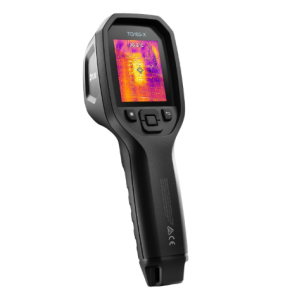
When the goal is to find a heat difference and identify where to investigate further, you do not always need detailed thermal imaging. The Flir TG165-X Thermal Imaging Camera with Bullseye Laser takes a straightforward approach by combining an 80 × 60 thermal sensor with a targeting laser. This makes it easier to direct attention to the area being measured, giving the camera a stronger focus on basic troubleshooting than detailed thermal analysis.
The Bullseye laser is particularly useful when checking a specific component or area. Instead of relying only on the thermal image to judge where a measurement is being taken, the laser indicates the measurement area. The center spot thermometer then provides a temperature reading from the middle of the display. MSX also adds visible-light outlines to the thermal image, giving heat patterns additional visual context.
The TG165-X measures temperatures from -25°C to 300°C (-13°F to 572°F), making it suitable for common HVAC, electrical, building, draft, and insulation checks. Its 51° × 66° field of view provides broad coverage when scanning an area for noticeable temperature differences. However, its 80 × 60 thermal resolution makes it less suited to examining fine thermal details from a distance.
Its physical design also supports practical field use. The camera is drop-tested and rated IP54, while the rechargeable lithium-ion battery makes repeated inspections more convenient. USB-C charging also simplifies recharging between uses. It comes with two years of parts-and-labor coverage and 10 years of detector coverage.
For anyone comparing the best FLIR Thermal Cameras, the TG165-X is best suited to straightforward troubleshooting. Homeowners, DIY builders, and technicians can use it for basic HVAC, electrical, building, and similar checks. Its laser and center spot temperature measurement help identify areas that need closer attention. However, buyers who need more detailed thermal information should consider a higher-resolution model.
Specifications
- Warranty: 2 years parts and labor; 10 years on the detector
- Thermal resolution: 80 × 60 pixels
- Temperature range: -25°C to 300°C (-13°F to 572°F)
- Thermal sensitivity: 0.1°C
- Field of view: 51° × 66°
- Temperature accuracy: ±2°C or ±2%
- Minimum focus distance: 1 ft
- Frame rate: 9 Hz
- Protection: IP54, drop tested
Pros
- Bullseye laser targeting
- MSX image enhancement
- Wide temperature range
- Broad field of view
- Rechargeable lithium ion battery
- USB C charging
- IP54 protection
Cons
- Center spot temperature measurement only
2. Flir C8 Compact Thermal Imaging Camera
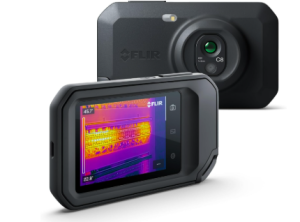
The FLIR C8 Compact Thermal Imaging Camera is built around the need for greater thermal detail during inspections. Its native 320 × 240 resolution captures 76,800 thermal pixels, giving inspectors more information to examine when working across building systems, electrical equipment, HVAC installations, plumbing, and maintenance applications. Rather than simply locating an obvious heat difference, the C8 is better positioned for inspections where the thermal image itself needs to be examined closely.
MSX adds visible-light details to the thermal image, helping place temperature patterns in the context of the surrounding scene. The camera can measure temperatures up to 450°C (842°F) with stated accuracy of ±2%, while isotherm alarms can highlight areas that fall within a selected temperature range. These tools give the inspector more ways to interpret the image when a temperature difference needs further investigation.
The C8 also supports the work that follows image capture. Its Wi-Fi connectivity and FLIR Ignite integration provide cloud-based storage and sharing, while reporting features help turn inspection findings into documented results. A built-in visual camera adds another layer of context to captured images, which is useful when thermal findings need to be associated with the physical component or area being inspected.
Its inspection style does have limits. The 35° horizontal field of view gives the camera a relatively focused view, and the 9 Hz refresh rate is better suited to deliberate inspections than fast-moving scanning. Limited zoom also makes it less appropriate for users who need to examine distant details without moving closer to the target.
The C8 therefore makes the strongest case for building inspectors, electricians, HVAC technicians, plumbers, and maintenance professionals who place a high value on thermal detail and inspection documentation. Its 320 × 240 native resolution is the central reason to consider it, while the measurement tools, MSX, isotherm alarms, and Ignite workflow extend that capability beyond simply viewing a thermal image.
Specifications
- Thermal resolution: 320 × 240 pixels
- Temperature range: Up to 450°C (842°F)
- Temperature accuracy: ±2%
- Field of view: 35° horizontal
- Frame rate: 9 Hz
- Image enhancement: MSX
- Visual camera: Included
- Connectivity: Wi-Fi and FLIR Ignite
- Warranty: 2 years parts and labor; 10 years on the detector
Pros
- 320 × 240 native thermal resolution
- MSX image enhancement
- 450°C maximum temperature range
- Isotherm alarms
- Built-in visual camera
- FLIR Ignite cloud connectivity
- Reporting and sharing capabilities
- Compact design
Cons
- Limited zoom
3. Flir C3-X Compact Thermal Imaging Camera
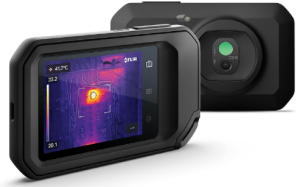
The FLIR C3-X Compact Thermal Imaging Camera takes a different approach to thermal inspection by combining a modest 128 × 96 thermal resolution with a 5MP visual camera. That combination matters when the task involves not only detecting a temperature difference but also understanding where it occurs. MSX adds visible details to the thermal image, while picture-in-picture brings the thermal and visual views together, giving routine building, HVAC, electrical, and maintenance inspections more context without requiring a larger dedicated camera.
Its value becomes clearer in everyday inspection work. The C3-X is compact and lightweight, making it practical to carry from one inspection point to another, while its -20°C to 300°C temperature range covers the routine diagnostic situations described in the source material. The camera is therefore less about extracting maximum thermal detail and more about having thermal information, visual context, and basic inspection tools available in a small package.
Documentation is another part of the C3-X’s appeal. Wi-Fi connectivity and FLIR Ignite allow captured findings to move beyond the camera for storage and sharing. This gives the C3-X a useful place among the best FLIR Thermal Cameras for inspection workflows where recording and communicating findings is part of the job, rather than treating thermal imaging as a standalone measurement.
The trade-off is its level of thermal detail. At 128 × 96, the C3-X is less appropriate when an inspection depends on examining finer temperature differences or working at greater distances. Its 9 Hz frame rate also makes it better suited to deliberate inspection than fast-moving thermal work.
The C3-X works best as an accessible inspection camera for users who value compactness, visual context, and straightforward documentation alongside thermal imaging. Its combination of features gives it more flexibility than its thermal resolution alone suggests, but that resolution remains an important boundary for anyone considering it for more demanding diagnostic work.
Specifications
- Visible-light camera: 5MP
- Image enhancement: MSX
- Picture-in-picture: Included
- Frame rate: 9 Hz
- Temperature range: -20°C to 300°C
- Connectivity: Wi-Fi and FLIR Ignite
- Design: Compact and lightweight
- Thermal resolution: 128 × 96 pixels
Pros
- 5MP visual camera
- MSX image enhancement
- Picture-in-picture
- Compact design
- Wi-Fi connectivity
- FLIR Ignite support
- Useful temperature range
Cons
- 128 × 96 thermal resolution
4. Flir TG268 Thermal Imaging Camera
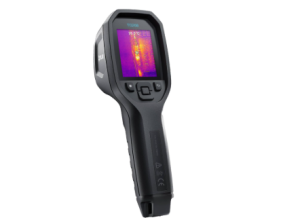
Bullseye laser and 30:1 spot ratio help the FLIR TG268 Thermal Imaging Camera target specific areas from a greater distance, while temperature trending and alarms provide additional ways to evaluate what the camera detects. This makes the TG268 particularly useful when locating a temperature difference is only the beginning of an inspection. Rather than focusing mainly on quick visual checks, it gives technicians more tools for targeting, measuring, and monitoring specific thermal conditions.
Its 160 × 120 native thermal resolution provides the foundation for those inspections, while VividIR enhances the displayed image to 320 × 240. The camera measures temperatures up to 400°C, giving it room for electrical, mechanical, HVAC, and other equipment checks where a wider measurement range is useful. The combination is particularly relevant when an inspector needs to identify a specific component, monitor a changing temperature, or determine whether a reading has crossed a defined threshold.
The TG268 also accommodates situations where thermal imaging alone is not enough. A Type-K thermocouple provides an additional temperature-measurement method, while METERLiNK supports communication with compatible measurement tools. These additions make the camera more useful when an inspection involves verifying readings or gathering several types of measurement rather than relying solely on the thermal image.
Field use is another important part of its design. The TG268 has an IP54 rating and is drop-tested, giving it protection for the practical demands of routine inspection work. Its measurement tools and rugged construction make it a natural fit for technicians who move between equipment and need to investigate specific thermal conditions rather than simply scan a broad area.
The TG268’s native 160 × 120 resolution remains an important consideration. VividIR improves the displayed image, but it does not change the camera’s underlying native thermal resolution. Occasional MSX alignment issues and rare firmware glitches may also affect the inspection experience, so buyers who need highly detailed thermal imaging or a more streamlined workflow may need to look beyond its measurement-focused strengths.
Specifications
- Thermal resolution: 160 × 120 pixels
- Enhanced image resolution: 320 × 240 with VividIR
- Temperature range: Up to 400°C
- Spot ratio: 30:1
- Targeting: Bullseye laser
- Temperature measurement: Trending and alarms
- Additional measurement: Type-K thermocouple
- Protection: IP54, drop-tested
- Connectivity: METERLiNK
Pros
- Bullseye laser targeting
- 30:1 spot ratio
- Temperature trending and alarms
- Type-K thermocouple support
- VividIR image enhancement
- IP54 protection
- METERLiNK connectivity
Cons
- 160 × 120 native thermal resolution
5. Flir C5 Compact Thermal Imaging Camera
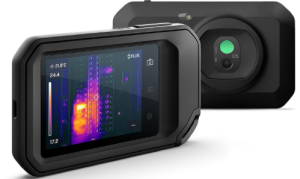
A camera that moves from one inspection point to another needs to be easy to carry, but portability becomes more useful when the camera can also cope with less forgiving working conditions. The FLIR C5 Compact Thermal Imaging Camera combines a pocket-sized design with an IP67 enclosure, giving it a more durable environmental profile than a camera chosen simply for convenience. Its 160 × 120 thermal resolution also provides substantially more thermal information than an entry-level sensor while keeping the camera small enough for regular field use.
The C5 also brings together several tools that make a thermal finding easier to investigate. MSX adds visible details to the thermal image, while the 5MP visual camera provides a conventional view of the inspection area. Its temperature range reaches 400°C, and an integrated LED flashlight can help when the inspection point is poorly lit. Together, these features make the camera suited to checking building systems, electrical equipment, HVAC installations, and other areas where the inspector needs both thermal and visual context.
Portability becomes particularly useful when documentation is part of the job. Wi-Fi connectivity and FLIR Ignite allow images to be transferred, stored, and shared after capture, so the C5 can support an inspection from finding a temperature difference through to recording the result. That connected workflow gives the camera a stronger practical identity than its small physical size alone suggests.
The C5 does have a less convenient side. Startup can take around 45 to 55 seconds or longer, while occasional freezing and software issues may affect responsiveness during an inspection. These limitations are particularly relevant when the camera is expected to be used continuously rather than carried as a compact tool for intermittent checks.
It is therefore most compelling when portability and environmental protection need to coexist with meaningful thermal capability. Its 160 × 120 resolution, 400°C measurement range, IP67 protection, visual camera, and connected documentation make it more than a basic pocket thermal camera. However, buyers who need consistently responsive operation for intensive daily inspections should weigh its reported startup and software issues carefully.
Specifications
- Design: Compact, 6.7 oz
- Image enhancement: MSX
- Connectivity: Wi-Fi and FLIR Ignite
- Thermal resolution: 160 × 120 pixels
- Temperature range: Up to 400°C
- Visual camera: 5MP
- Protection: IP67
- Additional lighting: Integrated LED flashlight
Pros
- 160 × 120 thermal resolution
- IP67 protection
- MSX image enhancement
- 5MP visual camera
- 400°C temperature range
- FLIR Ignite support
- Integrated LED flashlight
Cons
- Slow startup
- Occasional freezing and software issues
6. Flir One Pro – Thermal Imaging Camera for iOS
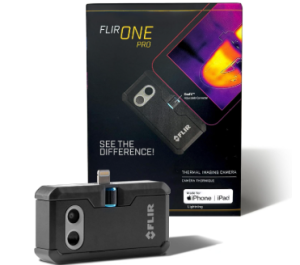
The FLIR ONE Pro – Thermal Imaging Camera for iOS takes the thermal camera out of the traditional handheld format and attaches it directly to a compatible iPhone. At just 1.27 oz, it adds little bulk to the device while providing a 160 × 120 native thermal image. VividIR can enhance the displayed image to 480 × 360, while MSX adds visible details that help put thermal patterns into context.
The phone-based design changes how the camera fits into an inspection. Rather than carrying a separate display and operating system, the ONE Pro uses the FLIR ONE app on the connected iPhone. Inspection guides within the app can also help structure common diagnostic tasks, making the setup useful for checking areas such as electrical components, HVAC systems, buildings, and other close-range applications where a smartphone is already part of the workflow.
Its imaging capability is complemented by a 5°C to 400°C temperature range and a 51° × 62° field of view. These specifications give the ONE Pro enough range for a variety of everyday thermal checks, while the relatively compact attachment makes it practical when portability matters. The trade-off is that the thermal camera remains dependent on the phone and its app, rather than functioning as a standalone inspection device.
Compatibility is the more decisive consideration. The iOS version uses a Lightning connector and, according to the supplied reference material, works with iPhone 14 and older models but not iPhone 15 or newer. That limitation can determine whether the camera is usable at all, so the connector and phone model need to be established before the imaging specifications become relevant. Its close-range design also limits distance performance, while using the camera can place additional demands on the connected phone’s battery.
The ONE Pro therefore has a specific advantage for iPhone owners with a compatible Lightning-equipped device who want capable thermal imaging without carrying a dedicated handheld camera. Its 160 × 120 native resolution, VividIR, MSX, broad temperature range, and app-based inspection tools give a compatible iPhone a useful thermal capability. However, its phone dependence and compatibility cutoff clearly define where this format makes sense.
Specifications
- Thermal resolution: 160 × 120 pixels
- Enhanced image resolution: Up to 480 × 360 with VividIR
- Temperature range: 5°C to 400°C
- Field of view: 51° × 62°
- Image enhancement: MSX
- Connection: Lightning
- App: FLIR ONE app
- Weight: 1.27 oz
Pros
- 160 × 120 native thermal resolution
- VividIR enhancement
- MSX image enhancement
- Lightweight design
- 400°C maximum temperature range
- FLIR ONE inspection guides
- Smartphone-based workflow
Cons
- Limited to compatible Lightning-equipped iPhones
- Dependent on the connected smartphone
7. Flir One Pro Thermal Imaging Camera for Android USB-C
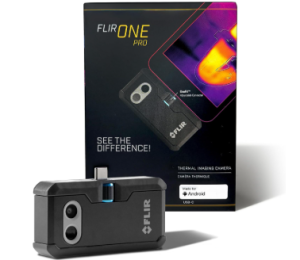
The FLIR ONE Pro Thermal Imaging Camera for Android USB-C turns a compatible Android phone into a portable thermal inspection tool through a direct USB-C connection. Its 160 × 120 native thermal resolution provides the underlying image, while VividIR enhances the displayed image to 480 × 360 and MSX adds visible details to help interpret heat patterns. At 1.38 oz, the attachment also adds little weight to a phone-based inspection setup.
The camera covers temperatures from -20°C to 400°C and has a 70 mK thermal sensitivity, giving it useful capability for close-range checks around electrical equipment, HVAC systems, buildings, and other everyday inspection points. Its approximately 57° horizontal field of view also provides a broad view for a small smartphone attachment. Rather than requiring a separate handheld display, the FLIR ONE app provides the interface for viewing and working with the thermal image.
That phone-based approach is also where the main practical consideration begins. The ONE Pro depends on the connected Android device for its display and app experience, so compatibility and connection stability become part of the thermal-camera experience itself. Connection problems, disconnections, and occasional app crashes can interrupt the workflow, while inconsistent battery performance can add another consideration during longer inspection sessions.
The format has limits beyond connectivity. Smartphone dependence makes the camera less self-contained than a dedicated thermal unit, while its compact design is less appropriate for inspecting targets at greater outdoor distances. These limitations matter most when the camera needs to support frequent inspections where uninterrupted operation and greater working distance are more important than the convenience of carrying a small phone attachment.
For Android users with a compatible USB-C device, the ONE Pro offers a lightweight way to add capable thermal imaging to an existing smartphone workflow. Its 160 × 120 native resolution, VividIR, MSX, wide temperature range, and FLIR ONE app make it useful for close-range inspection, while its smartphone dependence and connectivity limitations are important factors when deciding whether this setup is dependable enough for the intended work.
Specifications
- Enhanced image resolution: Up to 480 × 360 with VividIR
- Temperature range: -20°C to 400°C
- Thermal sensitivity: 70 mK
- Thermal resolution: 160 × 120 pixels
- Field of view: Approximately 57° horizontal
- Frame rate: 9 Hz
- Connection: USB-C
- App: FLIR ONE app
- Weight: 1.38 oz
Pros
- 160 × 120 native thermal resolution
- VividIR enhancement
- MSX image enhancement
- Broad field of view
- Lightweight design
- USB-C connection
- FLIR ONE app
Cons
- Dependent on compatible Android device
- Less suitable for greater-distance outdoor inspection
8. Flir E5 Pro Thermal Imaging Camera
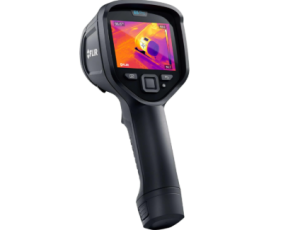
For professional inspection work, the best FLIR Thermal Cameras need to do more than reveal temperature differences. They also need to make those findings easy to interpret, measure, record, and communicate. The FLIR E5 Pro Thermal Imaging Camera addresses that broader workflow with a dedicated touchscreen camera, 160 × 120 thermal resolution, MSX image enhancement, and tools designed around inspection and documentation.
The 3.5-inch touchscreen gives the E5 Pro a larger dedicated display for examining thermal images and working through inspection tasks without relying on a connected smartphone. MSX combines thermal information with visible details, while the camera’s temperature range reaches up to 400°C. These capabilities provide a straightforward way to identify temperature differences and examine them directly on the camera rather than treating thermal imaging as an accessory to another device.
Measurement and documentation extend the E5 Pro beyond simply viewing an image. Delta T allows temperature differences between points to be examined, while notes provide a way to add inspection information to captured findings. FLIR Ignite then supports cloud storage and sharing, helping move images from the inspection into a workflow where findings can be reviewed or incorporated into reports. For professionals who need thermal observations to become part of documented inspection results, these features form an important part of the camera’s value.
The E5 Pro is also designed around continued field use. Its removable battery provides a practical way to manage power during inspections, while the dedicated handheld format keeps the thermal camera independent of a smartphone. The two-year parts-and-labor warranty and 10-year detector coverage also provide longer-term support for professional use.
There are some workflow limitations to consider. The camera can pause for recalibration, while slower software or image processing can affect responsiveness during an inspection. Power-state behavior can also be confusing, and close-range MSX alignment is not always consistent. Its bulkier design and charging accessories further reduce some of the convenience offered by smaller thermal cameras.
The E5 Pro makes the most sense for inspectors and technicians who want a dedicated thermal camera with measurement, touchscreen controls, and documentation tools built into the inspection workflow. Its 160 × 120 thermal resolution is supported by MSX, Delta T measurements, notes, FLIR Ignite, and a removable battery, giving the camera a broader professional role than thermal imaging alone. For buyers who prioritize a self-contained inspection and reporting process, that combination gives the E5 Pro a clear place in this roundup.
Specifications
- Thermal resolution: 160 × 120 pixels
- Temperature range: Up to 400°C
- Image enhancement: MSX
- Display: 3.5-inch touchscreen
- Temperature analysis: Delta T
- Documentation: Notes and FLIR Ignite
- Battery: Removable
- Warranty: 2 years parts and labor; 10 years on the detector
Pros
- 3.5-inch touchscreen
- MSX image enhancement
- Delta-T measurement
- Inspection notes
- FLIR Ignite connectivity
- Removable battery
- 400°C temperature range
Cons
- Bulkier design
- Slower processing and recalibration pauses
Advantages of FLIR Thermal Cameras
Detect Hidden Temperature Differences
Thermal imaging adds another layer to a conventional inspection by revealing temperature patterns that are not visible to the naked eye. This is particularly useful when investigating electrical components, HVAC systems, building structures, or equipment where an abnormal hotspot or cooler area can signal a condition worth examining further.
Pinpoint Areas That Need Closer Investigation
A thermal image can narrow an inspection down to a specific component or section rather than leaving the technician to examine an entire system without a clear starting point. Targeting and measurement capabilities make this especially useful for troubleshooting work where identifying the location of an abnormal temperature is the first step toward understanding the problem.
Inspect Potentially Hot or Energized Areas Without Direct Contact
Working around energized electrical equipment, heated components, or machinery often makes direct temperature checks impractical. Thermal imaging provides an initial view of temperature conditions from a distance, allowing technicians to assess an area before deciding whether closer physical inspection is necessary.
Survey Broad Areas More Efficiently
A suitable field of view allows an inspector to scan a wider area and identify temperature differences before concentrating on individual components. This approach is valuable during building, electrical, HVAC, and equipment inspections because it helps direct attention toward areas that warrant closer examination.
Put Thermal Findings Into Physical Context
A temperature anomaly becomes easier to interpret when the inspector can identify the physical object producing it. Image enhancement and integrated visual cameras provide that context, helping technicians connect a thermal pattern with a particular component, surface, or structural feature and communicate the finding more clearly.
Document Findings for Review and Communication
Thermal images can preserve evidence of an observed condition long after the inspection itself is over. Depending on the camera, findings can be stored, annotated, transferred, or shared, supporting reports, follow-up inspections, and communication with clients or other technicians. For professional workflows, that turns thermal imaging from a detection tool into part of a broader inspection record.
Factors to Consider When Choosing the Best FLIR Thermal Cameras
Match Thermal Resolution to the Inspection Distance
Thermal resolution should match the level of detail you need during an inspection. Lower resolution cameras can work well for identifying obvious temperature differences at close range. Higher native resolutions provide more detail when examining smaller components or closely spaced thermal patterns. When selecting the best FLIR Thermal Cameras, consider the target size and typical inspection distance rather than judging resolution on its own.
Consider the Temperature Range and Measurement Needs
The right temperature range depends on what you inspect. Building and HVAC work may not require the same upper limit as electrical, mechanical, or industrial applications involving hotter components. Measurement tools also matter because some inspections require more than simply viewing a hotspot. If you need to compare temperatures, monitor changes, or investigate a specific point, choose a camera with measurement capabilities that support your workflow.
Look at Targeting and Field of View
A broad field of view can help you survey larger areas quickly. Precise targeting becomes more important when the inspection involves individual components. Laser targeting, spot ratios, and specific area measurements can make it easier to move from detecting an anomaly to investigating its source. Consider both targeting and field of view to ensure the camera matches your inspection scale and working distance.
Prioritize Image Interpretation, Not Just Image Capture
Thermal images do not always explain themselves. MSX, VividIR, integrated visual cameras, and other image enhancement tools can provide useful physical context around a temperature pattern. Consider how easily you need to identify the component or surface producing an anomaly. This becomes especially important when thermal findings will be reviewed later or shared with someone who was not present during the inspection.
Evaluate the Documentation and Connectivity Workflow
If thermal inspections form part of professional reports, documentation should influence your decision from the beginning. Wi Fi, cloud storage, notes, reporting tools, and image sharing capabilities can reduce the work required after an inspection. Smartphone connected models can also offer a convenient workflow. However, their dependence on a compatible phone and app makes connectivity and device compatibility important considerations.
Choose a Form Factor That Fits Your Working Conditions
Portability becomes more valuable when a camera needs to move between multiple inspection points. A dedicated handheld design may be preferable for longer or more demanding sessions. Battery design, charging, startup time, durability, and environmental protection also affect how practical a camera feels in daily use. A compact model is not automatically the better choice if its limitations interfere with the way you work.
Weigh the Camera’s Limitations Against Your Main Use
Every model in this roundup involves trade offs. A camera with stronger thermal resolution may sacrifice some portability, while a smartphone attachment may be easier to carry but more dependent on the host device. Before buying, identify the limitation that would affect your work most. Then make sure the camera’s strengths compensate for it. This prevents a strong specification sheet from overshadowing a poor fit for your actual inspection needs.
Best FLIR Thermal Cameras FAQs
Are FLIR thermal cameras accurate for temperature measurements?
FLIR thermal cameras can provide accurate non-contact temperature measurements when used within their specified range and under suitable conditions. Emissivity, distance, reflective surfaces, and target size can all affect a reading. For precise work, use the camera according to its measurement guidelines and consider whether your application also requires contact measurement.
What is the difference between thermal resolution and displayed image resolution?
Thermal resolution refers to the number of pixels captured by the camera’s thermal sensor. Displayed or enhanced resolution refers to how that thermal information is processed and presented. Technologies such as MSX and VividIR can improve image clarity and provide more context, but they do not increase the number of native thermal pixels captured by the sensor. Native thermal resolution therefore remains important when comparing cameras for detailed inspections.
Are FLIR thermal cameras suitable for professional inspections?
Yes. FLIR offers models suited to routine troubleshooting and more demanding inspection and documentation workflows. The right choice depends on the thermal detail, measurement capability, durability, portability, and reporting support required for the work. Professional buyers should prioritize capabilities that directly match their inspection tasks rather than simply choosing the model with the most features.
Can a FLIR thermal camera detect problems behind walls?
A FLIR thermal camera can help identify temperature patterns on a wall that may indicate an issue behind the surface, but it does not directly see through the wall. Changes in surface temperature can sometimes reveal areas associated with moisture, insulation problems, electrical faults, or other conditions. However, environmental factors and the properties of the wall can affect what the camera detects. Any suspected problem should be investigated further using appropriate diagnostic methods.
Conclusion
The best FLIR Thermal Cameras are not defined by one specification or feature. The right choice depends on how much thermal detail your inspections require, how precisely you need to measure and investigate temperature differences, and whether portability, documentation, or a dedicated inspection workflow matters most.
For straightforward troubleshooting, a compact or more focused camera can provide the thermal information needed without adding unnecessary complexity. More demanding inspections benefit from higher native resolution, advanced measurement tools, stronger targeting, or better documentation capabilities. Smartphone based models offer another route for buyers who prioritize portability and already have a compatible device.
The strongest choice is the FLIR camera that matches the conditions, distance, detail, and workflow of your actual inspections. Prioritizing those requirements over the longest feature list makes it easier to invest in a camera that remains useful beyond the first few inspections.
More from us:
- 4 Best FLIR Cameras for Android
- 7 Best Long Range Rangefinders With Ballistic Calculator
- 6 Best Thermal Cameras under 1000