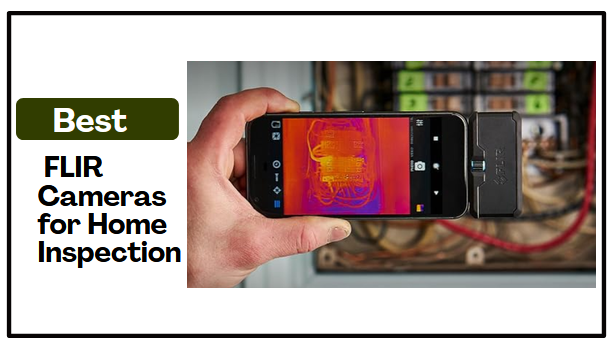
What if you could spot a hidden leak, a failing breaker or a gap in insulation without cutting into a single wall? That’s exactly what the best FLIR Cameras for Home Inspection help you do. By turning invisible heat patterns into clear images, they make it easier to identify potential problems early, explain findings to homeowners and reduce costly guesswork.
In this guide, I’ve gathered six FLIR models for different inspection needs, from smartphone attachments for quick checks to compact handheld cameras and touchscreen models designed for detailed client reports.
I’ll walk you through the features that matter most, including thermal resolution, MSX image enhancement, temperature range, cloud reporting and durability. You’ll also find my top picks at a glance, a practical buying guide to help you choose the right camera, and answers to common buyer questions.
Our Top Picks at a Glance
- FLIR C8 Compact Thermal Imaging Camera – Best overall
- FLIR One Pro Thermal Imaging Camera for iOS Smartphones – Best for smartphone users
- FLIR TG165-X Thermal Imaging Camera with Bullseye Laser – Best for quick spot checks
- FLIR C3-X Compact Thermal Imaging Camera – Best compact option for routine checks
- FLIR E6 Pro Commercial Thermal Imaging Camera – Best for high temperature work
- FLIR E5 Pro Thermal Imaging Camera – Best touchscreen workflow
Best FLIR Cameras for Home Inspection
1. Flir C8 Compact Thermal Imaging Camera

Client reports live or die on detail, and that is where the FLIR C8 Compact Thermal Imaging Camera pulls clear of the pack. Its 320 × 240 sensor records 76,800 temperature points in every image, four times the pixel count of the 160 × 120 models in this lineup. Packed into a 35° × 27° field of view, those pixels resolve small targets cleanly, from a single overheating fuse to the faint cold streak of an air leak or the damp outline of a pipe weeping behind drywall.
FLIR’s patented MSX technology sharpens the picture further. It borrows edges and outlines from the built-in 5 MP visual camera and lays them over the thermal view in real time, so a vague warm patch becomes a specific outlet, breaker or fitting you can name in your report.
The isotherm alarm saves time of its own by instantly highlighting anything above the threshold you set, which makes sweeping a full electrical panel quick work. Add an object range that reaches 842°F, an integrated LED flashlight for attics and crawl spaces, and a 3.5-inch touchscreen, and the C8 is ready for almost any residential job.
Paperwork moves just as fast. Images upload straight to FLIR Ignite cloud storage, where you can organize, edit and back them up from any device. New C8 units also come with a 12-month Ignite Pro subscription that unlocks prebuilt inspection report templates, while FLIR Thermal Studio handles detailed reports you can email to clients. On Wi-Fi, the camera downloads firmware updates and new features automatically.
If your income depends on reports that impress clients, the C8 is the strongest pick among the best FLIR cameras for home inspection in this lineup.
Specifications
- Thermal resolution: 320 × 240 (76,800 pixels)
- Field of view: 35° × 27°
- Temperature range: -4°F to 842°F (-20°C to 450°C)
- Image enhancement: MSX
- Isotherm alarm: Yes
- Display: 3.5-inch touchscreen
- Extras: 5 MP visual camera and LED flashlight
- Connectivity: FLIR Ignite cloud uploads and automatic updates
- Warranty: 2 years on the camera, 10 years on the detector
Pros
- Highest thermal resolution in this round-up
- Isotherm alarm speeds up panel scans
- Report-ready images with sharp MSX outlines
- 12 months of Ignite Pro included with new units
Cons
- Detailed reporting requires separate desktop software
2. Flir One Pro – Thermal Imaging Camera for iOS Smartphones
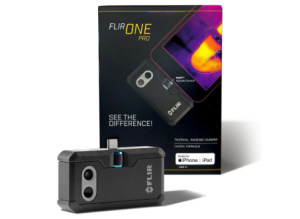
Already carrying an iPhone 15 or newer? Then the FLIR ONE Pro is one of the most affordable ways to bring thermal imaging into your inspections. The iOS USB-C version plugs straight into your phone’s charging port and uses its screen as the display, and the adjustable OneFit connector extends up to 4 mm, so most protective cases can stay on.
The native sensor captures 160 × 120 thermal resolution, and FLIR’s VividIR processing builds on that to deliver images up to 480 × 360. Edges look cleaner, and fine detail on walls, ducts and electrical panels comes through more clearly. MSX then adds the outlines of the scene, so you always know which wire is running warm or which corner is letting cold air in.
Guidance is where this little camera shines for homeowners and newer inspectors. The FLIR ONE app’s Home Inspect feature walks you step by step through tracking down air leaks, moisture buildup and other common faults, while Car Inspect brings the same help to automotive checks. You can also capture photos and video, upload to FLIR Ignite, and open compatible third-party apps for energy audits, restoration work and electrical maintenance.
It reads temperatures up to 752°F with typical accuracy of ±3°C (±5.4°F) or 5%, and FLIR rates it to survive a 1.8 m (about 6 ft) drop. For a pocket-sized tool that grows with your skills, it makes a smart entry point.
Specifications
- Compatibility: iPhone 15 and newer (iOS USB-C version)
- Thermal resolution: 160 × 120 (native), up to 480 × 360 (super resolution)
- Image processing: VividIR and MSX
- Temperature range: -4°F to 752°F (-20°C to 400°C)
- Accuracy: ±3°C (±5.4°F) or 5%, typical
- Drop rating: 1.8 m (about 6 ft)
- Connector: Adjustable OneFit
- Cloud storage: FLIR Ignite
- App guides: Home Inspect and Car Inspect
Pros
- Turns your iPhone into a thermal camera
- VividIR sharpens images up to 480 × 360
- Step-by-step Home Inspect guidance
- Works with most phone cases left on
Cons
- Requires a compatible iPhone and connector version
3. Flir TG165-X Thermal Imaging Camera with Bullseye Laser
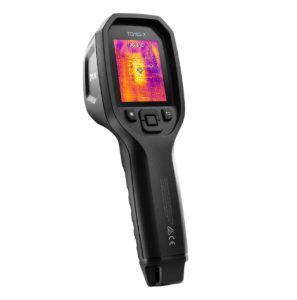
A spot thermometer gives you one number and leaves you guessing about everything around it. The FLIR TG165-X fixes that by showing hot and cold spots across the whole scene, so electrical faults, worn mechanical parts and air or water leaks reveal themselves at a glance. Its 80 × 60 sensor captures 4,800 pixels and measures from -13°F to 572°F.
The bullseye laser is the feature you’ll lean on most. It marks exactly where the camera is measuring, so every reading ties to a specific breaker, motor or fitting. MSX layers in visible detail as well, clear enough to read component labels right on the screen.
This is also the toughest camera in the group. An IP54-rated enclosure shrugs off dust and splashes, it is built to survive a 6.56-foot drop, and its rechargeable lithium-ion battery runs up to five hours of scanning. Internal storage holds up to 50,000 images, while the wide 51° × 66° field of view and close focus of about 1 foot suit cramped electrical panels and HVAC cabinets. Accuracy reaches ±1.5°C (±3°F) between 122°F and 212°F.
Pick the TG165-X for fast, confident point-and-shoot diagnosis on the job. When polished client report images matter more, the higher resolution models in this round-up are the better match.
Specifications
- Thermal resolution: 80 × 60 (4,800 pixels)
- Temperature range: -13°F to 572°F (-25°C to 300°C)
- Accuracy: ±1.5°C to ±3°C, depending on target temperature
- Field of view: 51° × 66°
- Minimum measurement distance: 0.85 feet
- Minimum focus distance: 0.98 feet
- Image enhancement: MSX
- Protection: IP54, drop rating of 6.56 feet
- Storage: Up to 50,000 images
- Battery: Rechargeable lithium-ion, up to 5 hours of scanning
- Warranty: 2 years on the camera, 10 years on the detector
Pros
- Bullseye laser pinpoints every reading
- Component labels readable with MSX
- Rugged IP54 build with a 6.56-foot drop rating
- Up to five hours of scanning per charge
Cons
- Limited 80 × 60 thermal resolution
4. Flir C3-X Compact Thermal Imaging Camera
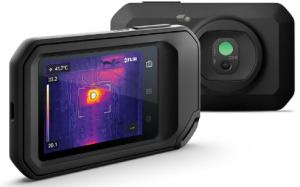
For routine checks of fuses, drafts and plumbing, the FLIR C3-X Compact Thermal Imaging Camera brings cloud reporting and a compact build without the cost of top-tier resolution. Property managers, handymen and inspectors with steady residential workloads will find it a sensible fit.
Its 128 × 96 sensor records 12,288 pixels and reads from -4°F to 572°F. MSX does a lot of the heavy lifting here, tracing visual outlines onto every frame so you can single out the warm breaker in a row of identical ones without second-guessing.
A bright LED flashlight lights up dark cabinets and crawl spaces, and the IP54 rating plus a 6-foot drop test mean everyday knocks are no cause for worry. Once a scan is finished, photos go straight from the camera to FLIR Ignite for quick reports, with FLIR Thermal Studio on hand for professional reports, faster analysis and video enhancement.
For budget-minded pros comparing the best FLIR Cameras for Home Inspection, the C3-X delivers dependable thermal checks that report straight to the cloud.
Specifications
- Thermal resolution: 128 × 96 (12,288 pixels)
- Temperature range: -4°F to 572°F (-20°C to 300°C)
- Image enhancement: MSX
- Lighting: Integrated LED flashlight
- Durability: IP54, drop tested to 6 feet
- Connectivity: FLIR Ignite cloud and automatic updates
- Software: Works with FLIR Thermal Studio
- Warranty: 2 years on the camera, 10 years on the detector
Pros
- Compact body with an LED flashlight
- MSX makes every frame easy to read
- Cloud uploads straight from the camera
- IP54 rating and 6-foot drop test
Cons
- Small sensor limits fine detail at longer distances
Read more: 6 Best Telescopes for Viewing Planets
5. FLIR E6 Pro – Commercial Thermal Imaging Camera
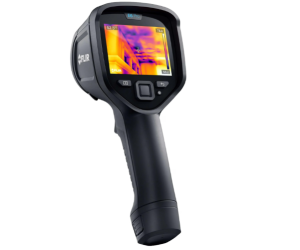
No camera in this lineup reaches higher than the FLIR E6 Pro, which reads from -4°F all the way to 1,022°F. That headroom lets it move from attic insulation checks to kilns, boilers and other high-heat equipment without missing a beat, making it a natural fit for inspectors whose work spills into commercial buildings.
Its 240 × 180 thermal resolution sits second only to the C8 here, and enhanced image processing combined with MSX keeps every frame vivid and easy to interpret. Problems stand out early, ideally before they grow into costly repairs.
The 3.5-inch touchscreen turns the camera into a mobile workstation. You can add detailed notes to each image, sort files on the spot and stream live video during an inspection. Everything uploads wirelessly to FLIR Ignite for sharing and quick reports, and built-in delta T tools calculate temperature differences automatically, which speeds up compliance documentation.
If you’re choosing among the best FLIR Cameras for Home Inspection with commercial contracts on the horizon, the E6 Pro is the one built to grow with your business.
Specifications
- Thermal resolution: 240 × 180
- Temperature range: -4°F to 1,022°F (-20°C to 550°C)
- Display: 3.5-inch touchscreen
- Image enhancement: MSX
- Measurement tools: Integrated delta T
- Connectivity: FLIR Ignite cloud with wireless sharing
- Video: Streaming supported
- Applications: Electrical, building and HVAC
- Warranty: 2 years on the camera, 10 years on the detector
Pros
- Highest temperature ceiling here at 1,022°F
- Large 3.5-inch touchscreen
- On-camera notes keep files organized
- Delta T tools cut calculation time
Cons
- Full reporting depends on cloud or desktop software
6. Flir E5 Pro Thermal Imaging Camera
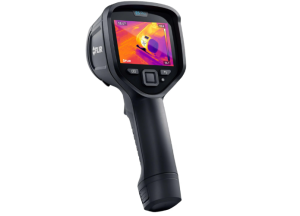
Think of the FLIR E5 Pro Thermal Imaging Camera as the everyday sibling of the E6 Pro. It shares the 3.5-inch touchscreen workflow, wireless Ignite uploads and delta T tools, then pairs them with a 160 × 120 sensor and a 752°F ceiling that still covers boilers and plenty of hot equipment beyond the home.
Those 19,200 pixels, sharpened by MSX, produce clear, well-defined thermal images for building, electrical and HVAC diagnostics. Every capture can carry detailed notes typed right on the screen, and image and notes upload together to FLIR Ignite, ready to edit and share. Over-the-air updates add new features as FLIR releases them, and FLIR Thermal Studio turns your files into polished professional reports whenever a client needs more than a quick summary.
Home inspectors, electricians and HVAC technicians who value organized, well-documented images will find the E5 Pro a dependable daily companion.
Specifications
- Thermal resolution: 160 × 120 (19,200 pixels)
- Temperature range: -4°F to 752°F (-20°C to 400°C)
- Display: 3.5-inch touchscreen
- Image enhancement: MSX
- Measurement tools: Integrated delta T
- Cloud: FLIR Ignite with automatic storage and sharing
- Updates: Over the air
- Applications: Electrical, building and HVAC
- Warranty: 2 years on the camera, 10 years on the detector
Pros
- 19,200-pixel sensor with MSX
- Touchscreen notes on every image
- Automatic cloud uploads and updates
- Handles hot equipment up to 752°F
Cons
- 752°F ceiling rules out hotter industrial equipment
Advantages of FLIR Cameras for Home Inspection
Find Hidden Problems Without Opening Walls
FLIR thermal cameras reveal temperature patterns behind drywall, under floors and above ceilings without cutting holes into building materials. During a home inspection, this helps locate potential plumbing leaks, insulation gaps and electrical hotspots without immediately resorting to invasive investigation.
Homeowners can therefore avoid unnecessary repair work just to identify the source of a problem.
Catch Small Issues Before They Grow
Many costly household problems start quietly. A slow plumbing leak, a loose electrical connection or a gap in insulation can go unnoticed for months. FLIR thermal imaging helps inspectors identify unusual temperature patterns associated with these developing faults. Further investigation can then establish whether repairs are necessary before minor issues lead to more extensive damage.
Show Clients Clear Proof
Telling a homeowner there may be moisture inside a wall is one thing. Showing them a thermal image with a distinct temperature pattern makes the finding easier to understand.
This visual evidence also builds trust, simplifies explanations and gives clients something concrete to share with contractors or insurers. For professional inspectors, it can also make findings easier to document in their final reports.
Save Time on Every Job
Scanning a room with a thermal camera can take minutes, while tracing a fault through trial and error may take hours. Inspectors can cover more ground in less time, and homeowners get answers sooner. This efficiency is particularly useful during property sales, when inspection schedules and closing deadlines are often tight.
Inspect More Safely
FLIR thermal cameras measure surface temperatures from a distance, allowing inspectors to examine potentially hot electrical components without touching them. They can also help identify overheating breakers, connections and wiring that may indicate developing electrical faults. However, thermal imaging does not replace proper electrical testing or safe inspection procedures.
Cut Energy Waste
Drafty windows, poorly sealed doors and missing insulation can allow heated or cooled air to escape. The best FLIR Cameras for Home Inspection help reveal temperature differences associated with these weaknesses, making problem areas easier to locate.
Addressing the underlying issues can improve indoor comfort and reduce unnecessary energy consumption, potentially lowering household utility bills.
Factors to Consider When Choosing the Best FLIR Cameras for Home Inspection
Camera Style
The best FLIR Thermal Cameras for Home Inspection come in different designs, each suited to particular working preferences. Smartphone attachments are lightweight and convenient, especially if you already carry a compatible phone.
Compact handheld models fit easily into a tool bag and operate independently. Larger touchscreen cameras offer more room to review images and manage inspection files on site.
Consider how frequently you inspect, whether you need a standalone device and how much equipment you’re comfortable carrying.
Thermal Resolution
Thermal resolution determines how much detail an image captures. A lower pixel count may be sufficient for spotting obvious temperature differences, such as an overheating breaker or a poorly insulated window.
However, identifying smaller anomalies and producing detailed client reports often requires a higher-resolution sensor. Also, check whether a camera offers enhanced image processing, as this can improve the appearance of images without changing the sensor’s native resolution.
Image Enhancement
Thermal images can sometimes lack the visual detail needed to identify specific components. FLIR’s MSX technology addresses this by overlaying visible edges and outlines onto the thermal image. Other processing technologies, such as VividIR, combine thermal image data to produce enhanced detail.
If you regularly inspect electrical panels, plumbing systems or HVAC equipment, consider how these technologies improve image interpretation and help communicate findings to homeowners.
Temperature Range and Accuracy
Consider the temperatures you expect to encounter during inspections. Most residential tasks involve identifying moderate temperature differences around plumbing, insulation and electrical systems. However, inspecting furnaces, boilers and other high-temperature equipment may require a wider measurement range.
Check the camera’s minimum and maximum temperature limits alongside its stated accuracy. A wider range is not necessarily more useful if readings become less accurate under the conditions you encounter.
Reporting and Cloud Tools
For professional inspectors, documenting findings is often as important as capturing thermal images. Some FLIR cameras support cloud connectivity, allowing you to upload, organize and share images directly from the field.
Others work with dedicated desktop software or mobile apps for creating inspection reports. If you regularly send findings to clients, prioritize a camera with a reporting workflow that suits your documentation needs.
Measurement Tools
Additional measurement tools can make inspections more straightforward and help you interpret temperature readings. A bullseye laser, for example, identifies the area being measured, making it easier to associate readings with specific components. Temperature difference tools can also help compare surfaces when investigating HVAC performance or insulation issues. Choose features that support your most common inspection tasks rather than paying for tools you rarely use.
Durability
Home inspections can take you into attics, crawl spaces, basements and other demanding environments. Look for a camera with adequate protection against dust, moisture and accidental drops. An IP rating indicates its level of protection against solid particles and water, while the manufacturer’s drop rating provides an indication of impact resistance. These details matter if you expect to use the camera regularly in challenging conditions.
Warranty
Warranty coverage can influence the long-term value of your investment. Check how long the manufacturer covers the camera, thermal detector and other components. Some FLIR models offer separate warranty periods for the camera and detector, so don’t assume they receive identical coverage. Also review the applicable warranty conditions, including registration requirements and exclusions, before making your decision.
Next read: 7 Best Catadioptric Telescopes for Astrophotography
Best FLIR Cameras for Home Inspection FAQs
Can a thermal camera see through walls?
No, a thermal camera cannot see through solid surfaces. Instead, it measures surface temperatures and displays differences that may indicate problems behind the wall.
For example, plumbing leaks, missing insulation and overheating electrical components can create unusual temperature patterns. These readings help inspectors identify areas that need further investigation without immediately opening the wall.
Can these cameras detect water leaks and moisture?
Yes, thermal cameras can help identify areas that may contain moisture. Damp materials can produce temperature differences compared with surrounding surfaces, making potential leaks and moisture buildup easier to locate. However, thermal imaging cannot confirm the presence of moisture on its own. Use a moisture meter to verify suspicious areas before recommending repairs.
What thermal resolution do I need for home inspection?
It depends on the level of detail you need. A lower-resolution camera can handle basic checks for noticeable temperature differences around electrical panels, windows and plumbing systems.
However, if you inspect properties professionally, prepare detailed client reports or need to investigate smaller temperature anomalies, a higher-resolution sensor can provide clearer images.
Is a smartphone thermal attachment good enough for home inspections?
Yes, a smartphone thermal attachment can handle many basic home inspection tasks. It is lightweight, easy to carry and may include guided inspection features through its companion app.
Some professionals also use these attachments for specific diagnostic tasks. However, inspectors who regularly produce detailed reports or need a standalone device may prefer a dedicated handheld thermal camera.
Conclusion
A good thermal camera changes how you inspect a home. Rather than relying on guesswork or opening walls, you see the temperature patterns that reveal leaks, drafts, missing insulation and overheating wiring. That’s exactly why the best FLIR Cameras for Home Inspection are worth having.
They combine clear thermal imaging with MSX enhancement, practical reporting tools and durable builds, all backed by long detector coverage. Whether you need a light smartphone attachment for occasional checks, a compact camera for routine work or a touchscreen model for detailed client reports, there’s an option in this guide to match.
In the end, choosing one that fits your workload means faster inspections, stronger evidence and more confident decisions for every home you assess.