Finding the best golf rangefinders with triangulation can make a noticeable difference when I am dealing with blind shots, doglegs, cart path restrictions, or targets that are difficult to approach.
Unlike a conventional rangefinder that mainly measures the distance from me to the flag, triangulation technology can help calculate the distance between two separate points, giving me more useful information for course management and club selection.
In this guide, I’ll look at the best golf rangefinders with triangulation, focusing on must have features such as accurate point to point measurements, slope compensation, fast flag locking, clear optics, useful magnification, long battery life, and convenient magnetic mounting.
I’ll also compare the top picks, explain what makes each option useful, provide a practical buying guide, and answer common FAQs to help me choose the right rangefinder for my game.
See summary of the best golf rangefinders with triangulation
- GOLFBUDDY 2S PRO Golf Range Finder with Slope: Best Overall
- ACEGMET PFS5 Golf Range Finder: Best for Coach Mode
- Jiehome Golf Rangefinder with Slope Magnetic Triangulation, 1200 Yards: Best Long Range
- THARNOX Golf Range Finder with Slope & Triangulation: Best Compact Option
- Bushnell Golf Tour V7 Shift Laser Rangefinder: Best for Slope and Target Locking
- Garmin Approach Z82, Golf GPS Laser Range Finder: Best GPS and Laser Combination
- Callaway 300 Pro Golf Laser Rangefinder: Best Lightweight option
7 Best Golf Rangefinders With Triangulation
1) GOLFBUDDY 2S PRO Golf Range Finder with Slope
Check Price in Amazon
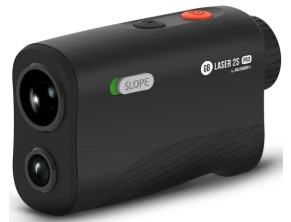
The GOLFBUDDY 2S PRO is a versatile golf rangefinder with triangulation that offers a practical solution for golfers who do not always want to approach the ball to measure the pin. Its Buddy Mode allows distance measurements between two points from different locations, making it especially useful on cart path only courses and during rounds where reaching the ball is inconvenient.
At the heart of the 2S PRO is its Buddy Mode, which uses triangulation technology to determine the distance between two locations. This gives golfers more freedom to measure from the fairway, cart, or another convenient position without having to stand directly beside the ball.
The integrated slope function calculates elevation changes and provides an adjusted distance to the target. This can make club selection easier on uphill and downhill shots. A dedicated switch also lets golfers turn slope measurements off when playing under tournament rules.
Speed is another major advantage. The ZST+ technology delivers measurements in about 0.15 seconds, while the rangefinder provides accuracy of approximately plus or minus 1 yard at distances up to 1,093 yards. Pin Finder Mode helps identify the flag, with vibration confirming when the flagpole has been locked.
The rangefinder also includes a scan function for checking multiple targets over a 10 second period. With 6x magnification and a lightweight design, it remains easy to use throughout a round. The built in magnetic mount can attach to a golf cart, while the included belt clip provides another convenient carrying option.
Specifications
- Magnification: 6x
- Maximum Range: 1,093 yards
- Accuracy: Plus or minus 1 yard
- Weight: 5.9 ounces
- Water Resistance: IPX4
Pros
- Triangulation technology makes measuring from different locations easier
- Buddy Mode is especially useful on cart path only courses
- Fast distance measurements
- Slope compensation assists with club selection
- Slope can be disabled for tournament play
- Pin locking vibration provides useful feedback
- Lightweight and easy to carry
- Magnetic mounting options add convenience
Cons
- Buddy Mode may take some practice to use confidently
2) ACEGMET PFS5 Golf Range Finder
Check Price in Amazon
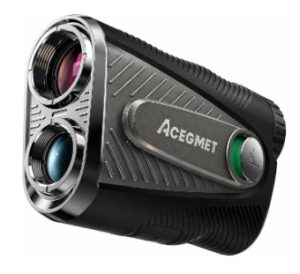
The ACEGMET PFS5 is a versatile golf rangefinder with triangulation designed for golfers who want accurate distance information without always needing to walk up to the ball. Its Coach Mode uses on course triangulation to calculate the distance between the ball and pin from another location, making it particularly useful when the pin is difficult to see or when course rules restrict cart access.
At the heart of the PFS5 is its Coach Mode, which can measure ball to pin distances without requiring the golfer to approach the ball. The triangulation system can also help determine distances when the flag is not directly visible, providing useful information for choosing the right club. It offers a maximum ranging distance of 1,300 yards with stated accuracy of approximately plus or minus 1 yard.
The EnviroSlope system adds greater precision by factoring environmental conditions such as temperature, humidity, and air pressure into distance calculations. Its fast flag locking system can identify targets within 450 yards in around 0.1 seconds, with vibration and a red visual alert confirming when the flag has been acquired.
Power management is another practical advantage. The PFS5 uses a rechargeable USB C battery and also accepts a CR2 battery as a backup. This dual power approach reduces the risk of running out of power during a round, while the rechargeable battery is designed to provide thousands of measurements between charges.
The compact design makes the rangefinder convenient to carry, while its textured grip provides a more secure hold. A built in magnetic strip and magnetic belt clip give golfers flexible ways to keep the device accessible during play. The 7x optical magnification and dual color display also help with target visibility in changing lighting conditions.
Specifications
- Maximum Range: 1,300 yards
- Accuracy: Plus or minus 1 yard
- Magnification: 7x
- Weight: 0.23 kg
- Battery: USB C rechargeable with CR2 backup
Pros
- Triangulation technology allows measurement without approaching the ball
- Coach Mode is useful on cart path only courses
- Environmental slope calculations provide more useful distance information
- Fast flag locking with vibration and visual confirmation
- Dual power system provides added reliability
- 7x magnification helps locate distant targets
- Magnetic mounting makes carrying convenient
- Compact ergonomic design
- 24 month warranty and lifetime technical support
Cons
- Coach Mode may require some practice to use effectively
3) Jiehome Golf Rangefinder with Slope Magnetic Triangulation, 1200 Yards
Check Price in Amazon
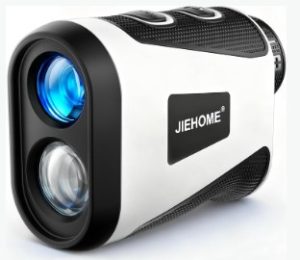
The Jiehome Golf Rangefinder with Slope Magnetic Triangulation is a versatile choice for golfers who want more than a basic distance reading. Its Coach Mode uses triangulation to determine the distance between two points, making it useful on blind shots, doglegs, and holes where the flag cannot be seen directly. This gives golfers another way to evaluate challenging layouts and make more informed club selections.
The rangefinder combines a 1,200 yard maximum range with 7x magnification, giving users a closer view of distant targets. Its fully multi coated optics are designed to improve brightness, contrast, and clarity while reducing glare. With claimed accuracy of ±1 yard, it provides the precision needed for everyday golf and practice sessions.
Slope compensation is another useful feature. The rangefinder can calculate elevation adjusted distances to help golfers account for uphill and downhill shots. An external slope switch makes it easy to disable the feature when playing under tournament rules, giving the device flexibility for both practice and competitive rounds.
It also offers a selection of measurement modes, including scanning, flag locking, slope compensation, Coach Mode, vertical and horizontal measurement, and speed measurement. A built in magnet allows it to attach securely to a golf cart, while the rechargeable 750mAh battery is designed to provide up to 20,000 measurements. This combination makes it a practical companion for repeated rounds on the course.
Specifications
- Range: Up to 1,200 yards
- Magnification: 7x
- Accuracy: ±1 yard
- Battery: Rechargeable 750mAh
- Weight: 144 g
Pros
- Triangulation based Coach Mode can measure the distance between two points
- Useful for blind shots, doglegs, and complicated course layouts
- Slope compensation provides elevation adjusted distances
- External slope switch allows the feature to be disabled for tournament play
- 7x magnification provides a closer view of distant targets
- Multiple measurement modes provide greater versatility
- Built in magnetic mounting makes it convenient to keep on a golf cart
- Rechargeable battery eliminates the need for frequent disposable battery replacements
Cons
- Multiple modes may take some time to become familiar with
4) THARNOX Golf Range Finder with Slope & Triangulation
Check Price in Amazon
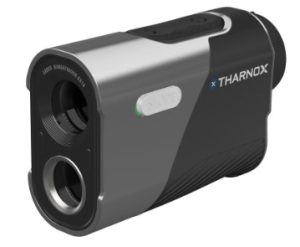
The THARNOX Golf Range Finder with Slope & Triangulation is designed for golfers who want quick distance readings without adding unnecessary bulk to their equipment. Weighing just 5.3 ounces, it is easy to carry in a pocket, while the rubberized exterior provides a comfortable and secure grip. Its compact design makes it particularly convenient for golfers who want their rangefinder readily available throughout a round.
A key feature is its triangulation capability, which allows golfers to calculate the distance between two separate points. This can be especially helpful on cart path only courses, blind shots, and complicated layouts where approaching the ball is inconvenient. Instead of relying solely on a direct reading to the flag, golfers can use triangulation to estimate distances between locations from their position in the cart.
The slope function adds useful information for shots involving elevation changes. When enabled, it provides an adjusted distance while also displaying the measured distance and angle. The feature can be switched off when needed, making the rangefinder suitable for golfers who want slope assistance during practice while retaining a straightforward measurement option for tournament play.
Flag acquisition is also designed to be fast, with a claimed response time of 0.2 seconds and accuracy of up to 1 yard. A vibration confirms when the flag has been locked, helping reduce the chance of accidentally measuring background objects. The 6x magnification and stated 1,300 yard range provide enough reach for both close approach shots and distant targets.
Convenience extends to the mounting and power system. A strong built in magnet allows the device to attach to a golf cart or other compatible surfaces, keeping it within easy reach. USB C charging eliminates the need for disposable batteries, with the battery rated for up to 10,000 measurements. Its IPX54 water resistance also provides some protection during light rain and damp conditions.
Specifications
- Maximum range: Up to 1,300 yards
- Magnification: 6x
- Accuracy: Up to 1 yard
- Weight: 5.3 ounces
- Battery: USB C rechargeable
- Water resistance: IPX54
Pros
- Triangulation mode can measure distances between two remote points
- Slope compensation provides adjusted distances for elevation changes
- Slope can be switched off when required
- Fast flag locking provides a measurement in about 0.2 seconds
- Vibration confirms successful flag acquisition
- Compact 5.3 ounce design is easy to carry
- Built in magnet provides convenient golf cart mounting
- 6x magnification offers a clear view of distant targets
- USB C charging eliminates the need for disposable batteries
- Up to 10,000 measurements per charge
- IPX54 water resistance provides added protection in light rain
Cons
- Triangulation may require some practice to use effectively
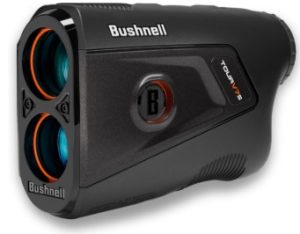
5) Bushnell Golf Tour V7 Shift Laser Rangefinder
Check Price in Amazon
The Bushnell Golf Tour V7 Shift Laser Rangefinder is built for golfers who want fast distance readings with additional information to make club selection easier. Its combination of slope compensation, target locking, and an easy to read OLED display makes it useful for golfers who want more than a basic yardage measurement during a round.
A major advantage is its dual color display, which separates actual distance from slope adjusted yardage. The display uses different colors to make these readings easier to distinguish at a glance, helping golfers quickly understand how elevation affects the shot. This can be particularly useful when playing courses with significant changes in elevation.
The rangefinder also incorporates PinSeeker with Visual JOLT technology to help identify and lock onto the flag quickly. Once the target is acquired, visual and tactile feedback provides confirmation, reducing uncertainty when several objects are close together. The yardage recall feature is another practical addition, allowing users to retrieve their previous measurement without repeating the reading.
Its LINK enabled functionality provides further integration with compatible Bushnell and Foresight launch monitors. When paired with supported equipment, golfers can use their own yardage information to receive personalized club recommendations and improve shot planning. This makes the rangefinder more useful for golfers who combine on course measurements with practice and launch monitor data.
Specifications
- Sport: Golf
- Display: Dual color OLED
- Target technology: PinSeeker with Visual JOLT
- Slope function: Slope adjusted distance
- Weight: 1.2 pounds
Pros
- Slope adjusted distances make elevation changes easier to account for
- Dual color OLED helps distinguish actual and adjusted yardages
- PinSeeker technology provides quick flag acquisition
- Visual feedback confirms the target lock
- Yardage recall makes it easy to review the previous measurement
- LINK connectivity supports personalized club recommendations
- Suitable for golfers who want more detailed shot planning
- Includes a carry case, battery, cleaning cloth, and divot tool
Cons
- Heavier than many compact golf rangefinders
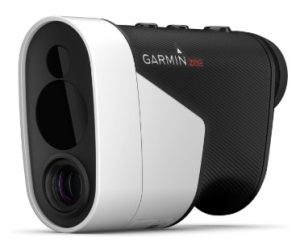
6) Garmin Approach Z82, Golf GPS Laser Range Finder
Check Price in Amazon
The Garmin Approach Z82 Golf GPS Laser Range Finder combines laser distance measurement with detailed GPS course information, making it a useful option for golfers who want more context than a traditional rangefinder provides. Rather than relying only on the distance to the flag, it overlays course information directly into the viewing experience, helping golfers understand what lies between their position and the target.
A key feature is its ability to provide highly precise flag measurements, with accuracy claimed to be within 10 inches at distances of up to 450 yards. Image stabilization makes it easier to locate and measure the flag, while vibration confirms when the target has been successfully acquired. This combination can make target acquisition quicker, particularly when the flag is difficult to see clearly.
The built in CourseView mapping system adds another dimension to the Garmin Approach Z82. It provides full color two dimensional maps for more than 41,000 golf courses worldwide. The Laser Range Arc feature then projects an arc onto the course map based on the measured distance, allowing golfers to see which hazards and other course features fall within that range.
Hazard View provides another practical advantage by allowing golfers to move through the hazards shown on the course map. This can help with planning shots before committing to a club, particularly on unfamiliar courses where bunkers, water, and other obstacles may not be immediately visible from the player’s position.
Specifications
- Course coverage: More than 41,000 courses
- Flag measurement accuracy: Within 10 inches up to 450 yards
- Mapping: Full color 2D CourseView
- Weight: 476 g
- Features: Laser ranging, GPS mapping, hazard information
Pros
- Combines laser ranging with detailed GPS course mapping
- Highly precise flag measurements at shorter golf distances
- Image stabilization helps locate the flag more easily
- Vibration confirms successful target acquisition
- CourseView covers more than 41,000 courses worldwide
- Laser Range Arc shows the effective range across the course map
- Hazard View provides quick access to information about course obstacles
- Provides more strategic information than a conventional laser rangefinder
Cons
- GPS mapping features may be unnecessary for golfers who only want basic yardage
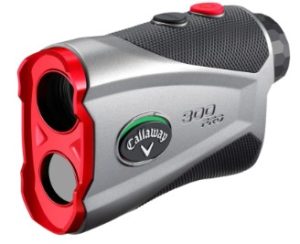
7) Callaway 300 Pro Golf Laser Rangefinder
 Check Price in Amazon
The Callaway 300 Pro Golf Laser Rangefinder is a practical option for golfers who want accurate yardages, slope information, and quick target acquisition in a compact design. It combines 6x magnification with a ranging distance of up to 1,000 yards, giving golfers enough reach for most situations encountered on the course.
A key feature is its slope measurement capability, which considers elevation changes and calculates an adjusted distance for uphill and downhill shots. The external slope switch makes it easy to disable this function when playing under tournament rules, allowing golfers to use the rangefinder during both practice and competitive rounds.
The Pin Acquisition Technology helps locate and lock onto the flag at distances of up to 300 yards. Once the pin is detected, a short vibration confirms the measurement, reducing the chance of accidentally ranging objects behind the flag. With claimed accuracy of ±1 yard, the rangefinder provides useful precision for club selection.
Convenience is also well considered. The integrated magnetic mount allows the rangefinder to attach securely to a golf cart, keeping it accessible throughout the round. It also comes with a molded hard case featuring a carabiner and quick close band, making storage and transportation easier.
Specifications
- Range: 5 to 1,000 yards
- Magnification: 6x
- Accuracy: ±1 yard
- Pin locking range: Up to 300 yards
- Weight: 8 ounces
Pros
- Slope measurement accounts for elevation changes
- External slope switch allows the feature to be disabled for tournament play
- 6x magnification provides a clear view of distant targets
- Pin Acquisition Technology helps lock onto the flag
- Vibration confirms successful pin detection
- Measures distances in both yards and meters
- Built in magnetic mount provides convenient golf cart storage
- Lightweight 8 ounce design is easy to carry
- Protective hard case is included
Cons
- Pin locking distance is more limited than the maximum ranging distance
Factors to Consider When Choosing The Best Golf Rangefinders With Triangulation
Triangulation Capability
The most important consideration is how effectively the rangefinder uses triangulation to calculate the distance between two separate points. This can be particularly useful on cart path only days, blind shots, doglegs, and holes where the flag cannot be approached directly. A good system should make point to point measurements simple and provide accurate results without requiring complicated calculations from the golfer.
Range and Accuracy
Range and measurement accuracy determine how confidently you can rely on the device when selecting a club. For golf, a rangefinder does not necessarily need an extremely high maximum distance, but it should provide consistent readings across normal playing distances. Accuracy of around one yard is desirable because even small measurement differences can influence club selection on longer or more demanding shots.
Slope Compensation
Slope compensation can make a significant difference when playing courses with steep elevation changes. This feature measures the angle between the golfer and target and uses it to calculate an adjusted distance. When choosing a rangefinder, look for a model that allows slope compensation to be switched off, particularly if you intend to use it during tournament play where adjusted yardages may not be permitted.
Target Locking and Flag Detection
Fast and reliable flag detection makes a rangefinder much easier to use during an actual round. Target locking technology helps distinguish the pin from trees, bunkers, and other objects behind it, while vibration or visual confirmation lets you know when the correct target has been acquired. This is especially valuable when the flag is distant or visibility is less than ideal.
Optical Quality and Magnification
Clear optics are essential because accurate ranging begins with being able to identify the target properly. Magnification around 6x or 7x can provide a useful balance between a closer view and a manageable field of vision. Fully multi coated lenses can also improve brightness, contrast, and clarity, particularly when playing in changing lighting conditions.
Battery Life and Charging
Battery performance should not be overlooked because a rangefinder is of little use if it runs out of power during a round. Rechargeable models can eliminate the need for disposable batteries, while replaceable battery systems can be convenient when access to charging is limited. Consider how many measurements the device can provide per charge and whether it offers a practical backup power option.
Portability and Mounting
A golf rangefinder should be easy to carry and readily accessible when you need it. A lightweight body can reduce the burden of carrying it around the course, while a built in magnetic mount can keep it securely attached to a golf cart. Ergonomic grips, compact dimensions, and included cases or clips can further improve convenience during a full round.
Weather Resistance and Durability
Golfers regularly encounter changing weather, so some level of water resistance is valuable. A durable exterior can also protect the rangefinder from accidental drops, bumps, and everyday handling. When choosing a model, consider its water resistance rating, construction materials, protective lens coatings, and overall ability to withstand regular outdoor use.
Best Golf Rangefinders With Triangulation FAQs
What is triangulation in a golf rangefinder?
Triangulation allows a rangefinder to determine the distance between two separate points rather than simply measuring the distance from the golfer to a target. This can be useful when the ball and pin cannot be viewed or approached from the same convenient position. It can help golfers assess blind shots, doglegs, and other complicated layouts.
Are golf rangefinders with triangulation useful on cart path only courses?
Yes. Triangulation can be particularly helpful when the golf cart must remain on the path. Instead of driving closer to the ball to obtain a conventional measurement, a golfer can use the rangefinder from the cart to calculate distances between relevant points. This can save time and make club selection easier.
Do triangulation golf rangefinders also provide slope measurements?
Many models combine triangulation with slope compensation, although the two functions perform different jobs. Triangulation calculates the relationship between separate points, while slope technology accounts for elevation changes between the golfer and target. If you plan to compete, choosing a model with a physical or easily accessible slope switch can be beneficial.
How accurate should a golf rangefinder with triangulation be?
Around ±1 yard is a useful target for most golfers. Consistent accuracy is more important than an exceptionally large maximum range because typical golf shots occur within a much shorter distance. A reliable device should also provide repeatable measurements when measuring the same target from different positions.
Conclusion
Golf rangefinders with triangulation bring a different kind of intelligence to distance measurement by helping golfers solve situations where simply pointing at the flag is not enough.
Their ability to measure between separate points can be valuable on blind holes, doglegs, restricted cart paths, and complicated layouts, while features such as slope compensation, fast flag locking, clear optics, magnetic mounting, and rechargeable power make them more practical during a round.
For golfers who want to think beyond a single yardage and better understand the relationship between different points on the course, triangulation can turn a conventional rangefinder into a useful course management tool.
See Also: