Best Thermal Scopes for Hunting
1) AGM Global Vision RattlerV2 25-256 25mm Thermal Imaging Rifle Scope
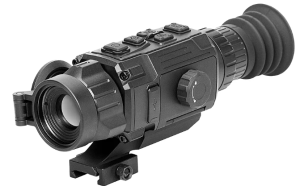
For hunters who want a thermal scope that balances useful imaging, straightforward operation, and long field endurance, the AGM Global Vision RattlerV2 25-256 25mm Thermal Imaging Rifle Scope offers a well rounded setup. Its 256 × 192 thermal sensor works with a 25mm Germanium lens and 3.5x base magnification, giving hunters a practical combination for scanning and examining heat signatures at closer and moderate distances. Rather than concentrating on one advanced specification, the RattlerV2 brings several useful capabilities together in a relatively compact package.
The 50Hz refresh rate helps keep the thermal image smooth as the scope moves across the surroundings, which can make scanning and following movement feel more natural. Its 7.0° × 5.3° field of view provides a useful area for searching, while the 3.5x to 28x digital zoom allows hunters to enlarge a detected heat signature when they need a closer look. The digital zoom is useful for observation, although pushing it toward the higher magnification levels can reduce image detail.
Battery endurance gives the RattlerV2 another practical advantage for hunters who spend several hours in the field. Its upgraded battery compartment accepts rechargeable batteries and provides up to 11.5 hours of operation. Shot Activated Recording can automatically capture footage when a shot is detected, while video and audio recording offer additional ways to document a hunt. Wi Fi connectivity also allows the scope to work with the AGM app for added functionality.
Field operation is another area where the scope keeps things relatively straightforward. Its simplified menu and raised five button layout make the controls easier to locate, including when wearing gloves. Ten reticle options and multiple zeroing profiles allow hunters to configure the optic for different rifles and calibers, while the included custom ADM mount simplifies installation and provides a secure attachment.
At 1.08 pounds, with 45mm of eye relief and an enhanced focus ring with a short throw, the RattlerV2 remains manageable on a hunting rifle. Its 256 × 192 sensor will not provide the same level of fine detail as higher resolution thermal optics, but that is not where this model is trying to compete. Instead, its combination of useful thermal performance, long battery life, accessible controls, recording features, and practical mounting options makes it a strong choice for hunters who want a capable thermal scope without paying primarily for high end specifications they may not need.
Specifications
- Manufacturer: AGM Global Vision
- Color: Black
- Magnification: 3.5x-28x
- Objective Lens Diameter: 25 mm
- Sensor Resolution: 256 × 192 pixels
- Refresh Rate: 50 Hz
- Eye Relief: 45 mm
- Detection Range: 1200 m
- Battery Type: Lithium Ion
- Battery Life: Up to 11.5 hours
- Weight: 1.08 lb
- NETD: 35 mK
Pros
- Smooth 50 Hz refresh rate for scanning moving surroundings
- 11.5 hour rechargeable battery runtime
- Ten reticle choices with multiple zeroing profiles
- Shot Activated Recording adds convenient hunting documentation
- Raised controls are easier to operate while wearing gloves
- Custom ADM mount included for secure attachment
- Wi Fi connectivity supports use with the AGM app
Cons
- Digital zoom can reduce image detail at higher magnifications
2) GOYOJO GRS Series Thermal Riflescope
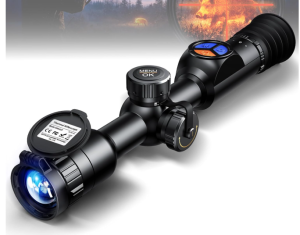
When changing weather, vegetation, and limited visibility make thermal observation more difficult, the GOYOJO GRS Series Thermal Riflescope puts considerable emphasis on image presentation and environmental resilience. Its 256 × 192 VOx thermal sensor has sub 35mK sensitivity and works with a 1440 × 1080 OLED display, giving hunters a detailed view of heat signatures while maintaining useful contrast in challenging surroundings. This combination makes the GRS Series particularly appealing to hunters who place a high value on seeing and interpreting thermal information clearly.
The 25mm objective lens provides a 7.0° × 5.3° field of view, while the thermal system can detect heat signatures at distances of up to 1,224 yards. Auto AI Image Enhancement processes the thermal scene to improve contrast and edge definition, which can make an animal easier to distinguish from vegetation and other background elements. The result is not simply a longer detection range, but a system designed to make the available thermal information easier to interpret.
A 50Hz refresh rate helps maintain smoother imagery when the scope is moved across the landscape or used to follow a moving animal. The 3.5x optical magnification provides a useful starting point for scanning, while up to 8x digital zoom allows the hunter to enlarge a detected heat signature for closer observation. Seven imaging modes and 10 reticle options also provide flexibility when adapting the display and aiming setup to different conditions.
Recording adds another practical layer to the scope. Recoil Activated Video can begin capturing footage when the rifle fires, while 32GB of internal storage provides room for saved recordings. Mobile app connectivity also supports real time viewing, giving hunters another way to monitor or review what the scope captures without relying entirely on the view through the optic.
The GRS Series is also built with demanding outdoor use in mind. Its IP67 rating provides protection against water and dust, while recoil resistance of up to 800g/0.4ms gives it the durability needed for a rifle mounted optic. A battery runtime of approximately 7 to 9 hours supports extended sessions, and the stated operating range of −22°F to 122°F gives the scope a broad range of environmental tolerance.
For hunters comparing thermal optics primarily on how clearly they can interpret a heat signature in difficult conditions, the GRS Series has a compelling combination of image presentation, thermal sensitivity, and rugged construction. Its numerous imaging and customization options can take some time to learn, but hunters willing to explore those controls get a versatile thermal platform designed around detailed viewing rather than simply maximum magnification.
Specifications
- Objective Lens Diameter: 25 mm
- Thermal Sensor Resolution: 256 × 192 pixels
- Display Resolution: 1440 × 1080 OLED
- Pixel Size: 12μm
- NETD: <35mK @ 25°C, F/1.0
- Optical Magnification: 3.5x
- Digital Zoom: 1x to 8x
- Refresh Rate: 50 Hz
- Field of View: 7.0° × 5.3°
- Eye Relief: 65 mm
- Reticle Options: 10
- Imaging Modes: 7
- Storage: 32GB
- Battery Life: 7 to 9 hours
- Water and Dust Resistance: IP67
- Recoil Resistance: Up to 800g/0.4ms
- Operating Temperature: −22°F to 122°F
Pros
- Detailed 1440 × 1080 OLED display
- Sub 35mK sensitivity helps reveal subtle temperature differences
- 50Hz refresh rate supports smoother tracking of moving targets
- Auto AI Image Enhancement improves thermal contrast and edge definition
- Seven imaging modes and 10 reticle options provide setup flexibility
- Recoil Activated Video captures footage automatically after firing
- IP67 protection and strong recoil resistance suit demanding hunting conditions
- 7 to 9 hour battery runtime supports extended sessions
Cons
- Multiple imaging options can take some time to master
3) RIX Storm S2 Thermal Imaging Rifle Scope
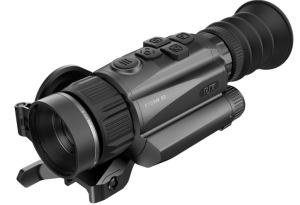
Carrying a thermal scope for hours can make weight just as important as imaging performance, and the RIX Storm S2 Thermal Imaging Rifle Scope takes a notably lightweight approach. At about 0.9 lb, its compact aluminum body adds relatively little to a hunting rifle while still incorporating a 25mm objective lens and 256 × 192 thermal sensor. The 3.5x base magnification and 7.0° horizontal field of view give hunters a practical starting point for scanning, while the scope’s detection range reaches up to 1,422 yards for distant heat signatures.
RIX’s RET technology is designed to make better use of the thermal information produced by the 256 × 192 sensor. It digitally enhances the image before displaying it on the 1024 × 768 OLED screen, which can make distant heat signatures easier to examine. Magnification extends from 3.5x to 14x, giving hunters room to move from broad scanning toward more focused observation without relying on the extremely high digital magnification ranges found on some competing models.
The compact design also carries over to the way the scope is operated. Its button arrangement is intended for use in darkness, and the controls remain accessible when wearing gloves. Five image modes allow the thermal presentation to be adjusted according to the surroundings, while 32 reticle options provide considerable flexibility when setting up the aiming display. This makes the Storm S2 relatively straightforward to configure without turning its compact design into a limitation during field use.
Recording and connectivity are built into the scope as well. Wi Fi allows the Storm S2 to connect with the RIX+ app for capturing video and snapshots, while 32GB of internal storage provides space for saved content. The removable 18650 lithium ion battery delivers approximately six hours of operation, although battery reliability can be a consideration for hunters planning particularly long sessions. Like other digital thermal optics, the scope also depends on battery power to produce an image rather than functioning as a conventional optical sight when switched off.
The lightweight construction comes with a few compromises. The smaller OLED display may not suit hunters who prefer a larger viewing area, and daylight performance is less compelling than its nighttime thermal capabilities. Even so, the Storm S2’s 0.9 lb weight, compact aluminum construction, image enhancement, and IP67 protection make it an appealing option for hunters who spend long periods carrying their rifle and want to keep the thermal setup as manageable as possible.
Specifications
- Thermal Sensor: 256 × 192 resolution
- Objective Lens: 25 mm
- Magnification: 3.5x to 14x
- Field of View: 7.0° horizontal
- Detection Range: Up to 1,422 yards
- Display: 1024 × 768 OLED
- Battery: Removable 18650 lithium ion
- Battery Runtime: Approximately 6 hours
- Weight: 0.9 lb (440 g)
- Construction: Aluminum
- Waterproof Rating: IP67
- Reticle Options: 32
- Image Modes: 5
- Storage: 32GB EMMC
- Image Enhancement: RIX RET technology
Pros
- Lightweight construction keeps the hunting setup manageable
- RET technology improves the appearance of the thermal image
- Detection range supports observation of distant heat signatures
- 32 reticle options provide extensive aiming customization
- Controls are convenient to operate in darkness and with gloves
- Wi Fi connectivity supports video and snapshot recording
- IP67 protection helps withstand outdoor hunting conditions
Cons
- Smaller OLED display may feel restrictive to some users
- Digital operation means the scope requires power to function
4) ATN ThOR 6 Mini Compact 3-24x50mm 640x512px Thermal Rifle Scope
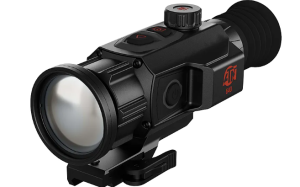
Specifications
- Manufacturer: ATN
- Color: Black
- Magnification: 3x to 24x
- Objective Lens Diameter: 50 mm
- Tube Diameter: 30 mm
- Sensor Resolution: 640 × 512 pixels
- Display Resolution: 1920 × 1080 pixels
- Refresh Rate: 50 Hz
- Reticle: Multiple
- Eye Relief: 50 mm, 15 mm
- Field of View: 8.8° to 7°
- Diopter Adjustment Range: −5 to +5 dpt
- Detection Range: Up to 3,500 m
- Battery Type: Lithium Ion
- Battery Life: Approximately 7 hours
- Operating Temperature: −22°F to 131°F
- Water Resistance: IP67
- Length: 7.87 in
- Width: 2.56 in
- Height: 2.56 in
- Weight: 1.28 lb
- Material: Magnesium Alloy
- NETD: 18 mK
- Mount Type: Picatinny
Pros
- 640 × 512 sensor produces detailed thermal imagery
- 18mK NETD helps reveal subtle temperature differences
- 3x-24x magnification suits different observation distances
- Picture in Picture preserves surrounding awareness while magnifying a target
- SharpIR processing improves thermal contrast and edge definition
- Hot Point Tracking can help locate the warmest object in view
- Recoil Activated Video simplifies recording around a shot
- Magnesium alloy construction keeps the scope relatively lightweight
- IP67 protection supports use in wet and dusty environments
Cons
- At 1.28 lb, it still adds noticeable weight to a rifle setup
5) Pulsar Thermion 2 XQ50 Pro 3-12x50mm Thermal Imaging Rifle Scope
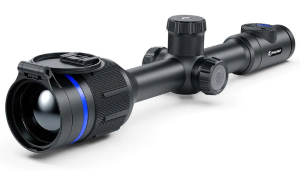
The Pulsar Thermion 2 XQ50 Pro 3-12x50mm Thermal Imaging Rifle Scope brings a more established riflescope style to thermal hunting, combining a 384 × 288 thermal sensor with a 50mm objective lens and 25mK NETD. Its 1024 × 768 AMOLED display presents the thermal scene with good detail, while the 3x to 12x magnification range gives the hunter room to scan at lower power before moving in closer on a detected animal. A 7.5° field of view and 50Hz refresh rate further support observation by providing a useful scanning area and smooth image movement.
One of its most useful capabilities appears when the same optic needs to be moved between rifles. Multiple weapon profiles allow individual configurations to be saved, meaning a hunter can switch between setups without having to recreate each zeroing configuration. Freeze Zeroing makes the process of establishing a new zero more convenient by freezing the image at the initial aiming position before adjustments are made.
The Thermion 2 XQ50 Pro also places considerable emphasis on maintaining a usable image rather than simply increasing magnification. Its 50mm objective lens helps gather thermal information for the sensor, while the 25mK NETD provides sensitivity to relatively small temperature differences. For someone comparing the best Thermal Scopes for Hunting, this combination offers a sensible middle ground between sensor resolution, viewing range, and the practical demands of field observation.
Extended sessions benefit from the scope’s power and physical construction as well. Up to 10 hours of battery life gives hunters substantial operating time before recharging becomes necessary, and USB C charging provides a convenient way to replenish the battery. The magnesium alloy housing keeps the construction durable, while the IPX7 rating provides protection when the scope encounters wet conditions. At 31.7 oz, however, the Thermion 2 XQ50 Pro is heavier than some compact thermal optics, so its feature set comes with a noticeable weight tradeoff.
Pulsar has also built recording and connectivity into the scope rather than treating them as afterthoughts. Integrated photo and video recording with audio allows footage to be captured directly through the optic, while Wi Fi connectivity works with the Stream Vision 2 app. Hunters can use the connected system for additional viewing and storage functions, extending the scope’s usefulness beyond the image seen during the hunt.
Altogether, the Thermion 2 XQ50 Pro is particularly well suited to a setup where consistency matters as much as thermal imaging performance. Multiple weapon profiles and Freeze Zeroing simplify repeated use across rifles, while the long battery life, recording functions, and weather protection make it practical for extended outings. The extra weight is worth considering, but hunters who prioritize a feature rich thermal platform with a repeatable zeroing workflow have a clear reason to consider this Pulsar model.
Specifications
- Manufacturer: Pulsar
- Color: Black
- Magnification: 3x-12x
- Objective Lens Diameter: 50 mm
- Tube Diameter: 30 mm
- Sensor Resolution: 384 × 288 pixels
- Display Resolution: 1024 × 768 pixels
- Video Resolution: 1024 × 768 pixels
- Refresh Rate: 50 Hz
- Reticle: Multiple
- Display Type: AMOLED
- Color Palettes: Multiple
- Eye Relief: 50 mm
- Field of View: 7.5° or 7.5 m at 100 m
- Diopter Adjustment: −3 to +5 dpt
- Detection Range: Up to 1,800 m
- Battery Type: Lithium Ion
- Battery Life: Up to 10 hours
- Water Resistance: IPX7
- Length: 16.5 in (412 mm)
- Weight: 31.7 oz
- Material: Magnesium Alloy
- NETD: 25 mK
- Mount Type: Riflescope Ring
Pros
- 384 × 288 thermal sensor provides useful heat detection for nighttime hunting
- 1024 × 768 AMOLED display delivers a detailed viewing image
- 3x to 12x magnification accommodates different observation distances
- Multiple weapon profiles simplify switching the scope between rifles
- Freeze Zeroing makes sighting adjustments more convenient
- Integrated video, photo, and audio recording preserves hunting footage
- Up to 10 hours of battery life supports extended nighttime sessions
- IPX7 protection helps the scope withstand wet hunting conditions
- Magnesium alloy construction provides a durable housing
Cons
- 31.7 oz weight makes it heavier than some compact thermal optics
6) DNT Optics ThermNight 3-12x52mm Thermal Rifle Scope
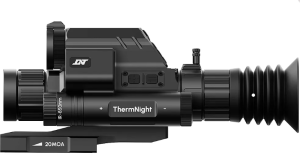
Thermal imaging can locate an animal quickly, but a heat signature does not always provide enough visual information to understand everything around it. DNT Optics addresses that limitation with the ThermNight 3-12x52mm Thermal Rifle Scope, combining a 256 × 192 thermal sensor with a Sony STARVIS 2 sensor for digital night vision. Hunters can switch between thermal, day or night vision, and hybrid viewing with a button press, allowing the scope to adapt as lighting and visibility change.
The two imaging channels can also work together through Picture in Picture, keeping thermal information and night vision detail available within the same viewing experience. The thermal sensor uses 12μm pixels and ≤25mK NETD, while the 50Hz refresh rate helps maintain smooth imagery when observing movement. Rather than relying on thermal detection alone, the ThermNight gives the hunter another way to examine what a heat signature represents once it has been located.
The scope’s aiming functions extend beyond conventional zeroing. One shot zeroing allows the point of impact established through the day or night vision channel to be transferred to the thermal view, reducing the need to repeat the process for each imaging mode. A built in gyroscope monitors inclination and cant angle, while the integrated laser rangefinder measures distances from 5 to 1,100 yards.
Distance information can then become part of the aiming process rather than simply another number on the display. The DNT app can use the measured range for ballistic calculations, with the resulting solution presented as either a dial in adjustment or holdover correction. A preloaded bullet database also helps simplify the creation of ballistic profiles, giving the ThermNight a broader role in the field than simply locating heat signatures.
Despite housing two imaging systems, ranging hardware, and ballistic functions, the ThermNight remains relatively compact. At 6.7 inches long and 22.8 oz, it is easier to carry than many larger multispectral optics. Two 18650 batteries provide up to five hours of operation, while 32GB of internal storage accommodates recorded footage. Wi Fi connectivity also allows the scope to communicate with the DNT app, and the IP67 rating provides protection against water and dust.
That breadth of capability does come with a tradeoff. The ThermNight has more functions to learn than a straightforward thermal scope, and its five hour battery life may require more attention during longer outings. For someone who wants thermal detection, digital night vision, ranging, and ballistic assistance in one optic, those compromises may be worthwhile. That makes the ThermNight a versatile choice among the best Thermal Scopes for Hunting for buyers who value an all in one system more than maximum thermal resolution or the longest battery runtime.
Specifications
- Manufacturer: DNT Optics
- Color: Black
- Magnification: 3x-12x
- Objective Lens Diameter: 52 mm
- Thermal Sensor Resolution: 256 × 192 pixels
- Display Resolution: 1024 × 768 pixels
- Refresh Rate: 50 Hz
- Diopter Adjustment Range: −5 to +5 dpt
- Battery Type: 18650
- Battery Quantity: 2
- Battery Life: Up to 5 hours
- Operating Temperature: −4°F to 122°F
- Water Resistance: IP67
- Length: 6.7 in
- Width: 3.3 in
- Height: 3.2 in
- Weight: 22.8 oz (646 g)
- Connectivity: Wi Fi
- Storage: 32GB
- Laser Rangefinder: 5 to 1,100 yards
- Night Vision Magnification: 5x to 20x
- Thermal NETD: ≤25mK
Pros
- Combines thermal detection with digital night vision for target identification
- Sony STARVIS 2 sensor improves low light visibility
- Picture in Picture allows thermal and night vision information to be viewed together
- One shot zeroing simplifies alignment between the two imaging channels
- Built in laser rangefinder measures distances up to 1,100 yards
- Integrated ballistic calculator provides dial in and holdover corrections
- Compact 22.8 oz construction is relatively easy to carry
- Digital gyroscope provides inclination and cant information
- 32GB internal storage accommodates recorded content
- IP67 protection supports use in wet and dusty environments
Cons
- Up to five hours of battery life may be limiting for longer hunting sessions
Advantages of Using Thermal Scopes for Hunting
Factors to Consider When Choosing the Best Thermal Scopes for Hunting
Thermal Sensor Resolution
Thermal sensor resolution influences how much detail a scope can display when examining a heat signature. A 256 × 192 sensor can work well for general detection and closer range hunting. Higher resolutions such as 384 × 288 or 640 × 512 can reveal finer details at greater distances. Resolution alone, however, should not determine your choice. Objective lens size, image processing, display quality, and thermal sensitivity can also affect image clarity.
Detection Range and Field of View
A long detection range can be valuable when hunting across open terrain. However, you also need enough field of view to search your surroundings effectively. A wider view lets you cover more ground when looking for heat signatures. A narrower view can make it easier to concentrate on a distant animal. Consider the environments and distances you normally hunt. The scope with the longest advertised range will not automatically be the best fit. Detection range also does not mean the scope will provide enough detail to identify an animal at that distance.
NETD and Thermal Sensitivity
NETD describes how well a thermal sensor can distinguish small differences in temperature. Lower values generally indicate greater sensitivity. This can become especially useful when an animal’s temperature is only slightly different from its surroundings. A lower NETD can help reveal subtle heat signatures when thermal contrast is limited. Still, it should not be evaluated on its own. Sensor resolution, lens quality, image processing, and environmental conditions all influence the image you ultimately see.
Magnification and Digital Zoom
The magnification range should correspond to the distances at which you expect to hunt. Lower magnification provides a broader view for scanning and following movement. Higher magnification allows you to examine a detected animal more closely. Digital zoom can provide additional enlargement when needed. However, excessive use may reduce apparent image detail because it enlarges existing information rather than creating more. A sensible optical magnification range can therefore be more useful than a scope with an extremely high maximum zoom.
Refresh Rate
Refresh rate matters most when you are scanning quickly or following an animal in motion. A higher refresh rate generally produces smoother thermal imagery. This can make movement easier to follow and reduce the sense of lag as you pan across the landscape. A 50Hz scope can be particularly useful if moving targets are common in your hunting situations. When your typical hunts involve mostly stationary observation, other characteristics may deserve greater priority.
Battery Life and Power Options
A thermal scope depends on battery power for both its imaging system and display. That makes runtime an important consideration for extended outings. Look beyond the advertised battery life. Check whether the scope uses removable batteries, supports USB charging, or allows you to carry spare cells. Shorter runtime may be adequate for brief hunts. Longer sessions can make greater endurance or convenient power options much more valuable.
Weight, Durability and Weather Protection
Every additional ounce on a rifle becomes more noticeable when you carry the setup over long distances. Lighter thermal scopes can make the rifle easier to handle. Heavier models may accommodate larger lenses, additional features, or more substantial construction. The environment you hunt in also matters. Look at the scope’s water and dust resistance rating, construction materials, and recoil resistance. These factors become especially important when hunting exposes the optic to moisture, dust, temperature changes, or repeated recoil.
Useful Hunting Features
Extra features can make a thermal scope more convenient. Their value depends on whether they solve problems you actually encounter in the field. Recording and recoil activated video can help document a hunt. Picture in Picture can provide magnified detail without completely removing the surrounding scene. Multiple weapon profiles and convenient zeroing functions can simplify switching between rifles. Laser rangefinders and ballistic calculators can provide additional aiming information. Before paying more for these additions, consider how often you will use them. Investing in thermal performance, battery life, or handling may offer greater value.
Best Thermal Scopes for Hunting FAQs