Comparing the best Thermal Scopes for Coyote Hunting can quickly turn into a numbers game. One model advertises a longer detection range, while another offers a higher resolution sensor. Others add laser rangefinders, ballistic calculators, or multiple viewing modes.
That makes the comparison more complicated than simply finding the biggest numbers. The better question is whether a feature helps you detect, identify, follow, or engage a coyote under the conditions in which you actually hunt. With that in mind, the differences between these scopes become much more meaningful when their specifications are considered alongside how each optic is intended to perform in the field.
Overview of the Best Thermal Scopes for Coyote Hunting:
- AGM Global Vision Varmint V2 LRF 35-384 3-24x35mm Thermal Imaging Rifle Scope — Best Overall
- Pulsar Thermion 2 XQ50 Pro 3-12x50mm Thermal Imaging Rifle Scope — Best for Long Hunting Sessions
- AGM Global Vision RattlerV2 25-256 25mm Thermal Imaging Rifle Scope — Best Budget Option
- GOYOJO GRS Series Thermal Riflescope — Best for Image Presentation
- RIX Storm S2 Thermal Imaging Rifle Scope — Best Lightweight Option
- DNT Optics ThermNight 3-12x52mm Thermal Rifle Scope — Best Multispectral Option
- Pulsar Thermion 2 LRF XQ50 Pro 3-12x Thermal Rifle Scope — Best Premium Option
Best Thermal Scopes for Coyote Hunting
1) AGM Global Vision Varmint V2 LRF 35-384 3-24x35mm Thermal Imaging Rifle Scope
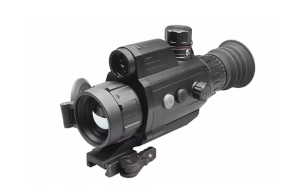
A coyote can look much closer or farther away than it actually is when all you have to judge distance by is a dark field and a thermal image. That makes ranging more than a convenience during predator hunts, especially when an animal appears across open ground. The AGM Global Vision Varmint V2 LRF 35-384 3 to 24x35mm Thermal Imaging Rifle Scope addresses that problem by putting a laser rangefinder and ballistic calculator alongside its thermal imaging system. Its 384×288, 12 micron sensor has sub 20mK thermal sensitivity, while the 1024×768 OLED display and 50 Hz refresh rate provide the responsive view needed to scan terrain and follow a moving coyote.
The 3x to 24x magnification range gives the Varmint V2 room to adapt as a coyote moves from one part of the hunting area to another. At 3x, the 35mm lens provides a 7.53° × 5.65° field of view for searching and tracking. Higher magnification can then be used when a distant heat signature needs closer examination. Digital zoom from 1x through 8x adds more flexibility, although it only enlarges the available image rather than adding thermal detail.
The integrated rangefinder is the feature that most clearly separates this model from a basic thermal scope. It can measure distances out to 600 meters with stated accuracy of ±1 meter, giving the hunter a concrete range instead of relying entirely on visual estimation. The ballistic calculator then builds on that information to assist with distance based aiming adjustments. For coyote hunting, that combination has a practical advantage: once an animal is detected, the hunter can obtain range information and work through the aiming solution without switching to a separate rangefinder.
Thermal performance also matters when the coyote does not stay still. The 50 Hz refresh rate helps keep movement fluid, while the sub 20mK NETD supports the sensor’s ability to distinguish small temperature differences. That does not turn the 384×288 sensor into a higher resolution system, but it gives the scope a useful foundation for detecting and tracking heat signatures at night. The manufacturer also lists multiple thermal palettes and a highest temperature spot tracking function, both of which can help the hunter work through a scene when searching for an animal.
Weight is another practical consideration for a predator setup. At 1.14 pounds, the Varmint V2 35-384 keeps the rifle from taking on as much additional weight as some larger thermal optics. Its 18650 rechargeable battery provides more than six hours of runtime, while USB Type C external power can extend operation when a longer stand or night hunt demands it. The IP67 rating also gives the scope protection against dust and water, which is useful when moving between stands or hunting through changing outdoor conditions.
The biggest compromise is the 384×288 sensor. It provides useful thermal performance, but hunters who place a higher priority on image resolution may find the 640×512 version of the Varmint V2 more appealing. The 35-384 model also has a narrower field of view than that 35-640 version, although its 3x starting magnification and 24x maximum give it a broad range for hunters who want more magnification flexibility.
Specifications
- Manufacturer: AGM Global Vision
- Magnification: 3-24x
- Objective Lens Diameter: 35 mm
- Sensor Resolution: 384×288 pixels
- Pixel Pitch: 12 μm
- Thermal Sensitivity: Less than 20 mK
- Display Resolution: 1024×768 OLED
- Refresh Rate: 50 Hz
- Field of View: 7.53° × 5.65°
- Eye Relief: 45 mm
- Laser Rangefinder: Up to 600 m, ±1 m accuracy
- Detection Range: 1800 m on a 6 foot target
- Digital Zoom: 1x, 2x, 4x and 8x
- Battery Type: 18650 lithium rechargeable
- Battery Life: Over 6 hours
- Water Resistance: IP67
- Weight: 1.14 lb
- Dimensions: 8.4 × 2.6 × 3.4 inches
Pros
- Integrated laser rangefinder with ±1 m stated accuracy
- Onboard ballistic calculator
- 3x to 24x magnification range
- 384×288 sensor with less than 20mK thermal sensitivity
- 50 Hz refresh rate
- Relatively lightweight 1.14 lb design
- More than 6 hours of battery life
- IP67 protection
Cons
- 384×288 resolution provides less image detail than higher resolution thermal options
2) Pulsar Thermion 2 XQ50 Pro 3-12x50mm Thermal Imaging Rifle Scope
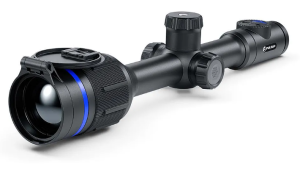
The Pulsar Thermion 2 XQ50 Pro 3-12x50mm Thermal Imaging Rifle Scope is built for coyote hunters who may spend hours watching the same terrain before an animal finally appears. Its 384×288, 17 micron thermal sensor, 50 mm F/1.0 objective, 50 Hz refresh rate, and up to 10 hours of battery life all support that kind of extended field use. A 1024×768 AMOLED display provides a detailed viewing interface, while the traditional riflescope format keeps the setup familiar for hunters accustomed to conventional optics.
The 50 mm objective gives the Thermion 2 XQ50 Pro a configuration suited to deliberate observation. Its 3x to 12x magnification range lets the hunter begin with a broader view before increasing magnification when a distant coyote needs closer examination. At 3x, the 7.5 degree field of view provides useful coverage for scanning and tracking, while moving toward 12x narrows the view but provides more magnification for examining a heat signature. This makes the optic better suited to watching defined areas and working with detected targets than rapidly sweeping very large terrain.
The thermal system is designed to maintain a usable image while a coyote is moving. Its 384×288 sensor has 25 mK NETD, while the 50 Hz refresh rate helps keep movement fluid through the display. Those specifications become more useful once an animal has been detected. A coyote crossing the field of view can change position quickly, so maintaining a responsive thermal image gives the hunter a better chance of keeping track of it while adjusting magnification or waiting for a clearer view.
Zeroing is another area where the Thermion 2 XQ50 Pro adds practical value. Freeze Zeroing allows the hunter to preserve the original aiming reference while making sighting adjustments, reducing the need to keep the rifle precisely positioned throughout the process. Weapon profiles can also help when the scope is used with different compatible rifle setups, allowing separate configurations to be retained instead of repeatedly starting from the same baseline. These features matter because consistency at the rifle is just as important as the thermal image once a coyote finally appears.
Battery life gives this model its strongest practical advantage. The lithium ion battery system can provide up to 10 hours of operation, giving a hunter considerably more freedom during a long nighttime session. USB Type C power support provides another option when an external power source is available, while the IPX7 rating protects the optic against water exposure. For a hunter who spends extended periods on stand, that combination reduces the need to interrupt the hunt for power management or worry as much about changing weather.
The substantial configuration does come with a portability tradeoff. At 31.7 ounces, the Thermion 2 XQ50 Pro is considerably heavier than lightweight thermal designs. Its 384×288 sensor also gives up resolution to higher resolution alternatives. The 50 mm objective, long operating time, and traditional riflescope format therefore make more sense for a hunter who expects to settle into a stand and observe for long periods than for someone who prioritizes keeping a rifle as light and mobile as possible.
Specifications
- Manufacturer: Pulsar
- Magnification: 3 to 12x
- Objective Lens Diameter: 50 mm
- Tube Diameter: 30 mm
- Sensor Resolution: 384×288 pixels
- Pixel Pitch: 17 μm
- Sensor NETD: Less than 25 mK
- Display Resolution: 1024×768 AMOLED
- Refresh Rate: 50 Hz
- Eye Relief: 50 mm
- Field of View: 7.5 degrees
- Detection Range: 1800 m
- Battery Type: Lithium ion
- Battery Life: Up to 10 hours
- Water Resistance: IPX7
- Mount Type: Standard 30 mm rings
- Weight: 31.7 oz
- Dimensions: 16.5 inches
- Material: Magnesium alloy
Pros
- Up to 10 hours of battery life
- 50 mm F/1.0 objective
- 3x to 12x magnification
- 384×288 sensor with less than 25 mK NETD
- 50 Hz refresh rate
- Freeze Zeroing function
- Multiple weapon profiles
- 1024×768 AMOLED display
- IPX7 water resistance
Cons
- 31.7 oz weight is relatively substantial for a thermal scope
3) AGM Global Vision RattlerV2 25-256 25mm Thermal Imaging Rifle Scope
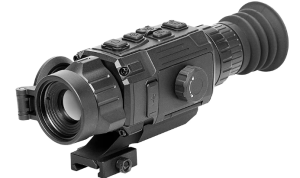
A coyote moving through cover can give a hunter only a brief opportunity to pick up its heat signature before it disappears again, and the AGM Global Vision RattlerV2 25 256 25mm Thermal Imaging Rifle Scope is built with those closer encounters in mind. Its 25mm Germanium lens, 256×192 thermal sensor, and 3.5x base magnification provide a practical starting point for scanning and identifying heat signatures, while the 7.0° × 5.3° field of view maintains enough coverage to follow a coyote without giving up useful magnification.
Once the animal starts moving, the 50 Hz refresh rate becomes more useful. The faster image updates help keep scanning and tracking smoother, which can make it easier to follow a coyote crossing the field of view. The 256×192 sensor is less detailed than the higher resolution systems in this category, so the RattlerV2 is better suited to hunters who do not regularly need to distinguish fine detail at extended distances.
Battery endurance fits that practical role well. The rechargeable battery can provide up to 11.5 hours of runtime, giving the hunter plenty of operating time for a long night in the field. At 1.08 pounds, the scope also adds relatively little weight to the rifle, making it easier to maintain a manageable setup during a hunt.
Operation is kept straightforward with raised five button controls, a simplified menu, and multiple zeroing profiles for different rifles or calibers. These features are particularly useful when adjustments need to be made in the dark or while wearing gloves. They also reinforce the RattlerV2’s appeal to hunters who want to get into thermal hunting without taking on an overly complicated optic.
The 256×192 sensor remains the clearest compromise. It provides less image detail than higher resolution thermal scopes when a coyote is farther away, making this model less suited to hunters who routinely depend on maximum identification detail at longer distances. For closer range predator hunting, that limitation is balanced by the 3.5x starting magnification, responsive 50 Hz imaging, long battery life, and relatively light design.
Specifications
- Manufacturer: AGM Global Vision
- Magnification: 3.5x-28x
- Objective Lens Diameter: 25 mm
- Sensor Resolution: 256×192 pixels
- Thermal Sensitivity: Less than 35 mK NETD
- Refresh Rate: 50 Hz
- Field of View: 7.0° × 5.3°
- Eye Relief: 45 mm
- Detection Range: Up to 1250 m
- Digital Zoom: 1x, 2x, 4x, and 8x
- Battery Type: Rechargeable lithium ion
- Battery Life: Up to 11.5 hours
- Water Resistance: IP67
- Weight: 1.08 lb
Pros
- 3.5x base magnification for closer range hunting
- 50 Hz refresh rate
- Up to 11.5 hours of battery life
- Lightweight 1.08 lb design
- Multiple zeroing profiles
- Raised controls for easier operation with gloves
- IP67 protection
Cons
- Less than 35 mK NETD falls behind more advanced thermal options
4) GOYOJO GRS Series Thermal Riflescope
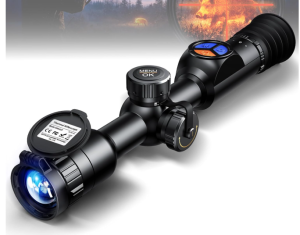
The GOYOJO GRS Series earns its place among the best Thermal Scopes for Coyote Hunting by putting image interpretation at the center of the hunting experience. A coyote may give off a strong heat signature, yet separating that signature from vegetation, uneven terrain, or other warm objects can still be challenging. The GRS Series addresses that problem with a 256×192 thermal sensor paired with a 1440×1080 OLED display, giving the hunter a detailed screen for reading the thermal scene and judging where the animal sits within it.
That combination becomes particularly useful when the background is visually busy. Image enhancement helps refine thermal contrast and edge definition, while the available imaging modes give the hunter more control over how the scene appears. Its 50 Hz refresh rate adds another practical advantage by keeping moving targets smooth and easier to follow. Rather than treating these features as separate specifications, they work together to make a coyote’s heat signature easier to monitor as it moves through vegetation or uneven surroundings.
The 3.5x optical magnification establishes a fairly close starting view, while the 1x to 8x digital zoom provides additional enlargement when the hunter wants to examine a detected target more closely. That flexibility can be useful when moving between observation and target assessment. Still, digital magnification cannot add thermal information that the sensor did not capture in the first place. At longer distances, therefore, the 256×192 resolution remains an important limitation to consider, particularly when distinguishing a coyote from its surroundings requires finer detail.
Beyond image performance, the GRS Series is built to stay in service through long nights and demanding outdoor conditions. Its stated seven to nine hour battery life can support a substantial hunting session, while IP67 protection provides resistance to dust and water. The scope is also rated to withstand recoil up to 800g/0.4 ms and operate between −22°F and 122°F. Those specifications give the GRS Series the durability and environmental tolerance expected from an optic intended for repeated field use.
Its stated detection range of up to 1,224 yards is impressive on paper, but that figure needs context. Detection simply means recognizing a heat source, not necessarily determining that it is a coyote or making a confident shot decision at that distance. With a 256×192 sensor, available detail becomes increasingly limited as range increases. For that reason, the GRS Series is better understood as a thermal scope that prioritizes a clear viewing experience, smooth target tracking, and flexible image presentation rather than maximum detail at extreme distances. That balance makes it particularly appealing to hunters who value how naturally they can interpret and follow a thermal scene in the field.
Specifications
- Manufacturer: GOYOJO
- Series: GRS
- Objective Lens Diameter: 25 mm
- Sensor Resolution: 256×192 pixels
- Thermal Sensitivity: Less than 35 mK
- Display Resolution: 1440×1080 OLED
- Magnification: 1x to 8x
- Refresh Rate: 50 Hz
- Detection Range: Up to 1,224 yards
- Imaging Modes: 7
- Reticle Options: 10
- Recording: Recoil Activated Video
- Internal Storage: 32GB
- Battery Life: 7 to 9 hours
- Water Resistance: IP67
- Recoil Resistance: Up to 800g/0.4 ms
- Operating Temperature: −22°F to 122°F
Pros
- 1440×1080 OLED display
- 50 Hz refresh rate
- Auto AI image enhancement
- 1x to 8x magnification
- Seven imaging modes
- Ten reticle options
- Seven to nine hours of battery life
- IP67 protection
- Recoil Activated Video
Cons
- Multiple imaging settings may take time for first time thermal users to master
5) RIX Storm S2 Thermal Imaging Rifle Scope
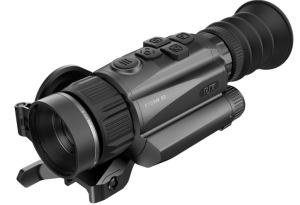
A thermal scope can add valuable nighttime capability without turning a rifle into a heavy, cumbersome setup. The RIX Storm S2 Thermal Imaging Rifle Scope weighs just 0.9 pounds and uses a compact design, making its low weight one of its most practical advantages for hunters who spend long hours in the field. Its 25mm F/1.0 objective lens, 256×192 thermal sensor, and 3.5x base magnification create a relatively focused viewing perspective, while the 7.0° horizontal field of view provides enough coverage to locate and follow a detected heat signature.
The 3.5x starting magnification also gives the Storm S2 a distinct character. Instead of prioritizing a broad scanning view, it begins with a more magnified perspective that can be useful when examining coyotes at moderate distances. Its 1x to 4x digital zoom provides additional enlargement when closer inspection is needed, but magnification alone cannot create thermal information that the detector did not capture. The 256×192 sensor therefore remains an important consideration when the target moves farther away and finer detail becomes more difficult to distinguish.
RIX pairs that sensor with its Resolution Enhancement Technology, which processes and expands the displayed thermal image to improve perceived clarity. That is particularly relevant here because the Storm S2 uses a 256×192 detector rather than a higher resolution sensor. RET can make the available information easier to interpret, but it should not be mistaken for the same thing as having more native sensor detail. The combination is better viewed as an effort to get more useful visual information from the Storm S2’s compact thermal platform.
The 1024×768 AMOLED display further supports that approach by providing a higher resolution viewing screen with strong contrast and detail. Meanwhile, the 50 Hz refresh rate helps keep the image fluid when a coyote moves across the field of view. Five selectable image modes also allow the presentation to be adjusted to different environments and viewing preferences. Together, these features give the Storm S2 a more adaptable viewing experience without changing its lightweight, compact character.
Operating a thermal scope in darkness can become unnecessarily difficult when controls require repeated menu navigation, particularly while wearing gloves. The Storm S2 takes a more direct approach, assigning functions to individual buttons so adjustments can be made without working through complicated menus. That is a small design decision, but it has genuine value during a fast encounter when attention needs to remain on the thermal scene rather than on the controls.
The lightweight construction remains one of the Storm S2’s strongest practical advantages, although its compact sensor and battery capacity reveal where the design makes compromises. RIX rates the 256×192 scope for detection out to 1,300 meters, but detection should not be confused with identifying a coyote with confidence at that distance. Its approximately five hour battery rating is also more suited to a shorter or moderately long outing than to hunters who regularly stay afield throughout the night. IP67 protection and recoil resistance up to 1000g/6000J nevertheless give the scope useful durability for demanding outdoor use.
Ultimately, the Storm S2 is not trying to compete by maximizing every specification. Its appeal comes from combining a 0.9 pound footprint with image enhancement, a high resolution AMOLED display, smooth 50 Hz imaging, and controls that are straightforward to operate in darkness. That makes it a particularly sensible option among the best Thermal Scopes for Coyote Hunting for hunters who want thermal capability without adding substantial weight to their rifle.
Specifications
- Manufacturer: RIX Optics
- Model: STORM S2
- Objective Lens: 25mm F/1.0
- Sensor Resolution: 256×192 pixels
- Pixel Pitch: 12 μm
- Thermal Sensitivity: Less than 25 mK
- Base Magnification: 3.5x
- Digital Zoom: 1x to 4x
- Field of View: 7.0° × 5.3°
- Refresh Rate: 50 Hz
- Display: 1024×768 AMOLED
- Eye Relief: 48 mm
- Detection Range: 1,300 m / 1,422 yards
- Battery Type: 18650
- Battery Life: About 5 hours
- Storage: 32GB
- Water Resistance: IP67
- Operating Temperature: −4°F to 122°F
- Weight: 0.9 lb / 408 g
- Mount: Picatinny
- Recoil Resistance: Up to 1000g / 6000J
Pros
- Lightweight 0.9 lb construction
- 256×192 thermal sensor with less than 25 mK NETD
- RET image enhancement technology
- 1024×768 AMOLED display
- 3.5x base magnification
- 50 Hz refresh rate
- Direct button controls for operation in darkness
- Five selectable image modes
- IP67 protection
- 32GB internal storage
Cons
- About five hours of stated battery life is modest for extended night hunts
6) DNT Optics ThermNight 3-12x52mm Thermal Rifle Scope
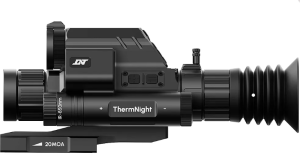
The DNT Optics ThermNight TNC225R brings more than thermal imaging to the rifle. Its multispectral design combines a 256×192 thermal sensor with digital day and night vision, giving the hunter two distinct ways to examine the same scene. The thermal channel uses a 12μm detector with less than 25mK NETD, while the digital night vision system uses a Sony STARVIS 2 sensor for low light viewing. This combination gives the ThermNight a broader role than an optic designed solely around thermal detection.
Picture in Picture makes that difference particularly useful when a heat signature needs further examination. The ThermNight can display thermal, day and night vision, or a hybrid view that brings both images together, allowing the hunter to retain the thermal reference while gaining additional visual context. One Shot Zeroing complements those modes by aligning the thermal and day or night vision channels to the same point of impact. Switching between them can therefore be part of the same aiming setup rather than requiring separate zeroing references.
Distance measurement fits naturally into that workflow. The integrated laser rangefinder covers 5 to 1,100 yards, and its readings can be transferred to the DNT app for ballistic calculation. The resulting correction can be displayed as either a dial in adjustment or a holdover, while the preloaded bullet database helps simplify ballistic profile configuration. Instead of treating ranging and ballistic assistance as separate accessories, the ThermNight incorporates both into the same system used to locate and examine the target.
At 22.8 ounces and about 6.7 inches long, the ThermNight remains relatively compact considering how much functionality is built into the housing. A 50 Hz refresh rate keeps the thermal image responsive when movement enters the field of view, while the 1024×768 display provides a detailed interface for the different viewing modes. IP67 protection also helps the optic handle dust and water, making its compact design practical for outdoor use rather than simply reducing its size on paper.
Power management is the more noticeable compromise. The scope uses two 18650 batteries and is rated for up to five hours of operation, which may be sufficient for shorter outings but leaves less margin for extended nights in the field. Its 256×192 thermal sensor also provides less native fine detail than higher resolution systems, particularly when greater distance makes identification more demanding. Those limitations matter, but they do not diminish the reason to consider the ThermNight: its value lies in combining thermal detection, visible spectrum imaging, ranging, and ballistic assistance within one optic.
For hunters who value an integrated identification and aiming workflow more than maximum native thermal resolution, the ThermNight offers a broader role than a thermal only optic.
Specifications
- Manufacturer: DNT Optics
- Model: ThermNight TNC225R
- Thermal Magnification: 3x-12x
- Objective Lens Diameter: 52mm
- Thermal Sensor Resolution: 256×192 pixels
- Pixel Pitch: 12μm
- Thermal Sensitivity: Less than 25mK NETD
- Display Resolution: 1024×768 pixels
- Refresh Rate: 50 Hz
- Laser Rangefinder: 5 to 1,100 yards
- Digital Night Vision: Sony STARVIS 2 sensor
- Battery Type: 18650
- Battery Quantity: 2
- Battery Life: Up to 5 hours
- Storage: 32GB
- Connectivity: Wi Fi
- Water Resistance: IP67
- Operating Temperature: −4°F to 122°F
- Weight: 22.8 oz / 646g
- Dimensions: 6.7 × 3.3 × 3.2 inches
Pros
- Thermal and digital night vision in one optic
- 256×192 thermal sensor with less than 25mK NETD
- Sony STARVIS 2 low light sensor
- Picture in Picture viewing
- One Shot Zeroing for thermal and day or night vision channels
- Built in laser rangefinder
- Integrated ballistic calculator
- 50 Hz refresh rate
- 1024×768 display
- 32GB internal storage
- IP67 protection
- Compact 22.8 oz design
Cons
- Multispectral functionality adds complexity compared with a thermal only scope
Next read: 8 Best Reflex Sights for Turkey Hunting
7) Pulsar Thermion 2 LRF XQ50 Pro 3-12x Thermal Rifle Scope
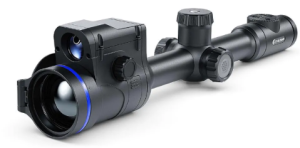
Extended nighttime observation puts a different emphasis on a thermal scope than a brief encounter does. The Pulsar Thermion 2 LRF XQ50 Pro 3 12x Thermal Rifle Scope is built for that kind of use, combining a 384×288 thermal sensor with a 50mm F/1.0 objective lens and 1024×768 AMOLED display. Its 50 Hz refresh rate keeps the image fluid when movement enters the field of view, while the less than 25mK NETD rating supports sensitivity to differences in heat.
The optical configuration gives the Thermion a deliberate viewing character. Its 3x to 12x magnification range allows the hunter to observe at the lower end before increasing magnification to examine a detected target more closely. The 50mm objective supports that setup, while the 9.3° angular field of view at the lower end provides useful coverage before narrowing as magnification increases. This makes the scope better suited to watching established areas and examining activity within them than to constantly sweeping large expanses of terrain.
Repeatable setup is another practical strength. Multiple weapon profiles allow different rifle configurations to be stored, while Freeze Zeroing preserves the original aiming reference when sighting adjustments are made. For hunters who use more than one compatible rifle or regularly fine tune their setup, these functions reduce repeated zeroing work and make the optic easier to configure from one session to the next.
The 10 hour battery rating also suits longer nights in the field. Rather than having to manage power after only a few hours, the Thermion can support extended observation before recharging becomes a concern. Its integrated laser rangefinder adds another useful capability when estimating distance to a detected target, particularly when the hunter is working at varying ranges.
The main compromise is weight. At about 34.2 ounces, the Thermion 2 LRF XQ50 Pro is better suited to hunters who prioritize sustained observation and a substantial feature set over keeping the rifle as light as possible.
Specifications
- Manufacturer: Pulsar
- Model: Thermion 2 LRF XQ50 Pro
- Magnification: 3x-12x
- Objective Lens: 50mm F/1.0
- Sensor Resolution: 384×288 pixels
- Pixel Pitch: 17μm
- Thermal Sensitivity: Less than 25mK NETD
- System Sensitivity: Less than 18mK NETD
- Display Resolution: 1024×768 pixels
- Refresh Rate: 50 Hz
- Field of View: 9.3° × 7.0°
- Linear Field of View: 16.3 × 12.2m at 100m
- Eye Relief: 50mm
- Laser Rangefinder: Up to 800m
- Battery Life: Up to 10 hours
- Battery System: Rechargeable internal and removable external lithium ion batteries
- Storage: 16GB
- Connectivity: Wi Fi
- Water Resistance: IPX7
- Operating Temperature: −25°C to 50°C
- Construction: Metal housing
- Weight: 34.2 oz / 970g
Pros
- 384×288 thermal sensor
- Less than 25mK NETD sensitivity
- 1024×768 AMOLED display
- 50 Hz refresh rate
- 3x to 12x magnification range
- 50mm F/1.0 objective lens
- Up to 10 hours of battery life
- Integrated laser rangefinder
- Multiple weapon profiles
- Freeze Zeroing function
- Rugged construction
Cons
- 34.2 oz weight makes it relatively substantial for a thermal scope