Have you ever tried to read a buoy number through binoculars while the deck rolls beneath you, only to watch it slide out of view every time the hull lifts? On the water, magnification alone is not enough, because every swell and gust gets magnified along with the target. In my view, the best Image Stabilized Binoculars for Boating solve that problem by countering both hand tremor and hull motion, so markers, vessels, and shorelines hold still long enough to identify.
The features I consider essential are a wide stabilization range, waterproof or at least rain resistant construction, sensible magnification, enough eye relief for sunglasses, and battery life that lasts a full day afloat.
This guide covers those features, shares my top picks, walks you through a practical buying guide, and answers the questions boaters ask most often. By the time you finish reading, I hope you’ll have everything you need to compare your options and decide which pair fits you best.
Here’s a quick summary of my top choices:
- Canon 12×36 Image Stabilization III Binoculars – Best Lightweight Option
- SIG SAUER ZULU6 HDX PRO 18x50mm Image Stabilized Binoculars – Best Long Range
- Canon 10×30 Image Stabilization II Binoculars – Best for Casual Boaters
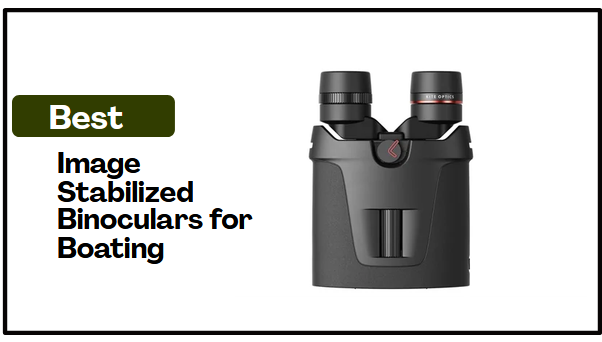
- Kite Optics APC Stabilized 16×42 Binoculars – Best Overall
- Fujinon Techno Stabi TS1440 14×40 Image Stabilization Binoculars – Best for Offshore Use
- Canon 18×50 Image Stabilization All-Weather Binoculars – Best for Wet Weather
- Canon 10×42 L IS WP Image Stabilized Binoculars – Best Premium Option
Best Image Stabilized Binoculars for Boating
1) Canon 12×36 Image Stabilization III Binoculars
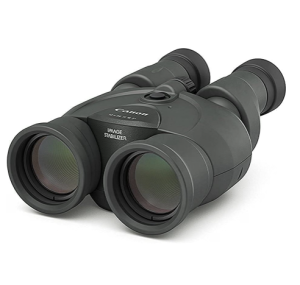
Spotting a channel marker from a rocking cockpit usually turns into a guessing game at 12x. Canon’s answer is an optical stabilizer based on its EF camera lens technology, switched on with a single button press. Once it engages, the hand tremor that normally blurs a buoy number or a distant hull settles down, and the extra reach finally becomes useful.
Behind the 36mm objectives, Porro II prisms limit light loss and hold resolution. A doublet field flattener then keeps the picture sharp from the center out to the edges. That edge clarity helps when you sweep the horizon for other traffic rather than staring at one fixed point. Canon also uses lead free glass throughout the optics.
At about 23 ounces without batteries, the body is compact for a 12x model and fits easily in a chart table drawer or a small dry bag. With 14.5mm of eye relief, sunglasses or prescription lenses can stay on while you scan. In addition, the low reflective exterior cuts down on glare on bright days.
Two AA batteries run the stabilizer for roughly nine hours at room temperature, so a spare set covers a full weekend aboard. However, the housing carries no water resistance rating. Spray over the bow or a passing shower calls for a quick return to the case.
Day sailors and lake boaters who head out in fair weather will get the most from this pair. It suits anyone who wants a light, high powered binocular for picking out markers, wildlife, and shoreline features, then tucking it away below deck until the next sighting.
Specifications
- Magnification: 12x
- Objective lens: 36mm
- Prism: Porro II
- Field of view: 262 ft at 1,000 yds (5°)
- Eye relief: 14.5mm
- Close focus: 19.7 ft
- Weight: 23.3 oz (without batteries)
- Power: 2 AA batteries
- Battery life: About 9 hours at 77°F
Pros
- Steady 12x view at a button press
- Sharp image across the whole field
- Compact enough for easy storage aboard
- Comfortable with sunglasses
Cons
- Battery life drops in cold weather
2) SIG SAUER ZULU6 HDX PRO 18x50mm Image Stabilized Binoculars
SIG SAUER built the ZULU6 HDX PRO 18x50mm for long distance observation, and on open water that reach lets you read a vessel name or confirm a landmark well before it gets close. At 18x, even a light swell would normally make the image unusable. OmniScan optical stabilization steps in by reading your movement through a digital accelerometer. Hold steady on a target, and correction is at its strongest. Start panning across the horizon, and it eases off so the view follows you naturally instead of lagging.
The 50mm objectives and a 66.6 degree apparent field give a bright, roomy picture, while a twilight factor of 30 supports early departures and late returns. Meanwhile, the HDX PRO lens system reduces ambient glare, which matters when sunlight is bouncing off the water. SpectraCoat lifts light transmission, and LensArmor protects the outer glass from scratches and abrasion.
Marine conditions are well covered too. An IPX7 waterproof rating and fogproof construction protect it from rain, spray, and sudden temperature swings. The thermoplastic frame wears rubber armor for a secure grip on a wet deck, and the focus wheel and diopter ring carry a textured finish for cold or wet fingers.
Two AA batteries provide up to 40 hours of runtime, helped by a 10 minute auto shutoff. As a result, one set can last through several trips. For longer watches from a dock or flybridge, the binoculars also accept a tripod mount.
Offshore anglers and coastal cruisers who need to identify distant vessels, birds working over baitfish, or landmarks far down the coast will appreciate this pair most. Its power and size make it better for deliberate scanning than for quick, casual glances.
Specifications
- Magnification: 18x
- Objective lens: 50mm
- Stabilization: OmniScan with digital accelerometer
- Apparent field of view: 66.6°
- Twilight factor: 30
- Waterproofing: IPX7, fogproof
- Power: 2 AA batteries
- Runtime: Up to 40 hours
- Auto shutoff: 10 minutes
- Mounting: Tripod capable
Pros
- Long reach for distant vessels
- Stabilization adapts to panning
- Fully waterproof
- Long battery runtime
Cons
- Narrow 18x view is slower to aim from a moving deck
3) Canon 10×30 Image Stabilization II Binoculars
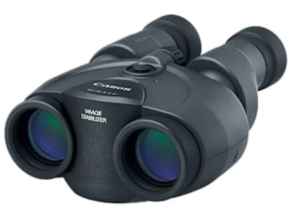
Not every trip on the water calls for extreme power. For harbor cruises, ferry rides, and relaxed afternoons on a lake, 10x gives a wider and more forgiving view. This compact Canon pairs that magnification with image stabilization at the press of a button.
Its 6 degree real field covers 315 feet at 1,000 yards. Consequently, following a passing sailboat, a pod of dolphins, or a seabird skimming the surface feels easier than with higher power optics. Canon’s lens based stabilizer, adapted from its EF lens technology, smooths out hand tremor so details such as sail numbers stay readable.
Optically, Porro II prisms preserve brightness, while a doublet field flattener keeps the edges crisp and free of noticeable distortion. The 14.5mm eye relief makes it practical for anyone wearing sunglasses on deck. Close focus sits near 14 feet, which is handy for watching activity on a nearby dock or alongside the boat.
At about 21 ounces without batteries, it rides easily in a day bag or a jacket pocket. Two AA batteries give roughly nine hours of stabilized viewing at 77°F. On the other hand, the body isn’t weather sealed, so spray and rain call for some care.
Ranked among the best Image Stabilized Binoculars for Boating, this pair makes the most sense for passengers, casual boaters, and families. It is light and simple enough to pass around on calm water without any setup.
Specifications
- Magnification: 10x
- Objective lens: 30mm
- Prism: Porro II
- Field of view: 315 ft at 1,000 yds (6°)
- Eye relief: 14.5mm
- Close focus: 13.8 ft
- Weight: 21.2 oz (without batteries)
- Power: 2 AA batteries
- Battery life: About 9 hours at 77°F
Pros
- Wide field for tracking moving boats
- Light and easy to share
- Comfortable with sunglasses
Cons
- Less reach than higher power models
4) Kite Optics APC Stabilized 16×42 Binoculars
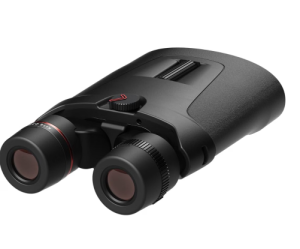
Most stabilizers are tuned for hand tremor alone, yet a boat adds roll and pitch on top of it. Kite designed its APC system with 2 and 3 degree correction angles to handle exactly that kind of motion on boats, in vehicles, and in strong wind. For this reason, it is one of the most capable Image Stabilized Binoculars for Boating when the water gets choppy.
Inside, the KDGS-1 suspension uses second generation accelerometers to track the movement of the roof prisms precisely. In practice, a 16x view of a distant buoy or shoreline holds steady enough to read instead of bouncing in and out of the frame.
Power management also suits life aboard. APC mode puts the binoculars to sleep when you lower them and wakes them as soon as you raise them, so there are no buttons to fumble while holding a rail. Two active AA batteries plus two spares stored in the body deliver at least 120 hours of continuous use. Running out of power mid passage is therefore unlikely.
Despite its power, the 42mm roof prism body handles much like a standard binocular and weighs about 26 ounces without batteries. Furthermore, an IPX7 rating allows submersion to one meter for 30 minutes, and nitrogen filling stops fog from forming inside. Military and law enforcement teams rely on it for observation on land, at sea, and in the air.
Sailors, powerboat skippers, and patrol crews who spend hours on rough water will appreciate it most, especially when they need a 16x view that stays calm while the hull moves.
Specifications
- Magnification: 16x
- Objective lens: 42mm
- Prism: Roof
- Field of view: 204 ft at 1,000 yds (3.9°)
- Eye relief: 14mm
- Close focus: 13.1 ft
- Weight: 25.9 oz (without batteries)
- Stabilization: 2° and 3° correction angles
- Battery life: 120+ hours (2 active and 2 spare AA)
- Waterproofing: IPX7
Pros
- Strong correction for boat motion
- Automatic sleep and wake
- Spare batteries stored onboard
- Submersible to one meter
Cons
- Lithium AA batteries recommended for best life
5) Fujinon Techno Stabi TS1440 14×40 Image Stabilization Binoculars
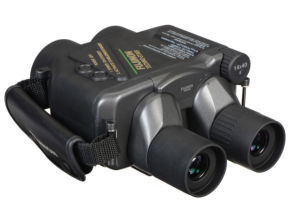
The Fujinon Techno Stabi TS1440 was designed with moving vehicles and vessels at sea in mind, and its ±5 degree vertical stabilization range shows it. That much correction lets you lock onto a subject at 14x and keep the view steady even as the hull pitches in a swell. As a result, a distant boat or headland stays in frame while the deck moves beneath you, and you spend less time hunting for the target again.
Optically, Fujinon’s EBC coating supports strong light transmission, and phase coated prisms keep contrast crisp. A 4 degree field and 2.9mm exit pupil give a clear, detailed picture in daylight. With 13mm of eye relief, most glasses wearers can still see the full image, and a center focus wheel handles quick adjustments when a new target appears.
Wet conditions are part of the design. The body uses fiberglass reinforced, high durability plastic that is waterproof and fogproof, while rubber armor keeps a secure grip in wet hands. Better still, a flotation strap means a slip over the rail doesn’t have to end with the binoculars on the bottom. An automatic shutoff also helps conserve the four AA batteries that power the stabilizer.
At roughly 2.7 pounds, this is a substantial pair. Still, the weight comes with a rugged mil spec hard case, eyepiece covers, a strap, and a cleaning cloth, so the whole kit is ready to stow aboard from day one.
Charter captains, offshore anglers, and coastal patrol crews who observe from moving vessels and regularly deal with spray will find it a dependable choice.
Specifications
- Magnification: 14x
- Objective lens: 40mm
- Stabilization: ±5° vertical
- Field of view: 4°
- Eye relief: 13mm
- Exit pupil: 2.9mm
- Coatings: EBC lens coating, phase coated prisms
- Weather protection: Waterproof, fogproof
- Power: 4 AA batteries
- Weight: 2.71 lb
Pros
- Wide correction for hull motion
- Flotation strap included
- Rugged hard case for storage aboard
Cons
- Heavy for long handheld sessions
- Needs four batteries to run
6) Canon 18×50 Image Stabilization All-Weather Binoculars
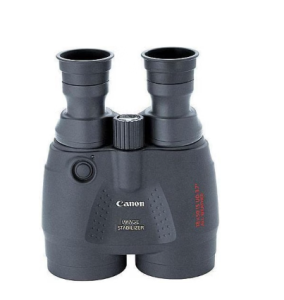
Rain and spray rarely cancel a day on the water, so a high power binocular has to keep working when the weather turns. Canon built this 18×50 with water resistant construction that meets JIS Class 4, meaning it remains usable in heavy rain. A non slip rubberized coating also keeps it secure in wet hands.
Its stabilizer relies on a Vari Angle Prism, and Canon notes that the binoculars can even be used from inside a moving vehicle. On deck, that steadiness turns 18x from a shaky novelty into a practical tool for identifying a far off vessel or reading a distant shoreline.
The optics are equally serious. A UD lens element reduces color fringing, while a doublet field flattener keeps the image sharp and free of distortion to the edges. Super Spectra coating supports brightness, and the 67 degree apparent field makes it easier to find a target before you zoom in on detail. Furthermore, 15mm of eye relief suits anyone wearing glasses.
There are trade offs worth knowing. The binoculars weigh about 41.6 ounces without batteries, so a neck strap becomes essential on long watches. Battery life is also modest, with about 2.5 hours from alkaline AA cells or around 8 hours from lithium cells at 77°F. Carrying spares in a dry bag is sensible.
Coastal cruisers and sailors who scan wide water in changeable weather will make the best use of it. It also works well for anyone who wants to stargaze from the deck after dark.
Specifications
- Magnification: 18x
- Objective lens: 50mm
- Prism: Porro II
- Field of view: 194 ft at 1,000 yds (3.7°)
- Apparent field of view: 67°
- Eye relief: 15mm
- Exit pupil: 2.8mm
- Weight: 41.6 oz (without batteries)
- Battery life: About 2.5 hours (alkaline) or 8 hours (lithium) at 77°F
- Water resistance: JIS Class 4, usable in heavy rain
Pros
- Rain resistant build
- Wide apparent field for easy aiming
- Sharp, low distortion image
Cons
- Short battery life
- Heavy for extended handheld use
7) Canon 10×42 L IS WP Image Stabilized Binoculars
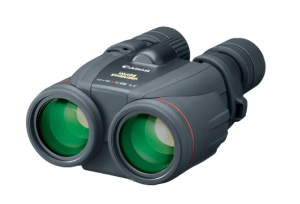
The Canon 10×42 L IS WP carries the red ring of Canon’s L series, and it was the brand’s first fully waterproof image stabilized binocular. For boaters, that combination means premium glass that can handle spray, rain, and humid mornings without worry. A metallic coating on the body components also helps prevent fogging when you step from a warm cabin into cool air.
One touch activates the stabilizer, which offers a ±0.8 degree correction angle. At 10x, that is enough to calm hand tremor and much of the small movement on deck. In turn, you can study a distant vessel or read a marker without bracing against a rail.
Low light is where this pair shines. Its 4.2mm exit pupil keeps the view bright at dawn departures and evening returns, when the light on the water fades quickly. Two UD elements per side control color fringing, which helps when you look at a dark hull against a bright sky. Meanwhile, a doublet field flattener holds sharpness to the edges, and the wide 6.5 degree field makes scanning the horizon comfortable.
Eye relief measures 16mm, so polarized sunglasses can stay on. The package includes a padded case, a neoprene strap, an eyepiece rainguard, an objective cap, and two AA batteries. However, at about 39 ounces, it is noticeably heavier than compact models.
For serious boaters who want the best Image Stabilized Binoculars for Boating in mixed light and wet weather, this pair brings top optics and dependable sealing together. It suits skippers, sailors, and wildlife watchers who are out on the water early and late.
Specifications
- Magnification: 10x
- Objective lens: 42mm
- Prism: Porro II
- Field of view: 341 ft at 1,000 yds (6.5°)
- Exit pupil: 4.2mm
- Eye relief: 16mm
- Close focus: 8.2 ft
- Stabilization: ±0.8° correction angle
- Weight: 39.2 oz (without batteries)
- Weather protection: Waterproof, anti fog body coating
Pros
- Bright view in low light
- Fully waterproof
- Excellent control of color fringing
- Comfortable with sunglasses
Cons
- Heavier than compact models
Advantages of Image Stabilized Binoculars for Boating
A Steady View on a Moving Deck
Even a gentle swell keeps a hull in constant motion, and ordinary binoculars magnify every bit of it. Stabilization counters that movement along with the tremor in your hands. As a result, a channel marker or a distant hull stays in frame instead of drifting in and out of view, which is the main reason boaters turn to image stabilized binoculars for boating in the first place.
Quicker Identification of Markers and Hazards
On the water, the time it takes to confirm what you are seeing matters. A settled image lets you read a buoy number, spot a floating log, or check another vessel’s heading in seconds rather than after several shaky attempts. That speed leaves you more time to adjust course calmly.
More Usable Magnification Without a Tripod
A tripod is rarely practical aboard a boat, and bracing against a rail only helps so much. Stabilization makes 12x, 14x, and even 18x workable by hand, so the extra reach turns into real detail. You can study a coastline or a far off vessel without first finding a solid rest.
Less Eye Fatigue on Long Watches
Following a jittery image forces your eyes and brain to work constantly, and long passages only make that strain worse. With the motion removed, scanning the horizon for an hour feels far more relaxed. Consequently, you stay alert for longer when keeping watch matters most.
Safer Navigation in Busy Waters
Harbors, channels, and crowded anchorages ask you to track several boats, markers, and swimmers at once. A steady view helps you judge distance and movement more accurately, especially when traffic is converging. For skippers, that added clarity supports better decisions at the helm.
Better Spotting of Wildlife and Fish Activity
Birds working over baitfish, dolphins breaking the surface, and whales blowing in the distance often appear for only a moment. Stabilized optics let you lock onto those brief sightings and actually see the detail. Anglers benefit in particular, since diving birds often point to fish feeding below.
Easier Viewing for Everyone Aboard
Not every passenger has steady hands or experience with binoculars. Because the stabilizer does much of the work, guests, children, and first time users can see clearly without a learning curve. In short, the best Image Stabilized Binoculars for Boating become a shared tool rather than one only the skipper can use well.
Factors to Consider When Choosing the Best Image Stabilized Binoculars for Boating
Stabilization Range
Not every system is designed for the same kind of movement. Some mainly correct hand tremor, while others offer wider correction angles that also handle the roll and pitch of a hull. If you often head into open water or choppy conditions, a broader range keeps the image steadier when the boat moves most.
Magnification
Higher power brings distant vessels and landmarks closer, yet it also narrows the view and makes targets harder to find from a moving deck. Around 10x to 12x suits general cruising and lake use, while 14x to 18x helps offshore, where you may need to identify objects miles away. Think about how far you usually need to see before deciding.
Waterproofing and Fog Protection
Spray, rain, and humid air are part of life on the water. A fully waterproof rating such as IPX7, along with nitrogen filling or another fogproof design, protects the internals over time. When shopping for image stabilized binoculars for boating, keep any model without weather sealing for calm, dry days, or store it well covered between sightings.
Objective Lens Size and Low Light Performance
Larger objective lenses gather more light, which helps during early departures, evening returns, and overcast days. A bigger exit pupil also keeps the view brighter as daylight fades. However, larger lenses add size and weight, so balance brightness against how much you are willing to hold.
Weight and Handling
Compact pairs are easy to carry and pass around, while full size models can feel heavy during long watches. Pay attention to grip as well, since rubber armor and textured controls make a real difference with wet hands. A neck strap or flotation strap also adds security when the deck gets lively.
Battery Type and Runtime
Stabilization depends on power, and a dead battery mid passage leaves you with ordinary binoculars. Runtime ranges from a few hours to well over 100, depending on the system. Look for models that use common AA batteries and offer automatic shutoff or sleep functions, and carry spares if you spend long days afloat.
Eye Relief and Field of View
Many boaters wear polarized sunglasses to cut glare, so generous eye relief lets you see the full image without removing them. A wider field of view, meanwhile, makes it easier to scan the horizon and follow moving boats. Together, these two details shape how comfortable the best Image Stabilized Binoculars for Boating feel in everyday use.
FAQs
Do image stabilized binoculars work on a moving boat?
Yes. They are among the most practical optics for marine use because they counter hand tremor and much of the hull’s motion. Models with wider correction angles cope better with rough water, while systems tuned mainly for hand shake perform best in calmer conditions.
What magnification is best for boating?
For most boaters, 10x to 12x offers a good balance of reach and a manageable field of view. Offshore anglers and coastal cruisers who need to identify distant vessels may prefer 14x to 18x, since stabilization keeps that higher power usable by hand.
Do I need waterproof image stabilized binoculars for boating?
It depends on where and when you head out. Spray and rain are common on open water, so a waterproof model is the safer choice for regular use. Pairs without sealing can still work on calm lakes and fair weather days, provided you keep them in a case between sightings.
Conclusion
Out on the water, the view rarely holds still on its own, and that is what makes stabilization so valuable for anyone at the helm or along the rail. Once the motion of the hull and your hands is taken out of the picture, a distant marker becomes a number you can read, a speck on the horizon becomes a vessel with a heading, and a splash becomes a pod of dolphins worth slowing down for.
Choosing the best Image Stabilized Binoculars for Boating comes down to knowing your water: how rough it gets, how far you need to see, and how often spray or rain joins the trip. Get those three things right, keep spare batteries aboard, and every outing gives you a clearer, calmer picture of what lies ahead.
More from us: