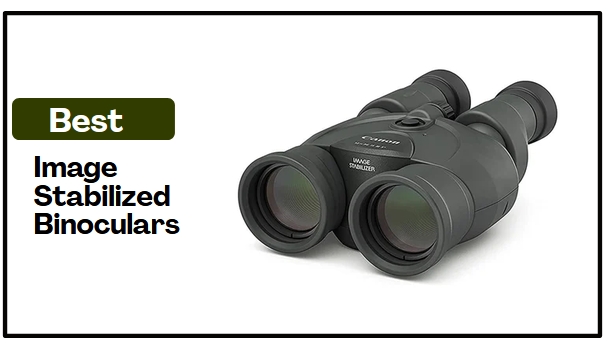
High magnification is only as useful as your ability to hold it steady, and beyond 10x, most hands simply can’t. The best Image Stabilized Binoculars close that gap with internal sensors and moving optics that counter hand tremor, wind, and even boat motion. As a result, a hawk on a distant snag, a buck on the far ridge, or a player across the stadium finally holds still. I see them as the clearest upgrade for birders, hunters, boaters, sports fans, and stargazers who rely on 12x and beyond.
Before you buy, though, a few features deserve close attention, namely stabilization range, magnification, weight, battery life, and weather protection. In this review, I cover each of those, share my top picks, take you through a practical buying guide, and answer the questions buyers ask most.
Let’s walk through them together.
Our Top Picks at a Glance
- Canon 12×36 Image Stabilization III Binoculars – Best Overall
- Canon 10×30 Image Stabilization II Binoculars – Best Value
- SIG SAUER ZULU6 HDX PRO 18x50mm FDE Image Stabilized Binoculars – Best Long Range
- Nikon STABILIZED 12×25 Binoculars – Best Compact
- Kite Optics APC Stabilized 16×42 Binoculars – Best for Boats and Vehicles
- SIG SAUER ZULU6 HDX PRO 16x50mm FDE Image Stabilized Binoculars – Best for Hunting
- Canon 15×50 IS All Weather Image Stabilized Binoculars – Best for Wet Weather and Astronomy
Best Image Stabilized Binoculars
1. Canon 12×36 Image Stabilization III Binoculars
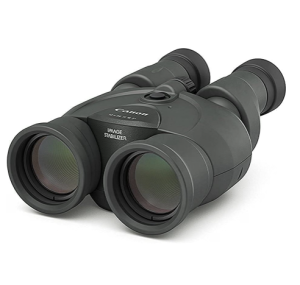
Twelve times magnification usually means a jittery image the moment you hold a binocular by hand. Canon tackles that problem with the same type of optical stabilization it builds into its EF camera lenses. One press of a button and the image settles, so a warbler on a far branch or a buck at the field edge stays still long enough to study.
Behind the 36mm objectives sit Porro II prisms, which help hold on to light and keep resolution high. A doublet field flattener then keeps the view sharp from the center out to the edges, with very little distortion. That matters when you scan a hedgerow and want detail beyond the middle of the frame.
Beyond the optics, the body stays compact for a 12x model, weighing about 23 ounces without batteries. Its low reflective exterior is also less likely to flash in the sun and alert wildlife. Eyeglass wearers get 14.5mm of eye relief, enough to see the full field without removing their glasses.
Power use is lower than on earlier versions. Two AA batteries run the stabilizer for roughly nine hours at room temperature, although cold weather shortens that considerably. That said, the housing carries no water resistance rating, so a sudden downpour calls for a quick trip back into the case.
Best suited for: Birdwatchers and hunters who want 12x reach in a compact binocular and mostly glass in fair weather.
Specifications
- Magnification: 12x
- Objective lens: 36mm
- Prism: Porro II
- Field of view: 262 ft at 1,000 yds (5°)
- Eye relief: 14.5mm
- Close focus: 19.7 ft
- Weight: 23.3 oz (without batteries)
- Power: 2 AA batteries
- Battery life: About 9 hours at 77°F
Pros
- Steady 12x view at the press of a button
- Sharp, flat image to the edges
- Comfortable for eyeglass wearers
- Compact for its magnification
Cons
- Battery life drops sharply in the cold
2. Canon 10×30 Image Stabilization II Binoculars
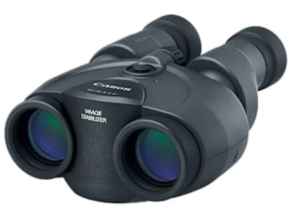
The Canon 10×30 IS II brings stabilization to the magnification many people find easiest to live with. At 10x, you get useful reach without the narrow, twitchy view of higher power. For that reason, it deserves a close look if you are shortlisting image stabilized binoculars for travel or the stands.
Its 6 degree real field of view covers 315 feet at 1,000 yards. As a result, tracking a winger down the touchline, a passing raptor, or a boat crossing the bay feels less like chasing the subject. Press the button, and Canon’s lens based stabilization smooths out the hand tremor that would otherwise blur fine feather markings or a player’s number.
Optically, the design follows a proven recipe. Porro II prisms preserve brightness, while the doublet field flattener keeps the edges crisp and free of noticeable distortion. The 14.5mm eye relief makes it a sensible choice for anyone who wears glasses.
On top of that, it weighs about 21 ounces without batteries, so it slips into a daypack or a carry on bag without much thought. The non glossy front cover and low reflective finish help when you watch shy birds at close range. Close focus sits near 14 feet, which is handy for backyard feeders.
You get roughly nine hours of stabilized viewing from two AA batteries in mild temperatures. However, the body isn’t weather sealed, so plan to keep it covered when rain moves in.
Best suited for: Travelers, sports fans, and casual birders who want a light, steady 10x binocular for everyday outings.
Specifications
- Magnification: 10x
- Objective lens: 30mm
- Prism: Porro II
- Field of view: 315 ft at 1,000 yds (6°)
- Eye relief: 14.5mm
- Close focus: 13.8 ft
- Weight: 21.2 oz (without batteries)
- Power: 2 AA batteries
- Battery life: About 9 hours at 77°F
Pros
- Wide field for following movement
- Light enough for all day carry
- Generous eye relief for glasses
- Low glare exterior
Cons
- Not weatherproof
- Short battery life in freezing conditions
3. SIG SAUER ZULU6 HDX PRO 18x50mm FDE Image Stabilized Binoculars
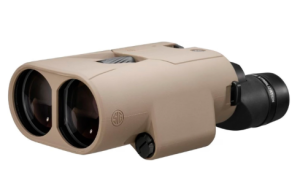
At 18x, even your pulse can shake the view. SIG answers that with OmniScan, an optical stabilization system that reads your movement through a digital accelerometer. When you hold still on a distant ridge, it applies maximum correction. Once you start panning, it eases off so the image follows you smoothly instead of lagging behind.
This is a glassing tool built for distance. The 50mm objectives and a 66.6 degree apparent field produce a roomy, bright image, and a twilight factor of 30 points to strong performance at first and last light. SIG’s HDX PRO lens system cuts ambient glare and improves color accuracy. SpectraCoat raises light transmission, while LensArmor resists scratches.
Equally important, the build matches the purpose. The thermoplastic frame wears rubber armor for grip and impact protection, and the IPX7 rating means rain, sleet, or an accidental dunk won’t end your hunt. Fog proofing also keeps the internals clear when temperatures swing.
On the handling side, the battery compartments now sit on opposite sides of the body, and the focus wheel and diopter ring carry a more textured finish for gloved hands. Two AA batteries provide up to 40 hours of runtime, helped by a 10 minute auto shutoff. For a fully locked view, it also accepts a tripod mount.
Keep in mind that at about 34 ounces, this isn’t a pocket binocular. Expect it to ride in a chest harness or on the seat beside you.
Best suited for: Western hunters, wildlife spotters, and marine users who glass across valleys or open water and need maximum detail at long range.
Specifications
- Magnification: 18x
- Objective lens: 50mm
- Prism: Schmidt Pechan
- Field of view: 3.7°
- Apparent field of view: 66.6°
- Eye relief: 15.3mm
- Close focus: 18 ft
- Weight: 33.97 oz
- Battery life: Up to 40 hours (2 AA)
- Waterproofing: IPX7
Pros
- Stabilization adapts to scanning and still viewing
- Excellent long range detail
- Long battery life
- Fully waterproof and fogproof
Cons
- Heavy for extended handheld carry
4. Nikon STABILIZED 12×25 Binoculars
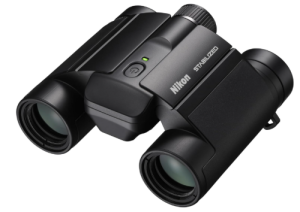
The Nikon STABILIZED 12×25 packs 12x magnification into a body that folds small enough for a jacket pocket. Because of this, it is easy to bring to a stadium, a music festival, or a hike where every ounce counts.
Nikon’s stabilization reduces image shake by up to 80 percent, correcting motion before it reaches your eyes. That lets you follow a batter at the plate or a singer on a distant stage without the jitter that 12x normally brings. Less shake also means less eye fatigue, so longer viewing sessions stay comfortable.
Multilayer coatings on the lenses cut glare, and a silver alloy coating on the roof prisms sends more light to your eyes for vivid color and contrast. Keep in mind that the 25mm objectives gather less light than larger designs, so the view is at its best from daylight into early dusk.
Handling is simple. A large, textured focus wheel allows quick adjustments, and turn and slide eyecups adapt to users with or without glasses. The closed bridge, dual hinge body weighs just 13.9 ounces.
As for power, two AA batteries provide up to 12 hours of stabilization. Activate it once, and it stays on for up to 60 minutes before shutting off automatically. Better still, you can keep using the binoculars with stabilization switched off.
Best suited for: Concertgoers, sports spectators, and travelers who want steady 12x views from a binocular that disappears into a bag.
Specifications
- Magnification: 12x
- Objective lens: 25mm
- Prism: Roof
- Field of view: 236 ft at 1,000 yds (4.5°)
- Eye relief: 12.3mm
- Close focus: 9.8 ft
- Weight: 13.9 oz
- Battery life: Up to 12 hours (2 AA)
- Auto shutoff: 60 minutes
Pros
- Folds small enough for a pocket
- Up to 80% less image shake
- Simple one press operation
- Usable with stabilization off
Cons
- Small objectives limit low light brightness
5. Kite Optics APC Stabilized 16×42 Binoculars
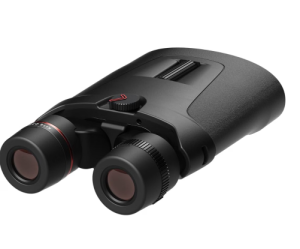
The Kite Optics APC 16×42 is built for viewing from platforms that never sit still. Its APC system works with 2 and 3 degree correction angles designed to steady the view on boats, in vehicles, and even in aircraft. Strong wind on an exposed hillside becomes far less of a problem, too.
For anyone comparing image stabilized binoculars for unstable platforms, that wide correction range is the main reason to look here. To achieve it, the KDGS-1 suspension uses second generation accelerometers to track the movement of the roof prisms precisely. As a result, fine detail at 16x stays readable instead of vibrating out of view.
Despite that power, the 42mm body handles much like a standard roof prism binocular. It weighs about 26 ounces without batteries, and the focus wheel rests right under your fingertips for fast adjustments.
Power management is where this model gets clever. APC mode puts the unit to sleep when you lower it and wakes it the moment you raise it again, with no buttons to press. The body holds two active AA batteries plus two spares, giving at least 120 hours of continuous observation. Many users will only replace batteries once or a few times per year.
Weather won’t slow it down either. An IPX7 rating allows submersion to one meter for 30 minutes, and nitrogen filling stops fog from forming inside. Military and law enforcement teams also rely on it for land, sea, and air observation.
Best suited for: Boaters, sailors, and observers who watch from moving vehicles or windy vantage points and need a rock steady 16x view.
Specifications
- Magnification: 16x
- Objective lens: 42mm
- Prism: Roof
- Field of view: 204 ft at 1,000 yds (3.9°)
- Eye relief: 14mm
- Close focus: 13.1 ft
- Weight: 25.9 oz (without batteries)
- Stabilization: 2° and 3° correction angles
- Battery life: 120+ hours (2 active and 2 spare AA)
- Waterproofing: IPX7
Pros
- Wide correction for boats and vehicles
- Automatic sleep and wake
- Spare batteries stored onboard
- Submersible to one meter
Cons
- Narrow field for tracking fast subjects
- Lithium AA batteries recommended for best life
6. SIG SAUER ZULU6 HDX PRO 16x50mm FDE Image Stabilized Binoculars
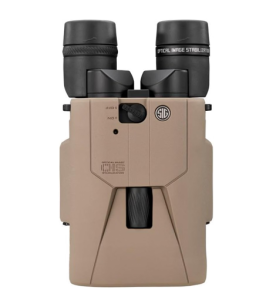
Sit on a ridge for a few hours, and eye strain often shows up before tired legs do. This 16×50 addresses that with a generous 16.4mm of eye relief and a 3mm exit pupil, so your eyes settle into position quickly and stay comfortable, even with glasses on.
To keep the image steady, OmniScan pairs a digital accelerometer with a 2 degree compensation angle. Slow, deliberate movements receive stronger correction, so a bedded animal or a distant antler tine holds still while you study it. Faster sweeps, on the other hand, get a lighter touch, which keeps panning natural.
On the optical side, the HDX PRO system leans toward low light. Glare drops, color looks truer, and the 28.3 twilight factor helps at dawn and dusk, when game tends to move. Abrasion resistant LensArmor protects the outer glass against dust and grit, while SpectraCoat lifts light transmission.
In addition, several handling refinements help in the field. You get a textured focus wheel and diopter ring, battery compartments on either side, and support for a tripod mount during longer sessions. Two AA batteries last up to 40 hours, and the unit powers down after 10 minutes of inactivity.
As for toughness, an IPX7 waterproof and fogproof rating, a thermoplastic frame, and rubber armor protect it from rain, knocks, and scrapes. A foam case and neck strap come in the box.
Best suited for: Hunters and wildlife watchers who spend long hours glassing and want high magnification with easier eye placement.
Specifications
- Magnification: 16x
- Objective lens: 50mm
- Field of view: 3.7°
- Apparent field of view: 59.2°
- Eye relief: 16.4mm
- Exit pupil: 3mm
- Close focus: 18 ft
- Weight: 33.91 oz
- Battery life: Up to 40 hours (2 AA)
- Waterproofing: IPX7
Pros
- Generous eye relief for long sessions
- Stabilization adjusts to your movement
- Strong twilight performance
- 40 hours on two AA batteries
Cons
- Weighs over two pounds
7. Canon 15×50 IS All Weather Image Stabilized Binoculars
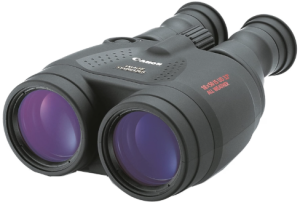
The Canon 15×50 IS All Weather is rated usable in heavy rain, which sets it up for wet days on the water or along the coast. Combined with large 50mm objectives, that protection also suits long night sessions under the stars.
Hold the button, and the optical image stabilizer counters hand shake as well as minute vibrations. At 15x, that turns a wobbling view of a distant seabird or a lunar crater into something you can actually study.
Inside, ultra low dispersion elements in the objectives reduce color fringing and add contrast and clarity. The 67.5 degree apparent field is wide for this magnification, which makes finding a target easier in the first place. In addition, Super Spectra coatings help keep the image bright, and 15mm of eye relief suits eyeglass wearers.
Size is the trade off. At roughly 2.6 pounds without batteries, it asks for a neck strap or a tripod, and a standard tripod socket is built in. Battery life is the other consideration. Two AA batteries deliver about 2.5 hours of continuous stabilization at room temperature, so carrying spares makes sense.
Best suited for: Boaters, coastal birders, and amateur astronomers who need steady 15x views in damp conditions.
Specifications
- Magnification: 15x
- Objective lens: 50mm
- Prism: Porro
- Field of view: 236 ft at 1,000 yds (4.5°)
- Apparent field of view: 67.5°
- Eye relief: 15mm
- Close focus: 19.7 ft
- Weight: 41.6 oz (without batteries)
- Battery life: About 2.5 hours at 77°F (2 AA)
- Water resistance: Usable in heavy rain
Pros
- Rain resistant build
- Wide apparent field for easy target finding
- Bright 50mm optics
- UD glass for crisp contrast
Cons
- Short battery life
- Heavy for long handheld use
Advantages of Image Stabilized Binoculars
Steady Detail at High Magnification
Every bit of extra power also magnifies the small tremors in your hands. As a result, standard binoculars at 12x or 16x often show a shaky picture that hides the very detail you wanted to see. Stabilization cancels much of that movement, so feather patterns, antler points, and distant markings hold still long enough to read clearly.
Less Eye Strain on Long Sessions
A jittery image forces your eyes and brain to work harder, and fatigue sets in quickly. With the view settled, you can glass a hillside, follow a match, or scan the horizon for far longer before needing a break. That comfort adds up over a full day outdoors.
Faster, More Confident Identification
When the image stops bouncing, you spend less time searching for your subject and more time studying it. Birders can separate similar species, hunters can judge an animal before committing to a stalk, and sailors can read a buoy number or a distant flag sooner. In short, you make quicker and more certain decisions.
Clear Views From Moving Platforms
Boats, vehicles, and windy vantage points make ordinary binoculars hard to use at high power. Stabilized designs counter that motion, so you can observe while underway or from an exposed ridge without bracing against anything. This makes them especially useful for marine travel, patrol work, and wildlife tours.
High Power Without a Tripod
Normally, steady views beyond 10x call for a tripod or a solid rest. Stabilization gives you much of that steadiness by hand, which means less gear to carry and quicker reactions when something appears. You can still add a tripod for the longest sessions, but you no longer depend on one.
Factors to Consider When Choosing the Best Image Stabilized Binoculars
Stabilization System and Correction Range
Start with how the stabilizer works and how much movement it can handle. Some systems correct only small hand tremors, while others offer wider correction angles built for boats and vehicles. Also check whether stabilization runs at the press of a button, stays on for a set time, or adjusts automatically to your movement, since that affects both comfort and battery use.
Magnification and Objective Lens Size
Higher magnification brings distant subjects closer, but it narrows the view and dims the image unless the objective lenses grow too. For general use, 10x to 12x keeps things manageable, while 15x to 18x suits long range glassing and marine use. Larger objectives, such as 50mm, gather more light for dawn, dusk, and astronomy, though they add weight.
Field of View
A wider field makes it easier to find a subject and keep fast movement in frame. This matters most for sports, birds in flight, and wildlife that won’t sit still. Because the field naturally shrinks as power rises, compare the real field of view, listed in degrees or feet at 1,000 yards, against how you plan to use them.
Weight and Portability
The best Image Stabilized Binoculars range from pocketable pairs under a pound to full size models over two pounds. Think about how far you will carry them and for how long. A lighter pair suits travel, concerts, and hiking, whereas heavier models make more sense from a vehicle, a boat, or a fixed glassing spot.
Battery Life and Power Management
Since the stabilizer runs on batteries, runtime decides how long you can rely on it. Figures vary widely, from a few hours to well over 100 hours, and cold weather can cut them sharply. Features like auto shutoff, sleep modes, and onboard spare batteries help a single set last through long trips.
Weather Resistance
Not every stabilized model is sealed against water. If you plan to use yours in rain, on the water, or in humid climates, look for a waterproof rating such as IPX7 or a clear rating for heavy rain, along with fog proofing. For fair weather use, however, an unsealed model can still serve well with some care.
Eye Relief and Comfort
Eyeglass wearers need enough eye relief, roughly 14mm or more, to see the full field without removing their glasses. Adjustable eyecups, a well placed focus wheel, and textured controls also make a difference, especially during long sessions or when wearing gloves.
FAQs
How do image stabilized binoculars work?
They use sensors, such as accelerometers, to detect movement, then shift prisms or lens elements to counter it. The result is a steadier image at high magnification without needing a tripod.
Are image stabilized binoculars worth the extra cost?
They are worth it if you regularly use 12x or more, observe from boats or vehicles, or spend long hours glassing. For occasional use at lower power, a standard pair held steadily may be enough.
What magnification works best?
For travel, sports, and general birding, 10x to 12x offers a good balance of reach and field of view. For long range hunting, marine use, and astronomy, 15x to 18x makes better use of stabilization.
Conclusion
Image stabilized binoculars earn their place by fixing the weakest link in any high power optic, which is the shake that comes from your own hands. Once that movement is under control, 12x, 15x, and even 18x become practical without a tripod, and the extra detail becomes something you can actually use. Stabilization also reduces eye fatigue, so long glassing sessions, full matches, and night sky viewing feel far more comfortable.
The right pair depends on where and how you observe. Compact 10x and 12x models suit travel, concerts, and casual birding, where light weight and a wider field matter most. For open country and long distances, 16x to 18x paired with 50mm objectives brings in more detail and holds up better in low light. If you spend time on boats or in vehicles, a system with a wide correction range keeps the view steady even when the platform won’t.
Finally, weigh battery life and weather sealing against your conditions, since runtimes range from a few hours to over 100, and not every model handles rain.
Read more: