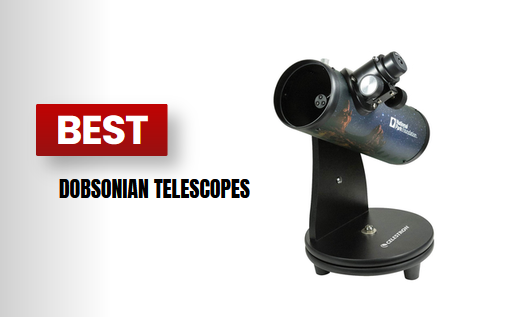
Seeing the Moon, planets, and distant galaxies in sharp detail is easy with the best Dobsonian telescopes and their large mirrors. I find them great because a big aperture reveals fine detail on lunar craters, Jupiter’s bands, star clusters, and nebulae without a complicated setup. The must have features include a quality mirror, smooth altazimuth movement, a stable base, and good eyepieces. Some models also add smartphone guided navigation, while others fold down for travel. So whether you want a compact tabletop scope for casual evenings or a larger reflector for deep sky targets, the right choice makes a real difference. In this guide, I cover the key features, my top picks, a buying guide, and answers to common questions. That way, you can choose a telescope with confidence and start enjoying the night sky.
Our Top Picks at a Glance
- Celestron StarSense Explorer 150mm App-Enabled Tabletop Dobsonian Telescope – Best Overall
- Celestron StarSense Explorer 10″ App-Enabled Dobsonian Telescope – Best for Deep-Sky Viewing
- Celestron StarSense Explorer 8″ Dobsonian Telescope with Smartphone App – Best for Smartphone-Guided Stargazing
- Celestron NPF FirstScope 76 Tabletop Dobsonian Telescope for Beginners – Best Budget Option
- Explore Scientific 10 Inch f/5 Hybrid Truss Tube Dobsonian Telescope – Best Premium Option
- HandyDob6 6-Inch Ultra Light Portable Dobsonian with Light Shroud and Smartphone Mount – Best for Travel and Portability
Best Dobsonian Telescopes
1)Celestron StarSense Explorer 150mm App-Enabled Tabletop Dobsonian Telescope
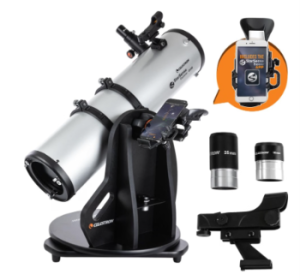
The Celestron StarSense Explorer 150mm App Enabled Tabletop Dobsonian Telescope makes stargazing a guided activity, which places it among the best Dobsonian telescopes for first time observers. A 6 inch mirror handles the viewing, and your smartphone handles the navigation.
Setup starts with a phone dock. You place your phone in it, launch the StarSense Explorer app, and follow the arrows on the screen. The app analyzes star patterns overhead to learn where the telescope points. This sky recognition approach sets it apart from many astronomy apps. Once the bullseye turns green, you look into the eyepiece and see your target.
Each night, the app also suggests top objects for your time and location. So you never need to wonder where to begin. Planets, bright nebulae, galaxies, and star clusters all appear on the list. City skies still offer plenty, but darker locations show more.
The optics deserve attention too. The 150mm Newtonian reflector uses high reflectivity coatings, so images look sharp and vivid. You can view the Moon, Jupiter, Saturn, the Orion Nebula, and the Andromeda Galaxy. The manual tabletop base moves smoothly in altitude and azimuth. It also feels solid at the eyepiece. Celestron supports the purchase with a two year warranty and help from a US team.
Best Suited For:Beginners and families benefit most. The telescope fits backyard evenings, school projects, and casual sessions where a big mirror matters more than a motor. Anyone who wants guidance without learning star charts should find it a comfortable start.
Specifications
- Type: 150mm (6 inch) Newtonian reflector on a tabletop altazimuth Dobsonian base
- Focal length: 650mm
- Eyepieces: 25mm and 10mm Kellner
- Finder: StarPointer red dot finderscope
- Smartphone support: dock and free app for iOS 18 and Android 12 or newer
- Power: one lithium metal battery included
- Weight: 25 lb
- Dimensions: 19 x 19 x 32.5 inches
Pros
- Ease of use makes it simple to operate and friendly to beginners
- Image quality earns praise for clear optics and views of Jupiter’s moons
- The Dobsonian frame and base feel solid
- Value looks strong, since many buyers say it is worth the price
Cons
- Assembly gets mixed feedback, as some find it quick while others want clearer instructions
2)Celestron StarSense Explorer 10″ App-Enabled Dobsonian Telescope
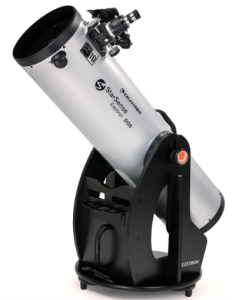
The Celestron StarSense Explorer 10″ App-Enabled Dobsonian Telescope is designed for astronomy enthusiasts who want a large-aperture telescope with smartphone-assisted navigation. It combines a 254mm (10-inch) Newtonian reflector with patented StarSense technology, helping users locate celestial objects without extensive knowledge of the night sky. By analyzing star patterns through a compatible smartphone camera, the StarSense Explorer app identifies the telescope’s position and provides directions to selected targets.
Finding objects is relatively straightforward. Users dock their smartphones, launch the StarSense Explorer app, and follow the arrows displayed on the screen. When the target is aligned with the telescope, the app’s bullseye indicator turns green, signaling that it is ready for viewing. Additionally, the application generates a list of recommended objects based on the user’s location and observing time. These suggestions include planets, bright nebulae, galaxies, and star clusters, making it easier to plan an observing session.
Optical performance is another important consideration with this model. Its 10-inch Newtonian reflector features a parabolic primary mirror and StarBright XLT coatings designed to improve light transmission. The large aperture gathers substantial light for observing lunar details, planetary features, and deep-sky objects. Users can explore Jupiter, Saturn, the Orion Nebula, and the Andromeda Galaxy, with darker observing locations offering opportunities to see more faint celestial targets. The included 25mm eyepiece provides an initial viewing option, while the 2-inch Crayford focuser accommodates compatible eyepieces.
The telescope uses a manual altazimuth Dobsonian base that provides stable support without requiring a tripod. Its simple movement system allows users to adjust the viewing direction by hand. However, it does not include motorized tracking, meaning celestial objects gradually drift out of view and require manual repositioning. This limitation also makes it less suitable for astrophotography.
Weighing approximately 54.8 pounds, the telescope is considerably bulky and requires adequate storage space. Moving it between observing locations may also require assistance. Nevertheless, its smartphone-guided navigation makes it an appealing option for beginners who want to explore the sky using a large-aperture reflector.
Best Suited For: This telescope is best suited to beginners, families, and astronomy enthusiasts interested in detailed planetary, lunar, and deep-sky observations. It is particularly useful for backyard and sidewalk-style stargazing where smartphone guidance can simplify locating targets. Celestron includes a two-year US warranty and access to technical support.
Specifications
- Type: 10 inch (254mm) Newtonian reflector with a parabolic primary mirror
- Focal length: 650mm, with a 25mm eyepiece included
- Focuser: 2 inch Crayford
- Finder: StarPointer red dot finderscope
- Smartphone support: dock and app for Android 12 or newer and iOS 18 or newer
- Mount: manual altazimuth Dobsonian base
- Power: one lithium metal battery included
- Weight: 54.8 lb
Pros
- Image quality earns praise, with reviewers seeing good detail in planets and star clusters
- Ease of use stands strong, since the app guides you with simple arrows
- Assembly gets positive feedback for clear instructions and a sturdy base
- Value looks solid, as reviewers generally find it worth the price
Cons
- The telescope is bulky and heavy, so it needs space and sometimes two people to carry
3)Celestron StarSense Explorer 8″ Dobsonian Telescope with Smartphone App
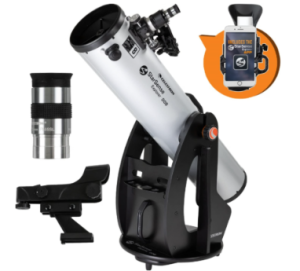
The Celestron StarSense Explorer 8″ Dobsonian Telescope with Smartphone App combines a large-aperture Newtonian reflector with smartphone-assisted navigation, making celestial observation more approachable for beginners. Its 203mm (8-inch) aperture provides the light-gathering capacity needed to explore the Moon, planets, star clusters, and selected deep-sky objects. Additionally, its patented StarSense technology helps users identify celestial targets without needing extensive experience reading star charts.
The StarSense Explorer app simplifies navigation by using a compatible smartphone camera to analyze star patterns and determine the telescope’s position. After placing the phone in the dedicated dock and launching the application, users can follow on-screen arrows toward their chosen objects. When the telescope is correctly aligned, the app’s bullseye indicator turns green. The application also recommends suitable viewing targets based on the user’s location and observing time, including planets, nebulae, galaxies, and star clusters. This guidance makes it easier to organize observing sessions, even for those unfamiliar with the night sky.
For optical performance, this model features an 8-inch Newtonian reflector with high-reflectivity StarBright XLT coatings. Its 1200mm focal length supports observations of lunar details, planetary features, and deep-sky objects. Users can explore Jupiter, Saturn, the Orion Nebula, and the Andromeda Galaxy, with darker skies providing better opportunities to observe fainter targets. The included 25mm eyepiece offers an initial viewing option, while the 2-inch Crayford focuser supports compatible eyepieces.
The telescope sits on a manual altazimuth Dobsonian base that provides stable support without requiring a tripod. Its straightforward mounting system allows users to move the optical tube vertically and horizontally. However, the mount does not provide automatic tracking, so objects gradually drift across the viewing area and require manual adjustments. The eyepiece also sits relatively high, meaning shorter users may find a stool or observing chair helpful.
Best Suited For:Weighing 43.4 pounds, this telescope is fairly heavy and bulky to transport, particularly without a dedicated carrying case. Nevertheless, it is well suited to beginners, families, and astronomy enthusiasts who want smartphone-guided navigation and detailed views of lunar, planetary, and deep-sky objects. Backyard observing and planned stargazing sessions are particularly suitable uses. Celestron also provides a two-year US warranty and access to technical support.
Specifications
- Type: 203mm (8 inch) Newtonian reflector with XLT coatings
- Focal length: 1200mm, with a 25mm eyepiece included
- Focuser: 2 inch Crayford
- Finder: StarPointer red dot finderscope
- Smartphone support: dock and app for Android 12 or newer and iOS 18 or newer
- Mount: manual altazimuth Dobsonian base
- Power: one lithium metal battery included
- Weight: 43.4 lb
Pros
- Image quality earns praise, with reviewers seeing planets and star clusters in sharp, clear detail
- Ease of use gets consistently positive feedback, since the arrows guide you to each target
- Assembly receives good marks for clear instructions and a sturdy base
- Value looks strong, as reviewers generally find it worth the price
Cons
- The telescope is bulky and heavy, and it has no carrying case
4)Celestron NPF FirstScope 76 Tabletop Dobsonian Telescope for Beginners
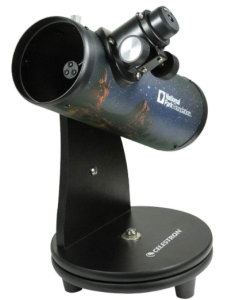
The Celestron NPF FirstScope 76 Tabletop Dobsonian Telescope for Beginners is a compact, lightweight telescope designed to introduce children, families, and first-time astronomers to stargazing. It features a 76mm Newtonian reflector with a 300mm focal length and a simple tabletop Dobsonian mount. Its straightforward design makes it suitable for casual observations without requiring complicated assembly or advanced knowledge of telescope operation. Weighing approximately 4.3 pounds, it is also easy to carry between the backyard, campsite, and other observing locations.
The telescope uses a spherical primary mirror to collect and focus incoming light. Its 76mm aperture is suitable for observing brighter celestial objects, particularly the Moon and nearby planets. Users can explore lunar craters and surface features, while Jupiter’s cloud bands and its four largest moons may also be visible under suitable conditions. Saturn’s rings are another potential observing target. However, its relatively small aperture limits deep-sky performance, so faint galaxies and nebulae will be difficult to observe. Brighter objects, such as the Orion Nebula and selected star clusters, offer more realistic targets.
For magnification, the telescope comes with 20mm and 10mm Kellner eyepieces, providing approximately 15x and 30x magnification, respectively. These options allow beginners to switch between wider views and closer observations of selected objects. The optical tube measures approximately 10 inches long, contributing to the telescope’s compact dimensions. Its stated field of view is 1.3 degrees, providing a useful viewing area for locating and observing celestial targets.
The tabletop altazimuth Dobsonian base provides a stable platform and allows users to move the telescope manually in horizontal and vertical directions. This simple arrangement makes it easier for beginners to understand basic telescope positioning. However, the package does not include a dedicated finder or Moon filter, so additional accessories may improve the observing experience. A suitable table or solid elevated surface is also needed for comfortable operation.
Best Suited For:This model is particularly suitable for children, families, and beginners looking for an affordable, portable telescope for introductory astronomy. It works well for casual backyard stargazing, camping trips, and educational activities focused on the Moon and brighter planets. Its limited light-gathering capacity makes it less appropriate for users seeking detailed observations of faint deep-sky objects.
Specifications
- Type: 76mm Newtonian reflector with a spherical mirror
- Focal length: 300mm
- Eyepieces: 20mm (about 15x) and 10mm (about 30x) Kellner
- Field of view: 1.3 degrees
- Mount: tabletop altazimuth Dobsonian base with manual focus
- Optical tube length: 10 inches
- Weight: about 4.4 lb
- Dimensions: 13 x 8 x 8 inches
Pros
- Portability makes it easy to take camping or to a park
- Stability earns praise, as reviewers find the mount steady and simple to use
- Moon and planet views show lunar detail, Jupiter’s bands and moons, and Saturn’s rings
- Setup suits families, with one reviewer ready to observe in 10 minutes
Cons
- The 76mm aperture limits light, so deep sky objects look faint
5)Explore Scientific 10 Inch f/5 Hybrid Truss Tube Dobsonian Telescope
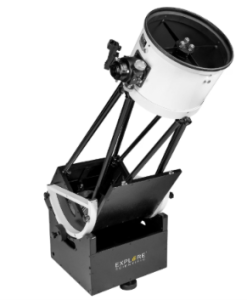
The Explore Scientific 10 Inch f/5 Hybrid Truss Tube Dobsonian Telescope is designed for astronomy enthusiasts who want a large-aperture reflector for exploring deep-sky objects, the Moon, and planets. It features a 254mm (10-inch) primary mirror that collects substantial light, helping reveal faint galaxies, nebulae, and star clusters. Its optical design also supports detailed observations of brighter celestial objects, making it suitable for experienced observers and beginners ready to explore more of the night sky.
One of its main advantages is the hybrid truss tube construction. A solid white aluminum tube supports and protects the secondary mirror, while the remaining truss structure allows the telescope to break down into separate sections for transportation. This tool-free assembly makes storage and transport easier, particularly when traveling with a smaller vehicle. The aluminum framework is designed to maintain structural rigidity during observations. However, the mirror box remains relatively heavy, so moving the complete telescope may require some effort.
The 254mm primary mirror operates at an f/5 focal ratio and has a 1,270mm focal length. Its light-gathering capacity supports observations of deep-sky targets, including galaxies, nebulae, and dense star clusters. It can also reveal lunar surface details and planetary features. Under suitable viewing conditions, observers may see Jupiter’s cloud bands and Saturn’s Cassini Division. Allowing the mirror to adjust to the outdoor temperature before observing can help achieve clearer images. The included collimation tool also assists with checking and adjusting optical alignment.
For convenient operation, the telescope comes with 25mm and 10mm Plossl eyepieces, a red-dot finder, and a single-speed focuser. Its high-altitude bearings support smooth manual movement, helping users position the optical tube when locating celestial targets. The focuser accepts 2-inch accessories and includes an adapter for 1.25-inch eyepieces. However, some owners report focusing instability, while the included 25mm eyepiece may leave room for an upgrade. An optional shroud can also help improve contrast and protect against dew.
Best Suited For:This telescope is particularly suitable for astronomy enthusiasts seeking a large-aperture instrument for serious deep-sky observation, lunar exploration, and planetary viewing. Its collapsible design makes it practical for observers who travel to darker locations, although its heavy mirror box requires careful handling. The manual mount also lacks motorized tracking, limiting its suitability for astrophotography.
Specifications
- Aperture: 254mm (10 inch) primary mirror at f/5
- Focal length: 1,270mm
- Focuser: single speed, manual, 2 inch with a 1.25 inch adapter included
- Eyepieces: 25mm and 10mm Plossl
- Finder: red dot finder
- Secondary obstruction: 24%
- Mount: manual altazimuth Dobsonian rocker box
- Weight: 41.5 lb
Pros
- Value looks strong, as reviewers call it a great choice for the price
- Viewing quality earns praise, with contrasty Jupiter bands and the Cassini division on Saturn
- Optics rate as excellent for a beginner scope
- Portability improves because it breaks down without tools into three units
Cons
- Focusing gets mixed feedback, with some reports of a wobbly focuser out of the box
6)HandyDob6 6-Inch Ultra Light Portable Dobsonian with Light Shroud and Smartphone Mount
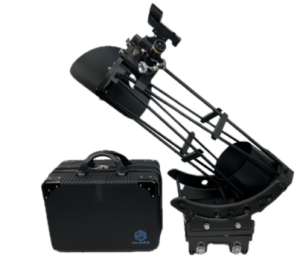
The HandyDob6 6-Inch Ultra Light Portable Dobsonian is designed for stargazers who want a capable telescope without carrying a bulky optical tube and mount. It combines a 150mm (6-inch) parabolic primary mirror with a compact, modular frame that can be disassembled for transportation. Its lightweight construction and travel-friendly dimensions make it suitable for backyard observations, camping trips, and astronomy outings where portability matters. The telescope can be assembled within minutes without requiring tools, making it convenient for observers who frequently change viewing locations.
Its 150mm primary mirror has a 750mm focal length and an f/5 focal ratio, providing a useful balance for observing the Moon, planets, and brighter deep-sky objects. The optical system is designed to deliver clear, high-contrast images, allowing users to explore lunar craters, planetary details, and selected star clusters and nebulae. However, its aperture has limitations when viewing faint deep-sky targets, particularly under less favorable observing conditions.
The modular construction uses a lightweight, carbon fiber-reinforced 3D-printed frame designed to provide structural support without adding unnecessary bulk. Its components separate easily for storage, while the included light shroud helps shield the optical path from surrounding light. A smartphone mount is also supplied, featuring 360-degree rotation and compatibility with phones measuring between 55mm and 110mm wide. This provides a convenient mounting option for smartphone-assisted observing and photography.
For manual navigation, the HandyDob6 uses PTFE bearings to support smooth movement in both altitude and azimuth. Its balanced construction helps users adjust the telescope when locating and following celestial objects. Those interested in smartphone-guided navigation can also add the Push-To Air system, which is sold separately and works with astronomy applications such as SkySafari. Although the focuser is designed for 1.25-inch accessories, compatible 2-inch filters can be mounted directly without additional adapters. The configuration also includes a Steel Tripod Stability Plate for models manufactured from July 2026 onward.
Best Suited For:This telescope is particularly suitable for traveling astronomy enthusiasts, families, and observers who need a portable 6-inch reflector for outdoor stargazing. Its compact design makes it practical for trips to darker observing locations. However, eyepieces and collimation tools must be purchased separately, increasing the initial setup cost. Beginners may also benefit from assistance when learning to align and operate the telescope.
Specifications
- Aperture: 150mm (6 inch) parabolic mirror at f/5
- Focal length: 750mm
- Focuser: 1.25 inch, 35mm travel
- Finder: red dot finder
- Mount: manual altazimuth Dobsonian with PTFE bearings
- Included extras: light shroud and smartphone mount for 55 to 110mm phones
- Weight: 4.2 kg body
- Warranty: one year from the manufacturer
Pros
- Portability earns top marks from reviewers, who call it great for travel
- Build quality draws praise for its solid mechanics and thoughtful design
- Setup needs no tools for assembly or disassembly
- Suitability gets positive feedback, with many customers calling it a good beginner choice
Cons
- Eyepieces and collimation tools cost extra
You may also like to read:10 Best Motorized Telescope
Advantages of Using the Dobsonian Telescopes
Excellent Light-Gathering Capability
Many Dobsonian telescopes feature relatively large primary mirrors that collect substantial amounts of light, making faint celestial objects easier to observe. Larger apertures help reveal details in the Moon, planets, star clusters, and deep-sky objects such as galaxies and nebulae. This makes them suitable for observers who want to explore more than the brightest objects visible to the naked eye. Depending on aperture and observing conditions, they can provide increasingly detailed views of distant targets.
Simple and Stable Mounting Systems
Dobsonian telescopes use straightforward altazimuth mounts that move horizontally and vertically. This arrangement makes pointing the telescope relatively easy, even for people with limited astronomy experience. Their low-profile bases also provide stable support without requiring complicated tripod arrangements. Consequently, users can concentrate on locating and observing celestial objects rather than learning complex mounting controls.
Beginner-Friendly Operation
Many models are designed with simple controls and uncomplicated setups, making them approachable for first-time astronomers. Manual movement allows users to learn how to position the telescope and follow objects across the sky. Some models also incorporate smartphone-guided navigation, which provides additional assistance when locating unfamiliar stars, planets, and deep-sky targets. These features make Dobsonian telescopes useful for educational activities and family stargazing.
Detailed Lunar and Planetary Observations
A suitable aperture and optical system can reveal impressive details on nearby celestial objects. Observers can examine lunar craters, mountain ranges, and surface features, while larger models may reveal Jupiter’s cloud bands, its moons, and Saturn’s rings. Different eyepieces also provide opportunities to adjust magnification according to the target and viewing conditions. This versatility makes these telescopes appealing for regular observations of the Solar System.
Access to Deep-Sky Objects
Larger Dobsonian telescopes collect enough light to explore a variety of deep-sky targets. These include bright nebulae, globular clusters, open star clusters, and some galaxies. Their performance depends on aperture, sky darkness, atmospheric conditions, and optical alignment. Nevertheless, they provide an opportunity to explore objects beyond the Moon and planets, particularly when observing away from city lights.
Practical Portability and Storage Options
Although larger models can be heavy, several designs incorporate tabletop bases, collapsible frames, or modular truss structures to simplify transportation. These arrangements allow users to separate telescope components for storage and travel. Lightweight models are particularly convenient for camping trips and visits to darker observing locations. As a result, buyers can choose a configuration that suits their available storage space and observing habits.
Flexible Observing Accessories
Dobsonian telescopes support different eyepieces, filters, finders, and other compatible accessories that can improve the observing experience. Changing eyepieces allows users to explore different magnifications, while filters can assist with selected lunar and planetary observations. Some models also accommodate smartphone mounts or optional electronic navigation systems. This flexibility allows owners to adapt their equipment as their astronomy experience develops.
Factors to Consider When Choosing the Best Dobsonian Telescopes
Aperture Size
Aperture determines how much light a telescope collects and plays a major role in its ability to reveal faint celestial objects. Smaller apertures are generally suitable for the Moon, brighter planets, and selected star clusters. However, larger mirrors collect more light, improving the potential for observing galaxies, nebulae, and other deep-sky targets. Consider your preferred observing activities and available storage space when choosing an aperture.
Optical Quality and Mirror Type
The quality of the primary and secondary mirrors influences image clarity, contrast, and overall viewing performance. Parabolic mirrors are commonly used in Newtonian reflectors because they focus incoming light effectively across the optical system. Mirror coatings can also influence light reflection and transmission. Check the optical specifications, mirror alignment requirements, and available coatings rather than relying on aperture size alone.
Focal Length and Focal Ratio
Focal length affects the magnification available with different eyepieces, while focal ratio describes the relationship between focal length and aperture. Longer focal lengths can be useful for observing the Moon and planets at higher magnifications with suitable eyepieces. Shorter focal ratios generally provide wider fields of view, which can benefit observations of larger star clusters and nebulae. Consider the types of celestial objects you intend to explore when assessing these specifications.
Mount Stability and Movement
A stable mount helps maintain a clear image and makes it easier to follow celestial objects. Dobsonian bases should support the optical tube securely while allowing smooth horizontal and vertical movement. Check the quality of the bearings, balance, construction materials, and ease of adjustment. Stiff or unstable movement can make locating and tracking objects frustrating, particularly when observing at higher magnifications.
Portability and Weight
Consider the telescope’s total weight, dimensions, and storage requirements before purchasing. Compact tabletop models are easier to carry and can suit camping trips or occasional outdoor observations. Larger instruments may offer greater light-gathering capacity but require more storage space and effort to transport. Collapsible and truss-tube designs can simplify packing, although their mirror boxes and other components may still be heavy.
Eyepieces and Focusing System
Included eyepieces determine the magnification options available immediately after purchase. Different focal lengths allow users to switch between wider views and closer observations of specific celestial objects. Also, examine the focuser size, adjustment mechanism, and compatibility with additional eyepieces. A smooth, stable focuser makes it easier to achieve sharp images, while compatible accessories provide more flexibility as your observing interests develop.
Navigation and Tracking Features
Traditional Dobsonian telescopes use manual controls, requiring users to locate objects and adjust the telescope as they move across the sky. Beginners may prefer models with smartphone-guided navigation, digital setting circles, or optional push-to systems. These features can simplify target identification, although they do not necessarily provide automatic tracking. If motorized movement is important, check whether the telescope supports it because most standard Dobsonian mounts require manual adjustments.
Included Accessories, Warranty, and Support
Check what comes with the telescope before comparing prices. Useful accessories may include eyepieces, finderscopes, smartphone holders, collimation tools, and protective shrouds. Some models require additional purchases before they are ready for regular observing. Warranty coverage and access to technical support are also worth considering, particularly for beginners who may need help with assembly, optical alignment, or accessory compatibility.
FAQs
Are Dobsonian Telescopes Good for Beginners?
Yes. Dobsonian telescopes are suitable for beginners because they generally feature simple mounting systems, straightforward manual controls, and relatively easy setup. Their large apertures also provide opportunities to observe the Moon, planets, star clusters, and brighter deep-sky objects. Models with smartphone-guided navigation can make finding celestial targets even easier for first-time users.
What Can You See with a Dobsonian Telescope?
A Dobsonian telescope can reveal various celestial objects, depending on its aperture, optical quality, and observing conditions. Common targets include lunar craters, Jupiter’s cloud bands and moons, Saturn’s rings, star clusters, nebulae, and galaxies. Larger-aperture models generally collect more light, making fainter deep-sky objects easier to observe, particularly under dark skies.
Do Dobsonian Telescopes Track Objects Automatically?
Most traditional Dobsonian telescopes use manual altazimuth mounts rather than motorized tracking systems. Users must move the telescope by hand to keep celestial objects centered as the Earth rotates. Some models offer optional electronic navigation systems to help locate targets, but these do not necessarily provide automatic tracking. Buyers interested in astrophotography should consider this limitation before purchasing.
Conclusion
The Best Dobsonian Telescopes provide an accessible and rewarding way to explore the night sky, combining practical mounting systems with optical designs suited to different levels of astronomy experience. Their range of apertures accommodates everything from casual lunar observations to more demanding deep-sky exploration. Additionally, features such as smartphone-guided navigation, collapsible frames, smooth manual controls, and interchangeable eyepieces make them useful for different observing preferences. Whether choosing a lightweight tabletop model for family stargazing or a larger reflector for exploring distant galaxies and nebulae, there are options for different budgets and experience levels. Consider aperture, optical quality, portability, mounting stability, and included accessories to find a telescope that matches your observing needs.