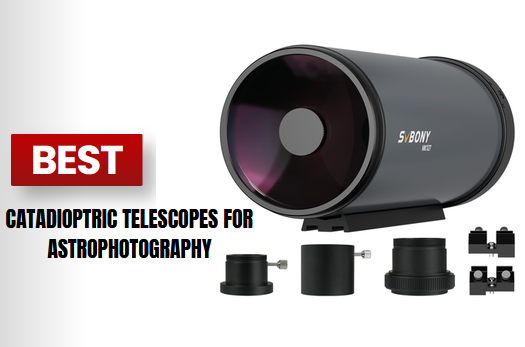
The best catadioptric telescopes for astrophotography pack long focal lengths into compact tubes, so you can chase the Moon and planets anywhere. I compared models from 5 inch to 11 inch apertures to see which ones suit imaging, and I found that the folded optical design delivers strong light gathering and large image scale in a body that is easy to carry. Quality coatings add brightness and contrast, and computerized GoTo mounts find and follow targets for you.
In this guide, I look closely at the must have features: aperture, focal length and focal ratio, mount type and tracking, alignment, camera compatibility, and included accessories. I also share my top picks and say plainly where each one falls short, since altazimuth mounts handle short exposures well but struggle with long exposures on faint deep sky targets. Next comes a buying guide covering the factors that matter most, followed by answers to common questions, so you can choose a telescope that fits your targets, your budget, and your observing spot.
Our Top Picks at a Glance
- Celestron NexStar 8SE Computerized Schmidt-Cassegrain Telescope – Best Overall
- Celestron NexStar 6SE Schmidt-Cassegrain Telescope – Best for Versatility
- Celestron NexStar 5SE Schmidt-Cassegrain Computerized Telescope – Best Compact Option
- SVBONY MK127 Telescope – Best Budget Option
- Celestron StarSense Explorer DX 5″ App-Enabled Schmidt-Cassegrain Telescope – Best for Beginners
- Sky-Watcher Skymax S11540 Maksutov-Cassegrain Reflector Telescope – Best for Planetary Astrophotography
- Celestron CGEM II 11″ Schmidt-Cassegrain Telescope with GoTo EQ Mount – Best Premium Option
Best Catadioptric Telescopes for Astrophotography
1)Celestron NexStar 8SE Computerized Schmidt-Cassegrain Telescope
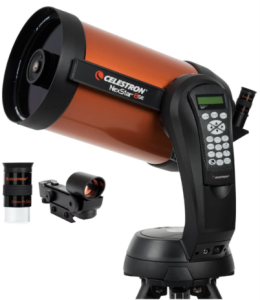
The Celestron NexStar 8SE Computerized Schmidt-Cassegrain Telescope gives observers a motorized route to the Moon and planets, which earns it a place among the best catadioptric telescopes for astrophotography. Celestron pairs its orange tube with a fully computerized GoTo system for people ready to leave manual scopes behind.
The 8 inch (203 mm) aperture gathers enough light to show fine lunar detail, cloud bands on Jupiter, and deep sky objects such as galaxies and globular clusters. StarBright XLT coatings cover the optics, and the tube measures a compact 43.2 cm.
The NexStar+ hand control stores more than 40,000 objects. Pick a target and the mount slews to it and tracks it, so you skip star charts and manual hunting.
SkyAlign asks you to center any three bright stars or planets, whether or not you know their names, then calculates your position and aligns the mount within minutes. Reviewers give alignment mixed marks, with only 30% positive, so expect some trial and error.
A 25 mm Plossl eyepiece and a StarPointer red dot finderscope come with the scope, which weighs 23.9 lb. Power does not come in the box, so plan on 8 AA batteries, a 12V adapter, or a PowerTank. Celestron accessories add automation, wireless control, or better location accuracy, and Celestron backs the scope with a 2 year US warranty and unlimited technical support.
Best Suited For:It is suited for ambitious beginners and intermediate hobbyists who want automated pointing for lunar and planetary viewing and introductory imaging.
Specifications
- Aperture: 8 inch (203 mm)
- Focal length and ratio: 2032 mm, f10
- Coatings: StarBright XLT
- Mount: computerized altazimuth GoTo
- Object database: 40,000+ objects
- Eyepiece: 25 mm Plossl
- Weight: 23.9 lb
- Warranty: 2 years
Pros
- Detailed lunar and planetary views
- Automatic object location and tracking
- SkyAlign speeds up setup
- Works with Celestron accessories
- 2 year US warranty with support
Cons
- Altazimuth mount limits long exposure imaging
2)Celestron NexStar 6SE Schmidt-Cassegrain Telescope
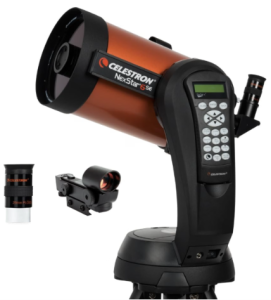
The Celestron NexStar 6SE Schmidt-Cassegrain Telescope suits shoppers browsing the best catadioptric telescopes for astrophotography who want a computerized mount to handle the pointing while they photograph the Moon and planets. Its orange tube holds a 6 inch (15 cm) optical system with StarBright XLT coatings.
The aperture gathers enough light to show lunar detail, Jupiter’s cloud bands, and deep sky targets such as galaxies and globular clusters. Reviewers describe clear views of the Moon, the planets, and Jupiter’s moons, and 78% of optical quality mentions are positive.
For imaging, you can attach a camera or phone at prime focus and take short exposures of the Moon and planets. Reviewers say the scope does not track well enough for deep sky imaging without an autoguider, and they point to an equatorial mount with a tracking motor for that work.
The NexStar+ hand control holds more than 40,000 objects. Choose a target and the mount slews to it and follows it. The computerized altazimuth mount uses a single fork arm.
SkyAlign needs three bright stars or planets, even unnamed ones, and then aligns the mount in minutes. Alignment feedback runs mixed at 40% positive, and some owners find the two star method frustrating. Ease of use fares better, with 81% positive mentions and quick setup. Reliability feedback sits at a mixed 53% positive.
The scope ships with a 25 mm Plossl eyepiece and a StarPointer red dot finderscope. The tube measures 40.6 cm and the scope weighs 21 lb. Power does not come in the box, so you supply 8 AA batteries, a 12V adapter, or a PowerTank. A 2 year US warranty and unlimited technical support back the purchase.
Best Suited For:This telescope fits beginners and intermediate hobbyists who want automated pointing for backyard lunar and planetary viewing and short exposure imaging.
Specifications
- Aperture: 6 inch (15 cm)
- Optical design: Schmidt-Cassegrain
- Coatings: StarBright XLT
- Mount: computerized altazimuth, single fork arm
- Object database: 40,000+ objects
- Eyepiece: 25 mm Plossl
- Finderscope: StarPointer red dot
- Weight: 21 lb
- Tube length: 40.6 cm
Pros
- Clear Moon, planet, and Jupiter moon views
- Quick, easy setup
- Automatic object location and tracking
- Camera or phone attaches for short exposures
- Works with Celestron accessories
- 2 year US warranty with support
Cons
- Tracking falls short for deep sky imaging without an autoguider
3)Celestron NexStar 5SE Schmidt-Cassegrain Computerized Telescope
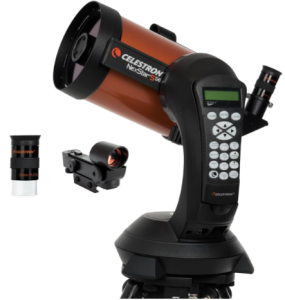
The Celestron NexStar 5SE Schmidt-Cassegrain Computerized Telescope offers an entry point into Moon and planet imaging, and it fits any list of the best catadioptric telescopes for astrophotography that welcomes beginners. Its orange tube holds a 5 inch (127 mm) system with StarBright XLT coatings and a 2500 mm focal length.
The aperture gathers enough light to show lunar detail, Jupiter’s cloud bands, and deep sky objects such as galaxies and globular clusters. Reviewers describe clear, high contrast views of the Moon, the planets, and brighter deep sky objects. The compact, one piece design travels easily, and the 25 mm eyepiece gives 50x.
The NexStar+ hand control holds more than 40,000 objects. Select a target and the mount slews to it and follows it. Reviewers say it finds and tracks objects well once aligned, and 88% of quality mentions are positive.
SkyAlign starts the session when you center any three bright stars or planets. The system then calculates your position and aligns the mount in minutes. Alignment feedback runs mixed at 31% positive, and some owners report SkyAlign failing repeatedly.
For imaging, a built in wedge lets you polar align the mount, which reduces field rotation and improves tracking, and a camera control feature comes with it. The altazimuth mount and short wedge still limit you to brief exposures. Reliability feedback runs mixed, and some owners report a cracked leg brace or a unit that stopped working.
The scope weighs 17.6 lb and has a StarPointer red dot finderscope. Power does not come in the box, so plan on 8 AA batteries, a 12V adapter, or a PowerTank. Celestron backs it with a 2 year US warranty and unlimited technical support.
Best Suited For:This telescope fits beginners and hobbyists stepping up from manual scopes who want automated pointing, backyard viewing, and short exposure imaging of the Moon and planets.
Specifications
- Aperture: 5 inch (127 mm)
- Optical design: Schmidt-Cassegrain with StarBright XLT coatings
- Focal length: 2500 mm
- Mount: computerized altazimuth, single fork arm
- Object database: 40,000+ objects
- Eyepiece: 25 mm (50x)
- Finderscope: StarPointer red dot
- Weight: 17.6 lb
Pros
- Clear, high contrast views of the Moon, planets, and brighter deep sky objects
- Reliable object finding and tracking once aligned
- Compact, one piece design that is easy to transport
- Built in wedge for polar alignment
- 2 year US warranty with support
Cons
- Mount and short wedge limit imaging to brief exposures
4)SVBONY MK127 Telescope
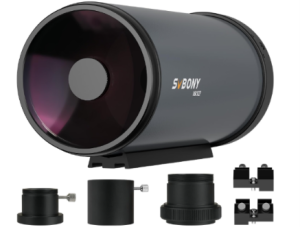
The SVBONY MK127 Maksutov-Cassegrain Telescope is a compact optical tube designed for astronomers interested in detailed lunar, planetary, and selected deep-sky observations. It features a 127mm effective aperture and an f/11.8 focal ratio, providing a long focal length of 1495.6mm for examining smaller celestial targets. Its Maksutov-Cassegrain optical design combines reflective and corrective elements to minimize optical aberrations and produce sharp images with good contrast. The fully multi-coated optics also feature 99% high-reflectivity dielectric coatings, helping improve light reflection and optical efficiency when observing distant objects.
For astrophotography, the MK127 offers several useful optical features. Its flat-field design helps maintain image sharpness across the viewing area, while the included 0.65x flat-field reducer provides a wider field of view. This accessory reduces the effective focal length, making it easier to frame larger celestial targets and capture more of their surrounding details. However, the f/11.8 focal ratio remains relatively slow for photographing faint deep-sky objects, which generally require longer exposures. A lens hood is also recommended when imaging deep-sky targets because it helps block unwanted stray light and improve image contrast.
Another useful feature is the dual-speed manual focusing mechanism. Its main adjustment allows users to bring objects into focus quickly, while the fine-tuning control supports more precise adjustments when examining small planetary details or preparing images. The telescope also accommodates both 2-inch and 1.25-inch eyepieces, providing flexibility when selecting additional observing accessories. An integrated dovetail slot allows users to attach a compatible star finder or guide scope to simplify target acquisition and tracking.
The optical tube measures 32.6cm and weighs approximately 3.2 pounds, making it convenient to transport between observing locations. It also features a Vixen-style dovetail plate for mounting compatibility. However, this product is supplied as an optical tube only, meaning users must purchase a suitable mount separately. For astrophotography, a motorized equatorial mount with accurate tracking is particularly important, especially when photographing faint deep-sky objects.
Best Suited For:This telescope is particularly suitable for amateur astronomers, planetary photographers, and enthusiasts who prioritize detailed lunar and planetary images in a portable setup. Its included focal reducer adds flexibility for wider-field observations, although deep-sky photographers will need additional tracking equipment to achieve longer exposures.
Specifications
- Optical Design: Maksutov-Cassegrain
- Aperture: 127mm
- Focal Length: 1495.6mm
- Focal Ratio: f/11.8
- Optical Coatings: Fully multi-coated, 99% dielectric coatings
- Focal Reducer: 0.65x flat-field reducer
- Focusing: Dual-speed manual focuser
- Eyepiece Compatibility: 2-inch and 1.25-inch
- Weight: 3.2 lb
Pros
- Sharp lunar and planetary views with good image contrast
- High-reflectivity coatings improve optical efficiency
- Flat-field design helps maintain image clarity
- Included focal reducer supports wider-field imaging
- Dual-speed focuser allows precise adjustments
- Lightweight construction makes transportation easier
- Compatible with different eyepiece sizes
Cons
- Slow f/11.8 focal ratio requires longer exposures for faint deep-sky objects
5)Celestron StarSense Explorer DX 5″ App-Enabled Schmidt-Cassegrain Telescope
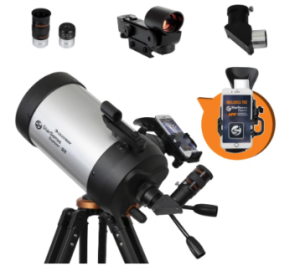
The Celestron StarSense Explorer DX 5″ App-Enabled Schmidt-Cassegrain Telescope works as a guided starting point for beginners, though the listing says it does not suit long exposure imaging, so it sits at the gentle end of the best catadioptric telescopes for astrophotography. Its 130 mm tube has StarBright XLT coatings and a 1250 mm focal length, and it gives sharp, vivid views of the Moon, Jupiter, Saturn, the Orion Nebula, and the Andromeda Galaxy.
The StarSense Explorer app handles setup. Dock your phone, launch the app, and it analyzes the star patterns overhead to find where the telescope points. On screen arrows lead you to the target, and when the bullseye turns green, you can see the object clearly in the eyepiece. No experience is necessary.
The app also builds a list of top targets for your time and location. You can see planets, bright nebulae, galaxies, and star clusters from a city, and dark skies reveal more.
The manual altazimuth mount has dual axis slow motion controls and arrives preassembled. Customers call the scope beginner friendly, with 100% of ease of use mentions and 100% of value mentions positive. Build quality earns 80% positive mentions for a sturdy frame, yet some customers find the mount and tripod shaky. Usability feedback sits at a mixed 50% positive, and some owners report unreliable apps or parts. A few customers measure the tube at 125 mm, not the 130 mm in the description.
Image quality earns 80% positive mentions. The kit includes 25 mm and 10 mm eyepieces, an erect image diagonal, and a red dot finderscope. The scope weighs 14.6 lb, the tube measures 33 cm, and a lithium metal battery comes in the box. The altazimuth mount cannot track long exposures, and the listing mentions no imaging accessories. Celestron backs it with a 2 year US warranty and unlimited technical support.
Best Suited For:This telescope is particularly suitable for beginners, families, and casual observers who want guided access to the night sky without complicated star charts. It works best for visual astronomy and introductory lunar and planetary observation rather than serious long-exposure astrophotography.
Specifications
- Aperture: 5 inch (130 mm) Schmidt Cassegrain
- Coatings: StarBright XLT
- Focal length: 1250 mm
- Mount: manual altazimuth, dual axis slow motion
- Eyepieces: 25 mm and 10 mm
- Guidance: StarSense Explorer app with phone dock
- Weight: 14.6 lb
- Tube length: 33 cm
Pros
- Beginner friendly, with 100% of ease of use mentions positive
- Clear Moon and planet views
- Strong value feedback, 100% positive
- Sturdy frame with 80% positive build quality mentions
- Battery included
- 2 year US warranty with support
Cons
- Altazimuth mount cannot track for long exposures
6)Sky-Watcher Skymax S11540 Maksutov-Cassegrain Reflector Telescope
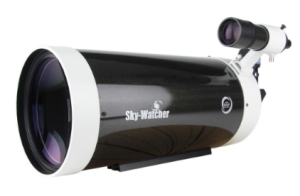
The Sky-Watcher Skymax 180mm Maksutov-Cassegrain Reflector Telescope is designed for astronomers who prioritize detailed lunar and planetary observation alongside specialized astrophotography. It features a 180mm (7-inch) aperture and a Maksutov-Cassegrain optical system that combines matched primary and secondary mirrors with a coated corrector plate. This arrangement helps reduce optical aberrations and produces high-contrast images with dark backgrounds. Its large aperture collects substantial light, allowing users to examine Jupiter’s cloud bands, planetary moons, lunar craters, and other fine celestial details.
The telescope uses a borosilicate primary mirror with an aluminum coating and protective quartz overcoat, providing approximately 94% reflectivity. Its fully multi-coated optical surfaces further support light transmission, while the internally baffled tube helps prevent stray light from interfering with observations. These features contribute to clear planetary views and make the optical tube particularly useful for imaging bright celestial objects. The 2700mm focal length, equivalent to approximately f/15, also provides a large image scale for planetary photography without necessarily requiring an additional Barlow lens.
For astrophotography, the Skymax 180mm is particularly suited to lunar and planetary imaging, where its long focal length helps capture smaller targets with considerable detail. However, the f/15 focal ratio presents limitations when photographing faint deep-sky objects because longer exposures are needed to collect sufficient light. Its narrow field of view also makes framing larger celestial objects more difficult. A motorized equatorial mount is therefore recommended for accurate tracking, especially during extended imaging sessions.
The optical tube features a Vixen-style dovetail plate, allowing it to attach to compatible astronomical mounts. This provides flexibility when selecting an appropriate equatorial tracking system. The telescope also uses internal primary mirror focusing, allowing users to adjust image sharpness through the focusing mechanism. Its optical tube weighs approximately 19 pounds, so a sufficiently sturdy mount is important for maintaining stability during observation and imaging.
Sky-Watcher includes several accessories to help users begin observing without immediately purchasing additional optical equipment. These include a 28mm 2-inch eyepiece, a 2-inch 90-degree star diagonal, and a 9×50 straight-through finderscope. The telescope also comes with a two-year warranty.
Best Suited For:This telescope is particularly suitable for experienced amateur astronomers, planetary photographers, and lunar imaging enthusiasts who want detailed views of bright celestial targets. It is less appropriate for wide-field astrophotography or faint deep-sky imaging without additional equipment and a capable tracking mount.
Specifications
- Optical Design: Maksutov-Cassegrain
- Aperture: 180mm (7 inches)
- Focal Length: 2700mm
- Focal Ratio: f/15
- Mirror Reflectivity: 94%
- Focusing: Internal primary mirror focusing
- Mount Compatibility: Vixen-style dovetail
- Included Accessories: 28mm eyepiece, 2-inch diagonal, 9×50 finderscope
- Weight: 19 lb
Pros
- Detailed views of lunar features and planetary cloud bands
- 94% mirror reflectivity supports efficient light transmission
- Long focal length provides a large planetary image scale
- Fully baffled tube helps reduce unwanted stray light
- Vixen-style dovetail supports compatible equatorial mounts
- Includes useful eyepiece, diagonal, and finderscope
- Two-year warranty
Cons
- Slow f/15 focal ratio limits faint deep-sky imaging
7)Celestron CGEM II 11″ Schmidt-Cassegrain Telescope with GoTo EQ Mount
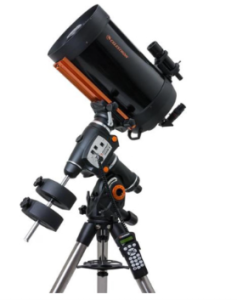
The Celestron CGEM II 11″ Schmidt-Cassegrain Telescope with GoTo EQ Mount belongs among the best catadioptric telescopes for astrophotography for observers who want an equatorial platform built for long exposures. Its 11 inch (27.9 cm) Schmidt-Cassegrain optics have StarBright XLT coatings and a 2800 mm focal length, and the large aperture gathers a lot of light for bright, detailed views of celestial objects.
The listing says the aperture collects about 89% more light than an 8 inch scope. With compatible eyepieces, magnification reaches up to 660x, which brings out fine detail on planets, the Moon, and deep sky objects. The StarBright XLT coatings add light transmission and contrast for brighter, sharper images.
The computerized equatorial mount uses a NexStar hand control with a database of more than 40,000 objects. Select a target and the mount locates it and tracks it automatically. Because the mount is equatorial, the listing describes the telescope as ready for both visual use and astroimaging, and it gives a vibration free platform for optional CCD cameras. It also connects with a camera, laptop, smartphone, or tablet.
Large altitude and azimuth knobs make polar alignment quick. One reviewer found the GPS alignment frustrating as a beginner, so expect a learning curve. Reviewers also note that the azimuth knobs can strip if overtightened and that the dovetail screws can loosen over time.
A sturdy 2 inch steel tripod and robust mount keep vibrations low for steady viewing. The kit includes a Plossl eyepiece and a 9×50 finderscope, with a 4 mm exit pupil, and the optical tube measures 61 cm. A CR2032 battery is included. The setup is heavy, though. The listing gives a total weight of 148.5 lb, and a Q&A reports about 120 lb for the full setup, so this is not a grab and go scope.
Best Suited For:This telescope is particularly suitable for experienced amateur astronomers, dedicated deep-sky photographers, and users who want an equatorial GoTo system for extended imaging sessions. Its aperture, computerized tracking, and substantial mounting platform make it suitable for demanding observation setups, although beginners may need time to master alignment and operation.
Specifications
- Aperture: 11 inch (27.9 cm) Schmidt-Cassegrain
- Coatings: StarBright XLT
- Focal length: 2800 mm
- Mount: computerized equatorial GoTo
- Object database: 40,000+ objects
- Eyepiece and finder: Plossl, 9×50 finderscope
- Tube length: 61 cm
- Power: 1 CR2032 battery, included
Pros
- Equatorial tracking built for long exposures
- Vibration free platform for optional CCD cameras
- About 89% more light than an 8 inch scope, per the listing
- Quick polar alignment with large knobs
- Connects with camera, laptop, smartphone, and tablet
Cons
- Heavy setup, so not a grab and go scope
You may also like to read:6 Best Dobsonian Telescopes
Advantages of Using Catadioptric Telescopes for Astrophotography
Compact Design and Portability
Catadioptric telescopes use folded optical paths that allow them to achieve long focal lengths without requiring excessively long optical tubes. This makes them easier to transport, store, and set up compared with their actual focal lengths. Their compact construction is particularly useful for astrophotographers who travel to dark-sky locations or need to move their equipment between observing sites.
Excellent Planetary and Lunar Imaging
Many catadioptric telescopes offer long focal lengths that help produce larger image scales when photographing the Moon and planets. This allows astrophotographers to capture details such as lunar craters, Jupiter’s cloud bands, Saturn’s rings, and planetary moons. Their optical designs also provide good contrast and sharpness, making them suitable for imaging relatively small and bright celestial targets.
Versatile Deep-Sky Observation
Larger-aperture catadioptric telescopes collect substantial amounts of light, allowing users to observe galaxies, nebulae, and globular clusters. Depending on the optical design, focal ratio, and available accessories, they can also support deep-sky photography. Focal reducers can further expand the field of view and make larger celestial objects easier to frame.
Reduced Optical Aberrations
The combination of mirrors and corrective lenses helps control several optical imperfections that can affect image quality. Maksutov-Cassegrain and Schmidt-Cassegrain designs use corrective optical elements to improve image sharpness and reduce unwanted distortions. This helps produce detailed images with good contrast, particularly when observing the Moon and planets.
Strong Light-Gathering Capability
Catadioptric telescopes are available with different aperture sizes, allowing astrophotographers to select an instrument based on their imaging requirements. Larger apertures collect more light, helping reveal faint celestial details and improving the potential for photographing distant objects. This is particularly beneficial when observing galaxies, nebulae, and other deep-sky targets.
Compatibility With Astrophotography Accessories
Many catadioptric optical tubes support additional equipment such as cameras, focal reducers, Barlow lenses, guide scopes, and electronic focusing accessories. Some models also feature standard dovetail mounting systems for compatibility with different astronomical mounts. These options allow users to modify their setups as their imaging experience and requirements develop.
Automated Tracking and Object Location
Computerized catadioptric telescopes can simplify the process of finding and following celestial targets. GoTo systems use databases containing thousands of astronomical objects to position the telescope automatically. When paired with suitable tracking mounts, these systems help maintain accurate target positioning during imaging sessions, reducing the need for constant manual adjustments.
Factors to Consider When Choosing the Best Catadioptric Telescopes for Astrophotography
Aperture Size
Aperture determines how much light a telescope collects and influences the level of detail visible in celestial objects. Larger apertures generally provide better light-gathering capabilities, making them useful for observing faint galaxies, nebulae, and distant star clusters. Smaller apertures can still deliver excellent lunar and planetary views while keeping the equipment lighter and easier to transport. Consider your primary imaging targets and choose an aperture that balances optical performance, portability, and budget.
Optical Design and Coatings
Catadioptric telescopes commonly use Schmidt-Cassegrain or Maksutov-Cassegrain optical designs. Schmidt-Cassegrain models offer versatility across different observing applications, while Maksutov-Cassegrain designs are particularly popular for detailed lunar and planetary observation. Optical coatings also influence light transmission, contrast, and image quality. Look for quality reflective and corrective optical surfaces, as well as coatings designed to improve light transmission and reduce unwanted reflections.
Focal Length and Focal Ratio
Focal length determines the telescope’s image scale and influences how large celestial objects appear in photographs. Longer focal lengths are useful for capturing smaller targets such as planets and lunar features. However, they can make accurate tracking more demanding. The focal ratio also matters because it affects how quickly the telescope collects light for a given image scale. Faster focal ratios are generally more convenient for deep-sky imaging, while slower systems are often suitable for high-magnification planetary photography.
Mount Type and Tracking Accuracy
The mount is particularly important when choosing a telescope for astrophotography. Altazimuth mounts move vertically and horizontally, making them convenient for visual observation and basic imaging. However, they experience field rotation during extended exposures. Equatorial mounts compensate for Earth’s rotation and are generally better suited to long-exposure deep-sky photography. Consider the mount’s payload capacity, tracking accuracy, stability, and compatibility with additional imaging equipment.
Focusing Mechanism
Accurate focusing is essential for producing sharp astronomical photographs. Some telescopes use manual focusing systems, while others offer dual-speed mechanisms that allow both quick adjustments and precise fine-tuning. Electronic focusers can provide additional control when working with cameras and automated imaging setups. Consider how smoothly the focusing mechanism operates and whether it can maintain accurate focus during extended observing sessions.
Astrophotography Compatibility and Accessories
Check whether the telescope supports camera attachments, focal reducers, Barlow lenses, guide scopes, and other imaging accessories. A focal reducer can shorten the effective focal length and provide a wider field of view, which is useful for photographing larger deep-sky objects. Camera compatibility is equally important, particularly when selecting adapters and connections. Also consider whether the telescope includes useful accessories or requires additional purchases before imaging can begin.
Portability, Weight, and Build Quality
A telescope’s weight and construction affect how easily it can be transported, assembled, and operated. Compact optical tubes are convenient for astrophotographers who regularly travel to darker observing locations. However, larger apertures and heavier optical tubes require stronger mounts and tripods to maintain stability. Examine the quality of the mounting hardware, dovetail plate, optical tube, and tripod before making a decision. A sturdy setup helps minimize vibrations that can interfere with image quality.
Budget, Warranty, and Technical Support
The total cost of an astrophotography setup extends beyond the telescope itself. Mounts, cameras, adapters, tracking accessories, power supplies, and focusing equipment can increase the overall investment. Compare the included accessories with the additional equipment needed for your intended imaging activities. A reliable warranty and accessible technical support are also important, particularly for computerized systems that may require setup assistance, troubleshooting, or occasional adjustments.
FAQs
Are Catadioptric Telescopes Good for Astrophotography?
Yes. Catadioptric telescopes are suitable for several types of astrophotography, particularly lunar and planetary imaging. Their folded optical designs provide relatively long focal lengths in compact tubes, while their corrective lenses and mirrors help produce detailed images. They can also photograph deep-sky objects when paired with suitable focal reducers, cameras, and accurate equatorial tracking mounts. However, the best results depend on the telescope’s aperture, focal ratio, optical quality, and mounting system.
Which Mount Is Best for Catadioptric Telescope Astrophotography?
An equatorial mount is generally the preferred option for long-exposure astrophotography. It compensates for Earth’s rotation by following celestial objects along their apparent movement across the sky. This helps reduce star trailing and supports longer exposures of galaxies, nebulae, and star clusters. Altazimuth mounts are convenient for visual observation and basic lunar or planetary imaging, but they are less suitable for extended deep-sky exposures because of field rotation.
Can Catadioptric Telescopes Photograph Deep-Sky Objects?
Yes. Catadioptric telescopes can photograph galaxies, nebulae, globular clusters, and other deep-sky objects. However, successful imaging depends on having sufficient aperture, a suitable focal ratio, accurate tracking, and appropriate camera equipment. Slower optical systems may require longer exposures to capture faint details. Focal reducers can help provide wider fields of view and improve imaging flexibility, while a motorized equatorial mount helps maintain accurate tracking.
Conclusion
The Best Catadioptric Telescopes for Astrophotography offer a useful combination of compact construction, versatile optical designs, and long focal lengths for exploring and photographing celestial objects. Their ability to deliver detailed lunar and planetary images, together with the light-gathering capabilities of larger apertures, makes them valuable instruments for amateur and experienced astronomers. Features such as quality optical coatings, accurate focusing mechanisms, computerized navigation, and compatibility with cameras and focal reducers further improve their usefulness. However, choosing the right telescope requires considering the intended imaging targets, focal ratio, aperture, and mount type. While altazimuth systems can handle visual observation and basic planetary imaging, an accurate equatorial mount is generally preferable for long-exposure deep-sky photography. With the right combination of optics, tracking equipment, and accessories, these telescopes provide a flexible foundation for exploring astrophotography and capturing impressive details of the night sky.