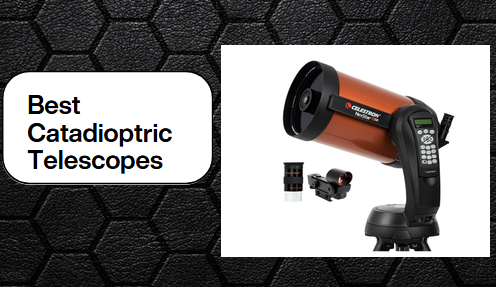
Turn a night of stargazing into an exciting journey through the universe with the Best Catadioptric Telescopes. I recommend these telescopes because their combination of mirrors and lenses delivers versatile optical performance while keeping the tube relatively compact. With features such as large apertures, long focal lengths, quality optical coatings, stable mounts, and computerized GoTo tracking, they make it easier to observe the Moon, planets, star clusters, and distant galaxies. Additionally, selected models support astrophotography, offering more opportunities to explore and capture celestial objects. However, choosing the right telescope requires attention to optical quality, magnification, mount stability, portability, and ease of alignment. In this guide, I’ll review the top picks, explore their essential features and advantages, share a practical buying guide, and answer common FAQs to help you find the Best Catadioptric Telescopes for your observing interests and budget.
Our Top Picks at a Glance
- Celestron NexStar 127SLT Maksutov-Cassegrain Computerized GoTo Telescope – Best for Beginners
- Celestron NexStar 8SE Computerized Schmidt-Cassegrain Telescope – Best Overall
- Celestron StarSense Explorer DX 5″ App-Enabled Schmidt-Cassegrain Telescope – Best for Smartphone-Guided Stargazing
- SVBONY MK127 Catadioptric Telescope – Best Budget Option
- Celestron NexStar 6SE Schmidt-Cassegrain Telescope – Best for Portability and Performance
- Sky-Watcher Skymax 180mm Maksutov-Cassegrain Compound-Style Reflector Telescope – Best for Planetary Viewing
- Celestron NexStar 5SE Schmidt-Cassegrain Computerized Telescope – Best for Intermediate Astronomers
- Celestron CGEM II 11″ Schmidt-Cassegrain Telescope – Best Premium Option
Best Catadioptric Telescopes
1)Celestron NexStar 127SLT Maksutov-Cassegrain Computerized GoTo Telescope
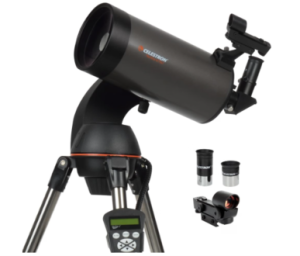
The Celestron NexStar 127SLT Maksutov-Cassegrain Computerized GoTo Telescope is designed for beginners and families who want to explore the night sky without spending too much time locating celestial objects manually. It combines a 127mm aperture with a 1500mm focal length, making it particularly suitable for observing the Moon, planets, and selected deep-sky targets. Its compact Maksutov-Cassegrain optical design also makes transportation and storage more manageable.
The telescope features fully coated, color-corrected optics that gather light for detailed observations of bright celestial objects. With its 127mm aperture, users can explore lunar craters, Saturn’s rings, and Jupiter’s cloud bands. Brighter deep-sky objects, including the Orion Nebula, are also within its observing range. The 1500mm focal length supports detailed views of smaller targets, although its relatively narrow field of view makes it less suitable for viewing larger star clusters and extended nebulae.
Another useful feature is the computerized GoTo mount. Its NexStar+ hand controller contains a database of more than 40,000 celestial objects, including stars, galaxies, and nebulae. Users simply select their desired target, and the telescope automatically moves toward it and tracks its apparent movement across the sky. This system makes finding astronomical objects easier, particularly for beginners who are still learning to navigate the night sky.
Getting started is also relatively straightforward with Celestron’s SkyAlign technology. The alignment process requires users to center three bright celestial objects in the eyepiece, allowing the computerized mount to establish its position. The package includes 20mm and 9mm Kellner eyepieces, a 90-degree star diagonal, and a StarPointer red-dot finderscope for initial targeting.
Portability makes the Celestron NexStar 127SLT suitable for backyard astronomy, camping trips, and visits to darker observing locations. Its optical tube measures approximately 27 inches, while the complete telescope weighs 18.1 pounds. Families can also use it for shared stargazing sessions. Additionally, the included Starry Night Special Edition software helps users explore celestial objects and plan observing sessions.
Best Suited For:This telescope is best suited to beginners and families who prioritize lunar and planetary observation with computerized object locating. It also comes with a two-year limited US warranty and access to Celestron’s customer support.
Specifications
- Optical Design: 127mm Maksutov-Cassegrain
- Aperture: 127mm
- Focal Length: 1500mm
- Eyepieces: 20mm and 9mm Kellner
- Mount: Computerized alt-azimuth single fork arm
- Alignment: SkyAlign
- Object Database: 40,000+ objects
- Weight: 18.1 lbs
- Warranty: 2-year limited US warranty
Pros
- Delivers detailed lunar and planetary views
- Fully coated, color-corrected optical system
- Computerized GoTo system locates and tracks celestial objects
- SkyAlign makes initial setup straightforward
- Portable design for backyard and campsite observation
- Includes two eyepieces and astronomy software
Cons
- Tripod and mount can feel flimsy and shaky
2)Celestron NexStar 8SE Computerized Schmidt-Cassegrain Telescope
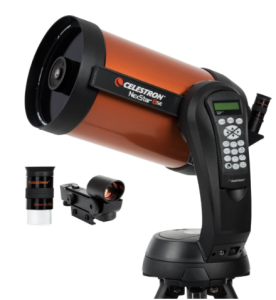
The Celestron NexStar 8SE Computerized Schmidt-Cassegrain Telescope is designed for astronomy enthusiasts who want detailed celestial views combined with automated object locating. Featuring an 8-inch (203mm) aperture and Schmidt-Cassegrain optical design, it gathers substantial light for observing the Moon, planets, and various deep-sky objects. Its computerized GoTo mount also makes it suitable for observers moving beyond manual telescopes and looking for easier navigation around the night sky.
The telescope uses StarBright XLT optical coatings to support bright, clear views. Its 2032mm focal length and f/10 focal ratio provide strong magnification for examining smaller celestial targets. Observers can explore lunar craters, Jupiter’s cloud bands, Saturn’s rings, and deep-sky objects such as galaxies and globular clusters. However, its relatively narrow 0.75-degree field of view makes framing larger celestial objects more challenging.
Another important feature is the computerized GoTo mount, which works with the NexStar+ hand controller. Its database contains more than 40,000 celestial objects, including stars, galaxies, and nebulae. After selecting a target, the mount automatically points the telescope toward it and tracks its movement across the sky. This reduces the need to locate and follow objects manually, making extended observing sessions more convenient.
For initial setup, the NexStar 8SE includes Celestron’s SkyAlign technology. Users center three bright stars or planets in the eyepiece, allowing the system to calculate the telescope’s position and align the mount. The objects do not need to be identified by name, which simplifies the process for those unfamiliar with star charts. However, user feedback indicates that alignment can sometimes be frustrating, with some experiencing difficulties completing the procedure.
Despite its 8-inch aperture, the telescope maintains a relatively compact optical tube measuring 43.2cm. It weighs 23.9 pounds and includes a 25mm Plossl eyepiece, mirror star diagonal, visual back, and StarPointer red-dot finderscope. The computerized system also supports compatible Celestron accessories, allowing users to expand their setup with additional automation and wireless control options.
Best Suited For:The Celestron NexStar 8SE is best suited to astronomy enthusiasts who prioritize detailed lunar and planetary observations alongside computerized navigation. However, beginners should be prepared for some setup learning, particularly when aligning the mount. It includes a two-year US warranty and access to Celestron’s technical support.
Specifications
- Optical Design: 8-inch Schmidt-Cassegrain
- Aperture: 203mm
- Focal Length: 2032mm
- Focal Ratio: f/10
- Optical Coatings: StarBright XLT
- Eyepiece: 25mm Plossl
- Mount: Computerized alt-azimuth single fork arm
- Object Database: 40,000+ objects
- Weight: 23.9 lbs
Pros
- 8-inch aperture gathers light for detailed celestial observations
- Produces bright, clear lunar and planetary views
- Computerized GoTo mount locates and tracks celestial objects
- Extensive database of more than 40,000 objects
- Compatible with additional Celestron accessories
- Compact optical tube for an 8-inch telescope
Cons
- SkyAlign can be difficult to complete successfully
3)Celestron StarSense Explorer DX 5″ App-Enabled Schmidt-Cassegrain Telescope
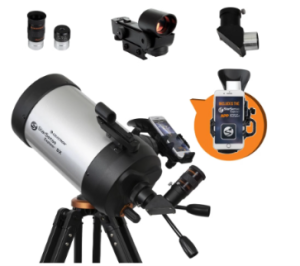
The Celestron StarSense Explorer DX 5″ App-Enabled Schmidt-Cassegrain Telescope is designed for beginners who want to explore the night sky without relying on complicated star charts or advanced navigation skills. It combines a 130mm Schmidt-Cassegrain optical tube with smartphone-guided navigation, making it easier to locate interesting celestial objects. Its compact design also suits casual backyard astronomy and observing sessions away from city lights.
The telescope features StarBright XLT optical coatings to support clear, detailed views of bright celestial targets. Its 1250mm focal length and 5-inch aperture make it suitable for observing lunar craters, Jupiter’s Galilean moons, Saturn, and brighter deep-sky objects. Users can also explore targets such as the Orion Nebula and Andromeda Galaxy, although faint objects may appear dim, particularly under light-polluted skies. Darker observing locations can help improve the experience.
One of its most useful features is Celestron’s patented StarSense technology. Instead of relying entirely on manual star identification, the system analyzes patterns of stars using a compatible smartphone’s camera to determine the telescope’s position. Users dock their phones, open the StarSense Explorer app, and follow the on-screen directions to locate selected objects. The app also recommends celestial targets based on the user’s location and observing conditions, helping beginners decide what to explore.
Unlike fully computerized GoTo telescopes, this model uses a manual altazimuth mount with dual-axis slow-motion controls. After following the app’s directional arrows, users adjust the telescope until the on-screen target indicator turns green. This provides guidance while allowing observers to control the telescope’s movement themselves. However, some users report inconsistent app performance, which can affect the locating experience.
Portability is another practical advantage. The optical tube measures approximately 33cm and the complete telescope weighs 14.6 pounds. Its preassembled tripod simplifies initial setup, while the package includes 25mm and 10mm eyepieces, an erect-image diagonal, and a StarPointer red-dot finderscope. The included accessories provide different viewing options without requiring immediate additional purchases.
Best Suited For:The Celestron StarSense Explorer DX 5″ is best suited to beginners and casual observers who want smartphone-assisted navigation for finding planets, the Moon, and brighter deep-sky objects. Although the mount receives some complaints about stability, the telescope offers an accessible introduction to astronomy. It also includes a two-year limited US warranty and access to Celestron’s technical support.
Specifications
- Optical Design: 5-inch Schmidt-Cassegrain
- Aperture: 130mm
- Focal Length: 1250mm
- Optical Coatings: StarBright XLT
- Eyepieces: 25mm and 10mm
- Mount: Manual altazimuth with dual-axis slow-motion controls
- Guidance: StarSense Explorer smartphone app
- Weight: 14.6 lbs
- Warranty: 2-year limited US warranty
Pros
- Beginner-friendly smartphone-guided object locating
- Produces detailed views of the Moon and Jupiter’s moons
- StarSense app recommends objects based on location
- Dual-axis controls allow smooth manual adjustments
- Compact and lightweight for easy transportation
- Includes two eyepieces and an erect-image diagonal
Cons
- Mount and tripod can feel shaky during observation
4)SVBONY MK127 Catadioptric Telescope
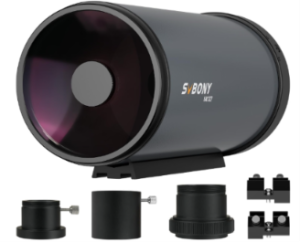
The SVBONY MK127 Catadioptric Telescope is a compact Maksutov-Cassegrain optical tube designed for astronomy enthusiasts who want detailed views of the Moon, planets, and selected deep-sky objects. It features a 127mm effective aperture and an f/11.8 focal ratio, providing a long focal length for observing smaller celestial targets. Its lightweight construction and advanced focusing mechanism also make it suitable for experienced beginners and hobbyists who want greater control over their observing setup.
The telescope uses fully multi-coated optics and high-reflectivity dielectric coatings to improve light transmission and optical efficiency. The manufacturer specifies 99% reflectivity for these coatings, helping the telescope collect and reflect light efficiently. Its Maksutov-Cassegrain design incorporates a flat-field optical system intended to reduce aberrations and maintain image clarity across the viewing field. These features support detailed observations of lunar craters, Jupiter, and other planetary targets.
With a focal length of 1495.6mm and an f/11.8 focal ratio, the MK127 is particularly suited to high-magnification observations. Users can examine planetary details and the Moon with good image sharpness. However, its relatively narrow 0.8-degree field of view makes it less suitable for viewing larger star clusters and extended deep-sky objects. For astrophotography, the included 0.65x flat-field reducer helps produce sharper star points and improve image detail toward the edges. A lens hood is also recommended by the manufacturer for deep-sky photography because it helps reduce stray light and improve contrast.
Focusing is handled by a manual dual-speed mechanism. The faster adjustment allows users to achieve initial focus, while the fine-tuning control supports more precise adjustments when examining smaller details. Additionally, the optical tube accommodates both 2-inch and 1.25-inch eyepieces, giving users flexibility when selecting compatible viewing accessories. An integrated dovetail slot also provides a convenient attachment point for a star finder or guide scope.
Portability is another advantage. Measuring approximately 32.6cm in length and weighing just 3.2 pounds, the optical tube is easy to transport between observing locations. However, the SVBONY MK127 is supplied as an optical tube assembly rather than a complete telescope. Buyers must purchase a compatible mount separately, making it important to consider the additional equipment required.
Best Suited For:This telescope is best suited to astronomy enthusiasts interested in lunar and planetary observation, as well as astrophotographers exploring deep-sky imaging with additional accessories. It comes with a lifetime warranty on the telescope or optical tube assembly.
Specifications
- Optical Design: Maksutov-Cassegrain
- Aperture: 127mm
- Focal Length: 1495.6mm
- Focal Ratio: f/11.8
- Optical Coatings: Fully multi-coated, dielectric coatings
- Eyepiece Compatibility: 2-inch and 1.25-inch
- Focal Reducer: 0.65x flat-field reducer
- Weight: 3.2 lbs (optical tube only)
- Warranty: Lifetime warranty
Pros
- Produces crisp lunar and planetary views
- High-reflectivity coatings support optical efficiency
- Flat-field design helps reduce optical aberrations
- Dual-speed focuser allows precise adjustments
- Compatible with 2-inch and 1.25-inch eyepieces
- Lightweight optical tube for easy transportation
- Includes a 0.65x flat-field reducer
Cons
- Requires a separately purchased telescope mount
5)Celestron NexStar 6SE Schmidt-Cassegrain Telescope
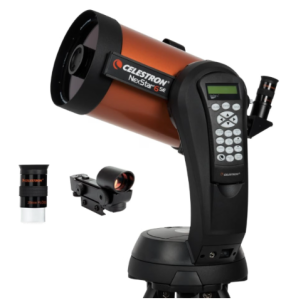
The Celestron NexStar 6SE Schmidt-Cassegrain Telescope is designed for astronomy enthusiasts who want detailed views of celestial objects without spending too much time locating them manually. It combines a 150mm aperture with a computerized GoTo mount, making it suitable for observing the Moon, planets, and selected deep-sky targets. Its compact Schmidt-Cassegrain optical design also provides a practical setup for intermediate observers and families interested in regular stargazing.
The telescope features StarBright XLT optical coatings that support light transmission and image clarity. Its 1500mm focal length and 6-inch aperture provide detailed views of lunar craters, Jupiter’s cloud bands, and its Galilean moons. Saturn and brighter deep-sky objects, including galaxies and globular clusters, are also among its potential viewing targets. However, its optical configuration is better suited to bright celestial objects than faint targets that benefit from wider fields of view.
Locating astronomical objects is easier with the NexStar+ computerized hand controller. Its database contains more than 40,000 stars, galaxies, nebulae, and other celestial targets. After selecting an object, the computerized mount automatically directs the telescope toward it and tracks its apparent movement across the sky. This reduces the need for manual searching and repeated adjustments during observing sessions.
The NexStar 6SE also incorporates Celestron’s SkyAlign technology to simplify initial setup. Users center three bright stars or planets in the eyepiece, allowing the system to calculate its position and align the mount. There is no need to identify the selected objects by name. Although this process is designed to save time, some owners report difficulties with alignment and calibration, so beginners may need practice to achieve consistent results.
The telescope comes with a 25mm Plossl eyepiece, mirror star diagonal, visual back, and StarPointer red-dot finderscope. Its optical tube measures approximately 40.6cm and the complete setup weighs 21 pounds. The mount also supports compatible Celestron accessories, allowing users to add features for wireless control, improved location accuracy, and additional automation as their observing interests develop.
Best Suited For:The Celestron NexStar 6SE is best suited to intermediate observers and families who prioritize lunar and planetary viewing with computerized navigation. Its weight may require some planning when transporting it to darker observing locations. It includes a two-year warranty and access to Celestron’s US-based technical support.
Specifications
- Optical Design: 6-inch Schmidt-Cassegrain
- Aperture: 150mm
- Focal Length: 1500mm
- Optical Coatings: StarBright XLT
- Eyepiece: 25mm Plossl
- Mount: Computerized alt-azimuth single fork arm
- Object Database: 40,000+ celestial objects
- Weight: 21 lbs
- Warranty: 2 years
Pros
- Produces clear, sharp views of the Moon and planets
- 150mm aperture supports observations of brighter deep-sky objects
- Computerized GoTo mount locates and tracks celestial targets
- Extensive database provides access to over 40,000 objects
- SkyAlign simplifies initial telescope alignment
- Compatible with additional Celestron accessories
Cons
- Alignment and calibration can be challenging
6)Sky-Watcher Skymax 180mm Maksutov-Cassegrain Compound-Style Reflector Telescope
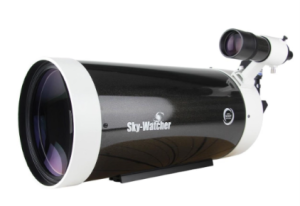
The Sky-Watcher Skymax 180mm Maksutov-Cassegrain Compound-Style Reflector Telescope is designed for astronomy enthusiasts who prioritize detailed lunar and planetary observations. It features a 180mm (7-inch) aperture and a long 2700mm focal length, providing the optical capacity to examine smaller celestial targets with considerable detail. Its Maksutov-Cassegrain design combines mirrors and a corrector plate to deliver high-contrast images, making it suitable for experienced hobbyists who want a dedicated planetary observing instrument.
The telescope uses matched primary and secondary mirrors alongside a carefully coated corrector plate to support image clarity and contrast. Its borosilicate primary mirror features an aluminum coating with a quartz overcoat, providing approximately 94% reflectivity. Additionally, the fully multi-coated optics and baffled optical tube help reduce unwanted stray light that could interfere with observations. These features contribute to dark backgrounds and well-defined views of bright celestial objects.
With its 180mm aperture and 2700mm focal length, the Skymax is particularly suited to observing the Moon and planets. Users can examine lunar surface details, Jupiter’s cloud bands, and features such as the Great Red Spot. Its long focal length supports high-magnification viewing, although the relatively narrow field of view makes it less appropriate for large star clusters and extended deep-sky objects. Some users may also notice slight color fringing around bright planetary targets.
The optical tube features an internal primary-mirror focusing mechanism with a 2-inch focuser. It comes with a 28mm 2-inch eyepiece, a 90-degree star diagonal, and a 9×50 straight-through finderscope. These accessories provide the basic equipment needed to begin observing once the telescope is mounted. Its Vixen-style dovetail plate also allows attachment to compatible astronomical mounts, giving users flexibility when selecting a suitable support system.
Despite its 7-inch aperture, the optical tube is relatively compact, measuring approximately 18cm in length according to the supplied specifications. However, it weighs 19 pounds and does not include a mount. Buyers therefore need a sturdy, compatible mounting system to support its weight and maintain stability during observation.
Best Suited For:The Sky-Watcher Skymax 180mm is best suited to experienced astronomy enthusiasts who prioritize high-contrast lunar and planetary viewing and already own, or are prepared to purchase, a sturdy mount. It includes a two-year warranty.
Specifications
- Optical Design: 180mm Maksutov-Cassegrain
- Aperture: 180mm (7 inches)
- Focal Length: 2700mm
- Primary Mirror: Borosilicate with aluminum and quartz coatings
- Mirror Reflectivity: 94%
- Eyepiece: 28mm 2-inch
- Finderscope: 9×50 straight-through
- Weight: 19 lbs
- Warranty: 2 years
Pros
- Produces high-contrast lunar and planetary views
- 180mm aperture reveals detailed planetary features
- 94% mirror reflectivity supports efficient light transmission
- Fully baffled tube helps reduce stray light
- Includes a 28mm eyepiece and 9×50 finderscope
- Vixen-style dovetail supports compatible mounting systems
Cons
- Narrow field of view limits large deep-sky observations
7)Celestron NexStar 5SE Schmidt-Cassegrain Computerized Telescope
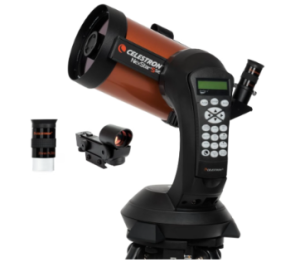
The Celestron NexStar 5SE Schmidt-Cassegrain Computerized Telescope is designed for astronomy enthusiasts who want convenient access to celestial objects without relying entirely on manual navigation. It combines a 127mm aperture with a computerized GoTo mount, making it suitable for observing the Moon, planets, and selected deep-sky targets. Its compact optical tube and automated features make it a practical choice for beginners and intermediate observers interested in developing their astronomy skills.
The telescope uses StarBright XLT optical coatings to support light transmission and image clarity. Its 5-inch aperture and 1250mm focal length provide detailed views of lunar craters, Jupiter’s cloud bands, and Saturn’s rings. Brighter deep-sky objects, including galaxies and globular clusters, are also within its observing range. The f/10 optical system supports planetary observation, although its field of view is less suited to framing larger celestial objects.
Finding astronomical targets is easier with the NexStar+ computerized hand controller. Its database contains more than 40,000 celestial objects, including stars, galaxies, and nebulae. Once users select an object, the mount automatically directs the telescope toward it and tracks its apparent movement across the sky. This reduces manual searching and helps observers follow their chosen targets during longer sessions.
For initial setup, the NexStar 5SE features Celestron’s SkyAlign technology. Users center three bright stars or planets in the eyepiece, allowing the system to calculate its position and align the mount. The objects do not need to be identified by name. However, user feedback indicates that alignment can sometimes be difficult, so beginners may need practice before achieving consistent results.
Another useful addition is the built-in wedge, which allows users to polar-align the mount for astrophotography. This configuration helps reduce field rotation during longer exposures, providing an introduction to imaging the night sky. The telescope also supports compatible Celestron accessories, allowing users to expand their setup with additional automation and wireless control features.
Measuring approximately 33cm in optical tube length and weighing 17.6 pounds, the NexStar 5SE is relatively easy to transport to different observing locations. It includes a 25mm Plossl eyepiece, star diagonal, and StarPointer red-dot finderscope. However, its power options require separate purchases because the AA batteries, AC adapter, and PowerTank are not included.
Best Suited For:The Celestron NexStar 5SE is best suited to beginners and intermediate observers who want portable, computer-guided lunar and planetary observation with some introductory astrophotography capabilities. It includes a two-year limited warranty and access to Celestron’s US-based technical support.
Specifications
- Optical Design: 5-inch Schmidt-Cassegrain
- Aperture: 127mm
- Focal Length: 1250mm
- Focal Ratio: f/10
- Optical Coatings: StarBright XLT
- Eyepiece: 25mm Plossl
- Mount: Computerized alt-azimuth single fork arm
- Object Database: 40,000+ celestial objects
- Weight: 17.6 lbs
Pros
- Produces clear, detailed lunar and planetary views
- Computerized GoTo mount locates and tracks celestial objects
- Extensive database provides access to over 40,000 targets
- SkyAlign simplifies the initial alignment process
- Built-in wedge supports introductory astrophotography
- Compact and portable optical tube
Cons
- SkyAlign can be difficult to complete consistently
8)Celestron CGEM II 11″ Schmidt-Cassegrain Telescope
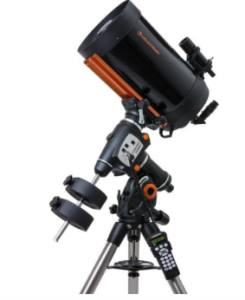
The Celestron CGEM II 11″ Schmidt-Cassegrain Telescope with GoTo EQ Mount combines a large-aperture optical system with computerized object location and tracking. Its 11-inch (279mm) aperture collects substantial light, helping observers see bright, detailed images of planets, the Moon, star clusters, and other deep-sky targets. In addition, its 2800mm focal length supports high-magnification viewing when paired with suitable eyepieces.
Celestron’s StarBright XLT optical coatings improve light transmission and contrast. As a result, the telescope can deliver brighter views while preserving detail across a range of celestial targets. With compatible eyepieces, it supports magnification up to 660x. However, actual image quality at high magnification depends on atmospheric conditions, optical alignment, and the accessories used.
The telescope pairs its optical tube with the CGEM II computerized German equatorial mount. Its NexStar hand controller contains a database of more than 40,000 celestial objects, allowing users to select targets and let the mount locate and track them after alignment. This feature makes it easier to explore objects that might otherwise take considerable time to find manually. Moreover, the equatorial design supports tracking during extended observations and provides a suitable platform for long-exposure astrophotography.
For stability, Celestron includes a sturdy 2-inch steel tripod and a 9×50 finderscope. The optical tube measures approximately 61cm long and weighs about 27.5lb. Nevertheless, the complete setup weighs considerably more, with the listed product weight reaching 148.5lb. Therefore, transporting and assembling the telescope requires planning, particularly when observing away from home.
Best Suited For:The CGEM II 11-inch is best suited to experienced astronomers and dedicated amateurs who want a large-aperture telescope for detailed planetary observations, deep-sky viewing, and astrophotography. Beginners can also learn to operate it, although the computerized alignment process and substantial weight may present an initial challenge. Overall, it offers extensive observing capabilities for users prepared to handle a large and relatively complex telescope.
Specifications
- Optical design: Schmidt-Cassegrain
- Aperture: 11 inches (279mm)
- Focal length: 2800mm
- Optical coatings: StarBright XLT
- Mount: CGEM II computerized equatorial
- Object database: Over 40,000 objects
- Finderscope: 9×50
- Maximum magnification: 660x with compatible eyepieces
- Tripod: 2-inch steel
Pros
- Large aperture gathers substantial light for bright celestial views
- GoTo system locates and tracks thousands of objects
- Sharp planetary and detailed deep-sky observations reported by users
- Sturdy equatorial mount supports long-exposure astrophotography
Cons
- Heavy assembly requires planning for transport and setup
You may also like to read:6 Best 3-15 Scopes
Advantages of Using Catadioptric Telescopes
Versatile Viewing Across Different Celestial Objects
Catadioptric telescopes combine lenses and mirrors to provide versatile observing capabilities. Depending on their aperture and focal length, they can reveal details on the Moon, planets, star clusters, and distant galaxies. Therefore, they suit astronomers who want one optical system for exploring different types of celestial objects rather than limiting themselves to a single observing activity.
Compact Optical Tube Designs
These telescopes use folded optical paths to fit long focal lengths into relatively compact tubes. As a result, many models offer substantial magnification potential without requiring an extremely long optical tube. This design also makes storage and handling more manageable, although larger apertures and heavy mounts can still increase the overall weight.
Strong Light-Gathering Performance
Aperture plays a major role in how much light a telescope collects. Catadioptric models with larger primary mirrors can gather more light, helping observers examine faint stars, nebulae, and galaxies. In addition, greater light collection can produce brighter views and reveal more detail, particularly when observing under dark skies.
Detailed Planetary and Lunar Observations
Many catadioptric telescopes feature relatively long focal lengths, which support higher magnification with compatible eyepieces. Consequently, observers can examine lunar craters, planetary cloud bands, and other visible surface or atmospheric details. Good optical coatings and careful focusing further improve image contrast and clarity.
Improved Contrast Through Optical Coatings
Some catadioptric telescopes use specialized optical coatings to increase light transmission and reduce unwanted reflections. These coatings help preserve image brightness and contrast as light passes through the optical system. Therefore, they can contribute to clearer observations, especially when examining objects with subtle details.
Computerized Object Location and Tracking
Many advanced models include computerized GoTo mounts with databases containing thousands of celestial objects. After alignment, the system can move the telescope toward selected targets and track them as they appear to move across the sky. This feature saves time during observing sessions and makes it easier to explore objects that are difficult to locate manually.
Support for Astrophotography
Catadioptric telescopes with suitable equatorial mounts can support astrophotography. The mount tracks celestial objects as they move across the sky, helping photographers capture longer exposures. Moreover, their long focal lengths and detailed optical performance make them useful for photographing the Moon, planets, and selected deep-sky targets with compatible cameras and accessories.
Factors to Consider When Choosing the Best Catadioptric Telescopes
Aperture Size
Aperture determines how much light a telescope collects and influences the level of detail it can reveal. Larger apertures generally provide brighter views and improve the ability to observe faint celestial objects. However, they often increase the telescope’s weight, size, and cost. Consider your main observing interests and choose an aperture that balances viewing performance with practical handling.
Optical Design
Catadioptric telescopes commonly use Schmidt-Cassegrain or Maksutov-Cassegrain optical designs. Both combine mirrors and lenses, but they differ in construction and optical characteristics. Schmidt-Cassegrain models offer versatility across many observing activities, while Maksutov-Cassegrain designs often appeal to observers interested in lunar and planetary viewing. Choose a design that matches your preferred targets, portability needs, and budget.
Focal Length and Focal Ratio
Focal length affects the magnification available with a particular eyepiece, while the focal ratio describes the relationship between focal length and aperture. Longer focal lengths generally make it easier to achieve higher magnification, which benefits lunar and planetary observations. Meanwhile, shorter focal ratios can provide wider fields of view with suitable eyepieces. Consider both measurements according to the objects you plan to observe.
Optical Coatings and Image Quality
Optical coatings influence how efficiently a telescope transmits light and controls reflections. Fully coated or specialized multi-coated optics can improve light transmission and preserve contrast. In addition, optical alignment, mirror quality, and atmospheric conditions affect the final image. Look for clear information about the coatings and optical construction rather than relying on magnification claims alone.
Mount Type and Stability
The mount supports the optical tube and determines how smoothly you can point and track the telescope. Altazimuth mounts offer straightforward up-and-down and side-to-side movement, while equatorial mounts follow the apparent motion of celestial objects more effectively after proper alignment. For astrophotography, a stable equatorial mount is particularly important. Also, check tripod construction and payload capacity to ensure the mount can support the telescope securely.
Computerized Features and Ease of Alignment
Computerized GoTo systems can locate thousands of celestial objects and automatically track selected targets. These features make observing more convenient, particularly when exploring unfamiliar areas of the sky. However, they require correct alignment and a reliable power supply. Beginners should consider how straightforward the setup process is, while experienced users may prefer more advanced tracking and alignment options.
Weight, Portability, and Assembly
A telescope’s total weight includes more than its optical tube. The mount, tripod, counterweights, and accessories can make the complete setup considerably heavier. Therefore, check the weight of individual components as well as the assembled system. If you plan to travel to dark-sky locations, consider whether you can transport, assemble, and store the telescope comfortably.
Accessories, Power, and Budget
Check which accessories come with the telescope, including eyepieces, finderscopes, diagonals, hand controllers, and power supplies. Some models require additional purchases before you can begin observing comfortably. Also, consider the availability of compatible cameras, adapters, and other accessories if you plan to explore astrophotography. Finally, compare the overall cost with the optical performance, mount quality, included equipment, and long-term observing needs.
FAQs
What Are Catadioptric Telescopes Best For?
Catadioptric telescopes are versatile instruments for observing the Moon, planets, star clusters, and deep-sky objects. Their combination of mirrors and lenses provides long focal lengths in relatively compact optical tubes. Depending on the aperture and mount, they can also support astrophotography and computerized object tracking.
Are Catadioptric Telescopes Suitable for Beginners?
Yes, many catadioptric telescopes suit beginners because they offer compact optical designs and straightforward viewing options. Models with computerized GoTo systems can also help new observers locate celestial objects. However, some advanced models require alignment, additional setup, and careful handling. Beginners should choose a telescope with manageable weight and controls that match their experience.
Can Catadioptric Telescopes Be Used for Astrophotography?
Yes, catadioptric telescopes can support astrophotography when paired with compatible cameras, adapters, and suitable mounts. Equatorial mounts help track celestial objects during longer exposures, while the telescope’s focal length and aperture influence the type of images users can capture. However, successful imaging also depends on tracking accuracy, atmospheric conditions, camera settings, and proper alignment.
Conclusion
The Best Catadioptric Telescopes combine versatile optical designs, strong light-gathering capabilities, and useful magnification potential in relatively compact tubes. They support detailed lunar and planetary observations while also allowing astronomers to explore star clusters, nebulae, and galaxies. Furthermore, computerized GoTo systems simplify object location, while stable equatorial mounts can support tracking and astrophotography. When choosing one, consider aperture, focal length, optical quality, mount stability, computerized features, portability, and included accessories. Ultimately, the right telescope will depend on your observing interests, experience, available space, and budget.