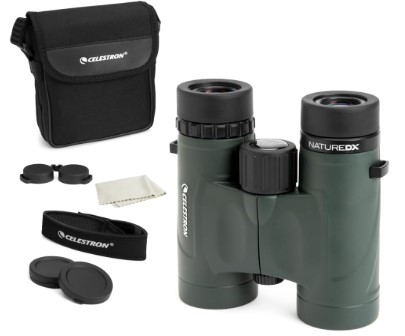
If you want to buy the best 8×32 binoculars and enjoy crisp, detailed views in a compact, easy-to-carry design, you are in the right place.
I have tested several models that combine bright, sharp optics with durable, weather-resistant construction, making them perfect for birdwatching, hiking, sports events, and general outdoor exploration.
These binoculars are great because they deliver a clear, immersive experience while staying comfortable for long periods of use.
In this guide, I’ll cover key features, highlight my top picks, provide a detailed buying guide, and answer frequently asked questions to help you make a confident choice.
See summary of the best 8×32 binoculars:
- Celestron Nature DX 8×32 Binoculars: Best overall
- Bushnell Spectator Sport 8x32mm Binoculars: Best budget option
- ZEISS Terra ED Binoculars 8×32: Best premium option
- Celestron 71401 TrailSeeker ED 8 x 32 Roof Prism Binocular: Best for long-range clarity
- Hawke Vantage Binoculars 8×32: Best for versatile outdoor use
- Vanguard Endeavor ED 8×32 Binoculars: Best compact and durable design
- Vortex Optics Diamondback HD 8×32 Binoculars: Best bright and crisp optics
7 Best 8×32 Binoculars
1) Celestron – Nature DX 8×32 Binoculars
Check Price on Amazon
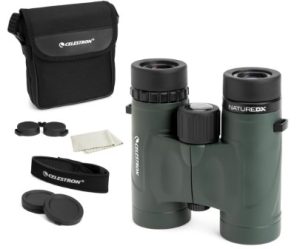
The Celestron Nature DX 8×32 is a compact, capable binocular from one of the most respected names in optics. With over six decades of experience behind it, Celestron has crafted a model that strikes a thoughtful balance between portability and genuine optical performance. Whether you are heading out for a morning of birdwatching, a weekend hike, or simply want a reliable pair of binoculars ready for wherever the day takes you, the Nature DX 8×32 is designed to fit that role without fuss or compromise.
The 8x magnification paired with 32mm objective lenses produces a configuration that many experienced observers consider the sweet spot for handheld use. Eight times magnification is powerful enough to bring birds, wildlife, and distant landscapes into satisfying detail while remaining stable enough to use without a tripod for extended periods. The 32mm lenses keep the package compact and lightweight without sacrificing the brightness needed for varied lighting conditions. The wide 7.4-degree angular field of view is a genuine asset, making it easier to locate fast-moving subjects and track birds in flight across open landscapes.
The optical quality of the Nature DX sets it apart from many binoculars at its price point. Fully multi-coated lenses treat every air-to-glass surface for maximum light transmission, while phase-coated BaK-4 prisms bring a level of contrast and resolution refinement that is not standard across the budget segment. Phase coating corrects the phase shift that occurs in roof prism designs, resulting in sharper, higher-contrast images with truer color rendition. The combination of these two optical technologies produces views that feel noticeably crisper and more natural than comparably priced alternatives.
Durability and weather resistance are well addressed in the Nature DX. The rubber-armored polycarbonate housing absorbs impact and provides confident grip, while full waterproofing and nitrogen purging keep the internal optics safe from moisture and fogging in rain, snow, or high-humidity environments. The built-in tripod adapter socket adds versatility for users who want to use the binoculars for extended, shake-free observation sessions. Celestron backs the Nature DX with its Limited Lifetime US Warranty and US-based technical support, completing a package that delivers strong overall value.
Pros
- Fully multi-coated lenses combined with phase-coated BaK-4 prisms deliver excellent image quality
- Wide 7.4-degree field of view aids subject tracking and landscape scanning
- Waterproof and nitrogen-purged construction handles demanding outdoor conditions
- Built-in tripod adapter socket adds flexibility for extended viewing
- Compact and lightweight design suits all-day outdoor use
- Backed by Celestron’s Limited Lifetime Warranty with US-based support
Cons
- Tripod adapter must be purchased separately
2) Bushnell Spectator Sport 8x32mm Binoculars
Check Price on Amazon
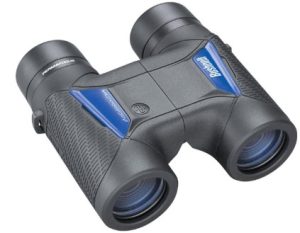
The Bushnell Spectator Sport 8×32 is a binocular built around a concept that sets it apart from virtually everything else in this roundup: permanent focus. Designed with a fixed-focus permafocus system, this model eliminates the focus wheel entirely, keeping all objects beyond a certain distance in continuous, sharp focus without any adjustment required. For stadium events, air shows, racetracks, and other fast-paced spectator activities where subjects are constantly moving across a wide visual field, this design choice is genuinely practical and removes the frustration of fumbling with focus while the action unfolds.
The optical system uses multi-coated lenses across all surfaces to improve light transmission and image brightness, producing clear, reasonably vibrant views in typical daylight conditions. The exit pupil measures 4 millimeters, and eye relief is rated at 13 millimeters, which is workable for most users, though eyeglass wearers may find the eye relief on the shorter side. The field of view is rated at 127 meters, providing a broad visual sweep well suited to scanning crowds, following athletes, or tracking subjects across open ground.
Weather protection is built into the Spectator Sport through nitrogen purging, which prevents internal fogging when humidity levels rise or temperatures shift suddenly. The IPX4 waterproof rating offers protection against splashing water from multiple directions, making the binoculars safe to use in light rain or near water without concern. One of the more distinctive aspects of this model is its customizable accent tile system, which allows users to swap colored panels in black, white, blue, or red to personalize the look of the binoculars, a feature that appeals particularly to fans who want their gear to reflect team colors or personal style.
The Spectator Sport is at its best in structured, predictable environments where subjects remain at a consistent distance. It is less suited to activities like birdwatching or hunting, where close-focus capability and precise adjustment are necessary. Within its intended use case, however, it offers a genuinely user-friendly experience that requires no learning curve and no optical fiddling.
Pros
- Fixed permafocus system eliminates the need for constant focus adjustment
- Nitrogen purging provides reliable fogproof performance in humid and wet conditions
- IPX4 waterproof rating handles rain and splash exposure
- Customizable color accent tiles allow personal style expression
- Multi-coated optics deliver bright, clear images in standard daylight conditions
- Simple, no-fuss operation suits spectator sports and casual outdoor events
Cons
- 13mm eye relief may be insufficient for comfortable use with eyeglasses
3) ZEISS Terra ED Binoculars 8×32
Check Price on Amazon
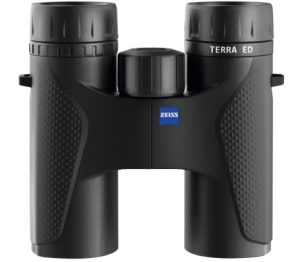
The ZEISS Terra ED 8×32 occupies a different tier from most entries in this roundup, representing a genuine step into premium optics from one of the most storied names in the history of optical engineering. ZEISS has been producing precision glass since the 19th century, and the Terra ED carries that heritage into a compact, field-ready format designed for nature lovers who refuse to accept compromises in image quality. For those willing to invest accordingly, the Terra ED delivers a viewing experience that redefines what 8×32 binoculars can achieve.
The optical system is built around Extra-low Dispersion glass arranged in a Schmidt-Pechan prism design, achieving 88% light transmission, a figure that reflects exceptional optical efficiency. ED glass reduces chromatic aberration, the color fringing that produces purple or green edges on high-contrast subjects, to levels that are virtually imperceptible in everyday use. The result is images with outstanding clarity, true color fidelity, and sharpness that holds from edge to edge across the field of view. ZEISS’s proprietary anti-reflective coating ensures brilliant, high-contrast images particularly in adverse light conditions and twilight, which is precisely when many of the most rewarding wildlife encounters occur.
One of the most practical design features of the Terra ED is its large, ergonomically positioned focus wheel. ZEISS has designed the wheel so that the index finger naturally rests on it at all times, allowing instant adjustment without repositioning the hand. This matters in the field, where hesitation during a fleeting wildlife sighting can mean the difference between a sharp view and a missed moment. The focusing action itself is smooth and precise, offering excellent control across the full range of distances.
The Terra ED’s construction uses a fiberglass-reinforced polycarbonate chassis that is both waterproof and impressively light for its build quality. ZEISS’s hydrophobic multi-layer anti-reflective coating applied to the exterior lens surfaces causes water to bead and run off rather than forming droplets that obscure the view, a meaningful advantage when birding or hiking in wet weather. The compact dimensions make it easy to slip into a jacket pocket or daypack, and the near-indestructible build quality gives it the durability to serve as a daily companion for years.
Pros
- 88% light transmission through ED glass and Schmidt-Pechan prism design delivers exceptional optical performance
- Hydrophobic multi-layer coating provides clear views in wet and adverse weather
- Ergonomically positioned focus wheel allows fast, natural adjustment in the field
- Fiberglass-reinforced waterproof chassis is lightweight and extremely durable
- ZEISS anti-reflective coating produces brilliant, high-contrast images in low light
- Compact enough for everyday carry without sacrificing premium optical quality
Cons
- Significantly higher price point
4) Celestron 71401 TrailSeeker ED 8 x 32 Roof Prism Binocular
Check Price on Amazon
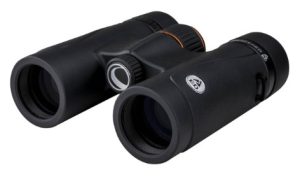
The Celestron TrailSeeker ED 8×32 sits at the upper end of Celestron’s accessible optics lineup, bringing Extra-low Dispersion glass technology into a compact, trail-ready format. For outdoor enthusiasts who want a meaningful optical upgrade over standard glass without crossing into premium price territory, the TrailSeeker ED represents a well-considered middle ground that delivers noticeably superior image quality in a package that is easy to carry and built for real-world conditions.
The defining optical feature of the TrailSeeker ED is its ED glass objective lenses. Extra-low Dispersion glass minimizes chromatic aberration, the optical flaw that causes color fringing around high-contrast edges, producing images with accurate color reproduction, improved resolution, and enhanced contrast. This is a meaningful upgrade over standard glass and one that becomes particularly apparent when viewing subjects against bright backgrounds, scanning fine feather detail in birdwatching, or working in mixed lighting conditions. Fully multi-coated optics across all surfaces further maximize light transmission throughout the optical path.
The prism system combines phase-coated and dielectric-coated BaK-4 roof prisms, two technologies that each contribute to the overall image quality in distinct ways. Phase coating corrects the phase shift inherent in roof prism designs to improve contrast and resolution, while dielectric coating maximizes reflectivity within the prism to boost brightness. Together they deliver views with exceptional clarity and light-gathering efficiency, making the TrailSeeker ED a strong performer in the early morning or late evening hours when light levels are at their most challenging.
A close focus distance of just 6.5 feet gives the TrailSeeker ED a versatility that many binoculars at this size cannot match. Butterflies, dragonflies, and other nearby subjects become easily observable, adding a dimension to the viewing experience that purely distance-focused binoculars cannot provide. Full waterproofing via dry nitrogen gas sealing ensures reliable performance in wet conditions, while the built-in tripod adaptability and Celestron’s Limited Lifetime Warranty round out a package that competes seriously above its price bracket.
Pros
- ED glass objective lenses deliver superior chromatic aberration control and color accuracy
- Phase-coated and dielectric BaK-4 prisms maximize contrast, resolution, and brightness
- Fully multi-coated optics optimize light transmission across all surfaces
- Impressively close 6.5-foot minimum focus distance for nearby subject observation
- Fully waterproof with dry nitrogen gas sealing for reliable fogproof performance
- Tripod adaptable and backed by Celestron’s Limited Lifetime Warranty
Cons
- Tripod adapter must be purchased separately
5) Hawke Vantage Binoculars (8×32)
Check Price on Amazon
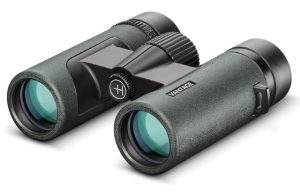
The Hawke Vantage 8×32 is a compact, straightforward binocular from Hawke Optics, a brand that has built a solid reputation for delivering practical, reliable performance at accessible price points. The Vantage series is designed for the everyday outdoor user who wants a dependable pair of binoculars that handles typical field conditions without complication or excessive cost. It is a practical, no-nonsense option that covers the fundamentals competently.
The optical system is built around BAK-4 roof prisms paired with a fully coated optical system, providing images that are clear and bright in standard daylight conditions. Close focus is rated from 6.6 feet, giving the Vantage reasonable versatility for observing nearby subjects as well as distant ones. The rubber-coated focus wheel provides a tactile, grippy surface for precise adjustment, even with damp or gloved hands, and operates smoothly across its full range of travel.
The chassis is constructed from a rubber-coated material that absorbs minor impacts and provides confident grip in the hand. The design is lightweight by the standards of full-size binoculars, which contributes to comfort during extended periods of use. Twist-up eyecups with position stops allow users to set their preferred eye relief and lock it in place, which is a practical feature for eyeglass wearers or those who share the binoculars with others. Stay-on lens covers provide consistent protection for both the objective and eyepiece lenses when the binoculars are not in active use, reducing the risk of scratches or dust accumulation during transport.
The Vantage 8×32 is best positioned as an entry-level to mid-range option for casual birdwatchers, hikers, and general outdoor users. It does not carry the optical refinements of ED glass or phase-coated prisms, but for users who are stepping up from a very basic binocular or buying their first dedicated outdoor optic, it offers a meaningful and accessible improvement.
Pros
- BAK-4 roof prisms deliver solid optical performance for the price
- Rubber-coated focus wheel provides a tactile, controlled focusing experience
- Twist-up eyecups with position stops suit both eyeglass and non-eyeglass wearers
- Stay-on lens covers protect optics during transport and storage
- Lightweight and durable rubber-coated chassis handles everyday outdoor use
- Close focus from 6.6 feet adds versatility for nearby subjects
Cons
- Limited accessory package compared to competitors at similar price points
6) Vanguard Endeavor ED 8×32 Binoculars
Check Price on Amazon
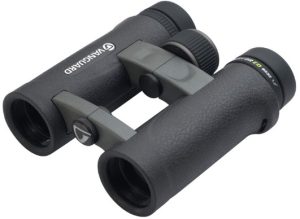
The Vanguard Endeavor ED 8×32 is a premium-leaning binocular that combines Extra-low Dispersion glass with an advanced coating system and an ergonomically refined design to produce one of the more capable compact binoculars available in its category. Vanguard has built a strong reputation in the optics and photography accessories market, and the Endeavor ED reflects the brand’s commitment to delivering specification and build quality that competes with higher-priced alternatives.
The optical foundation of the Endeavor ED is its ED glass combined with advanced multiguard coatings, which together produce exceptional color fidelity, fine detail resolution, and strong light transmittance even as lighting conditions deteriorate. ED glass minimizes chromatic aberration to deliver clean, accurate colors without the fringing that compromises lesser optics. The phase-coated BAK-4 roof prisms enhance image resolution further and extend the quality of the viewing experience to the edges of the frame, producing edge-to-edge sharpness that is a hallmark of well-engineered compact binoculars.
The field of view measures 377 feet at 1,000 yards, a notably wide window that benefits birdwatchers and wildlife observers who need to track fast-moving subjects across open terrain. The 7.2-degree view angle confirms this generous coverage. Eye relief is rated at a generous 19.5 millimeters, one of the longest figures across all the models reviewed here, making the Endeavor ED an excellent choice for eyeglass wearers who typically struggle to achieve a full field of view with shorter eye-relief binoculars. The three-stage twist-out eyecups allow precise positioning, while the locking diopter ring ensures that personal calibration settings stay exactly where you set them.
At 16.9 ounces, the Endeavor ED is impressively light for a binocular with this level of optical specification. The open bridge body design improves grip and balance in the hand, and the large, precise focus wheel allows smooth, rapid target acquisition. Full waterproofing and fogproofing round out a construction that is genuinely built for the demands of outdoor use across seasons and weather conditions.
Pros
- ED glass with advanced multiguard coatings delivers outstanding color fidelity and clarity
- Phase-coated BAK-4 prisms produce sharp, high-contrast, edge-to-edge images
- 19.5mm eye relief is among the longest available, ideal for eyeglass wearers
- Wide 377-foot field of view at 1,000 yards facilitates excellent subject tracking
- Three-stage twist-out eyecups with locking diopter ring allow precise, stable customization
- 100% waterproof and fogproof construction handles all-weather outdoor use
Cons
- Higher price point
7) Vortex Optics Diamondback HD 8×32 Binoculars
Check Price on Amazon
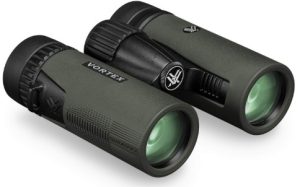
The Vortex Optics Diamondback HD 8×32 is a meticulously refined compact binocular that delivers a premium-level viewing experience within a field-ready, rugged package. Building on the strong reputation of the Diamondback line, Vortex has equipped this model with an HD optical system, multiple advanced coatings, and argon purging to produce a binocular that performs well across a wide range of outdoor activities. For birdwatchers, hunters, and general naturalists who want serious optical quality in a compact format, the Diamondback HD 8×32 is a compelling choice.
The optical system is anchored by select HD glass elements that are optimized to reduce chromatic aberration and maximize color fidelity, sharpness, and light transmission. Fully multi-coated lenses apply anti-reflective coatings to every air-to-glass surface, driving light transmission as high as the design allows. Dielectric coating on the prism surfaces provides bright, color-accurate reflectivity that surpasses what standard aluminum coatings deliver. The Armortek coating applied to the exterior lens surfaces adds a further layer of practical value by protecting the glass from scratches, oils, and dirt, reducing the maintenance burden in the field. The 8.1-degree apparent angle of view is notably wide, contributing to an immersive, expansive viewing experience.
Argon purging, rather than the more common nitrogen purging, is used to seal the Diamondback HD against moisture and fog. Argon molecules are larger than nitrogen molecules, which means they migrate through seals more slowly over time, theoretically providing a longer-lasting internal atmosphere. Combined with O-ring seals, the result is waterproof and fogproof performance that is reliable across all environments. The construction is also rated to withstand recoil and impact, making the Diamondback HD a credible companion for hunters who use it alongside firearms.
The adjustable eyecups operate with a smooth twist-up mechanism, accommodating both eyeglass and non-eyeglass wearers comfortably. The center focus wheel and right-eyepiece diopter work together to allow precise calibration to individual vision. Rubber armor provides a secure, non-slip grip, and built-in tripod adaptability extends the Diamondback HD’s usefulness for stationary observation. Vortex’s unconditional, unlimited, lifetime VIP Warranty, fully transferable and covering repair or replacement for damaged or defective units, completes a package that represents outstanding long-term value.
Pros
- HD optical system with fully multi-coated lenses and dielectric prism coating delivers exceptional image quality
- Armortek exterior coating protects lenses from scratches, oil, and dirt
- Argon purging offers superior long-term fogproof performance compared to nitrogen
- Wide 8.1-degree apparent angle of view provides an immersive, expansive field
- Rugged construction withstands recoil and impact for hunting applications
- Vortex’s unconditional lifetime VIP Warranty provides exceptional long-term value
Cons
- Does not include a glasspak harness, only a standard neck strap option
Factors to Consider When Choosing The Best 8×32 Binoculars
Optical Glass Quality
The type of glass used in a binocular’s objective lenses has a profound effect on the overall image quality you will experience in the field. Standard glass performs adequately in good lighting but tends to show chromatic aberration, the color fringing around high-contrast edges that can make images look slightly unnatural or soft. Extra-low Dispersion glass addresses this directly by bending different wavelengths of light more uniformly, resulting in images with accurate color reproduction, improved resolution, and noticeably cleaner contrast. If you intend to use your binoculars for detailed observation such as birdwatching or wildlife photography scouting, investing in ED glass makes a tangible and visible difference that you will appreciate every time you raise the binoculars to your eyes.
Lens Coating Specification
Lens coatings are among the most important optical specifications to evaluate when choosing an 8×32 binocular, yet they are frequently misunderstood. The terms fully coated, multi-coated, and fully multi-coated each describe a progressively higher level of anti-reflective treatment applied to the lens surfaces. Fully multi-coated glass, where multiple anti-reflective layers are applied to every single air-to-glass surface inside the binocular, represents the highest standard and delivers the brightest, most color-accurate, and highest-contrast images. This distinction is particularly meaningful in an 8×32 format, where the smaller objective lenses already gather less light than larger alternatives. Choosing binoculars with the highest coating grade available within your budget ensures you extract every possible photon from the available light, which translates directly to better performance during the golden hours of dawn and dusk.
Prism Type and Coating
The prism system inside a roof prism binocular plays a critical role in determining the final image quality delivered to your eye. BAK-4 glass is the preferred prism material at every serious price point, offering better light transmission and reduced edge distortion compared to BAK-7 alternatives. Beyond the glass material itself, prism coatings add further layers of optical refinement. Phase coatings correct the phase shift inherent in roof prism designs, restoring contrast and resolution that would otherwise be partially lost. Dielectric coatings maximize the reflectivity of the prism surfaces to near-total levels, pushing brightness above what standard aluminum coatings can achieve. The combination of BAK-4 glass with both phase and dielectric coatings represents the gold standard in compact roof prism binoculars and produces images that stand noticeably apart from less refined alternatives.
Field of View
Field of view is a specification that directly affects how useful and enjoyable a binocular is to use in real-world conditions. Expressed in feet at 1,000 yards or in degrees, it describes how wide a visual area you can observe without moving the binoculars. A wider field of view makes it significantly easier to locate subjects quickly, track birds and animals in motion, and maintain situational awareness in dynamic environments. In the 8×32 format, a field of view above 340 feet at 1,000 yards is generally considered generous, while figures above 370 feet represent genuinely wide coverage that confers a real practical advantage. For fast-moving subjects or scanning large open areas, the difference between a narrow and a wide field of view is something you will notice immediately in the field.
Eye Relief and Eyecup Design
Eye relief refers to the distance between the eyepiece lens and the point at which your eye receives the full field of view. It is a specification that matters most to eyeglass wearers, who need sufficient eye relief to position their eye at the correct distance while glasses sit between their eye and the eyepiece. A minimum of 14 to 15 millimeters is generally considered workable for glasses wearers, while figures of 17 millimeters and above offer noticeably more comfortable viewing. The design of the eyecups themselves is equally important. Twist-up eyecups with multiple locking positions allow users to set their preferred distance and hold it reliably, while smooth and precise rotation ensures the setting remains consistent throughout a session. For shared binoculars used by multiple people with different needs, high-quality adjustable eyecups with positive click stops are a practical necessity.
Waterproofing and Fogproofing
The ability to use a binocular without concern for weather conditions is not a luxury in the context of outdoor use; it is a practical requirement. Waterproofing prevents moisture from entering the optical system during rain, splashes, and condensation events, protecting the internal lenses and prisms from long-term damage. The level of waterproofing matters as well, with IPX ratings providing a standardized measure of protection. IPX4 covers splash resistance from multiple directions, while IPX7 certifies full submersion protection at one meter for 30 minutes. Fogproofing is achieved through internal purging with inert gas, either nitrogen or argon, which replaces the moisture-carrying air inside the housing and prevents internal condensation when the binoculars move between temperature environments. Together, these two features define whether a binocular can be trusted in the field conditions where it will most often be used.
Close Focus Distance
Close focus distance is a specification that is easy to overlook when evaluating binoculars but proves its value repeatedly during actual outdoor use. It describes the shortest distance at which the binoculars can achieve sharp focus, and in naturalist contexts, the difference between a 10-foot minimum and a 6-foot minimum is substantial. A short close focus distance opens up an entirely different category of observation, allowing you to study butterflies, dragonflies, beetles, wildflowers, and other nearby subjects in the same detail you would apply to a distant bird or landscape. For birdwatchers who work in woodland environments where subjects can be surprisingly close, and for anyone with an interest in insects or botany, prioritizing a short close focus specification adds a dimension to the viewing experience that a longer close focus binocular simply cannot provide.
Build Quality and Long-Term Value
The physical construction of a binocular determines both how it feels to use day after day and how long it continues to perform reliably under real-world conditions. Rubber-armored exteriors protect against drops and impacts while improving grip in wet or cold conditions, and the quality of the armor affects both its protective value and its tactile feel. Chassis materials range from polycarbonate to fiberglass-reinforced composites to full magnesium alloy, each offering a different balance of weight, rigidity, and thermal comfort in cold weather. Equally important is the warranty that backs the product, as it reflects the manufacturer’s confidence in the build quality and defines the long-term financial risk of the purchase. Unconditional lifetime warranties that cover repair or replacement regardless of circumstance represent the highest standard of customer commitment and effectively protect your investment for the entire usable life of the binocular.
Best 8×32 Binoculars FAQs
Who is the 8×32 binocular format best suited for?
The 8×32 binocular format occupies a practical and popular sweet spot between true compact designs and full-size alternatives. The 8x magnification level is widely regarded as the most versatile for handheld use, offering enough reach to observe distant birds, wildlife, and landscapes in satisfying detail while remaining stable enough for extended viewing without a tripod. The 32mm objective lens diameter keeps the overall package compact and light enough to carry comfortably all day, making it a natural fit for hikers, backpackers, and travellers who are conscious of weight and pack space. It is particularly well suited to birdwatchers who spend long hours in the field, naturalists who move frequently between observation points, and anyone who wants a genuinely capable binocular that can be worn around the neck without becoming a burden. It is also a format that works exceptionally well for children and younger users due to the manageable size and comfortable magnification level.
How does ED glass affect image quality in 8×32 binoculars?
Extra-low Dispersion glass makes a particularly meaningful contribution in compact binoculars like the 8×32 format because it addresses one of the most visible optical shortcomings in this class: chromatic aberration. Standard optical glass bends different wavelengths of light by slightly different amounts, causing the separate color channels to focus at marginally different distances. The result is color fringing around high-contrast edges, most visible when viewing dark subjects against bright skies or light-colored backgrounds. ED glass is formulated to minimize this dispersion, bringing all wavelengths of light to a much more consistent focal point. The practical outcome is images with cleaner, more accurate colors, sharper fine detail, and higher perceived contrast across the entire frame. In a compact 8×32 binocular where maximum image quality per millimeter of aperture is the goal, ED glass represents one of the most impactful upgrades available.
What is the difference between nitrogen-purged and argon-purged binoculars?
Both nitrogen and argon purging serve the same fundamental purpose: replacing the moisture-carrying air inside a binocular’s sealed housing with an inert gas that cannot support condensation. This is what gives purged binoculars their fogproof performance when moving between environments with different temperatures. The practical difference lies in the molecular properties of the two gases. Argon molecules are larger than nitrogen molecules, which causes them to migrate through the seals of a binocular more slowly over time. In theory, this means an argon-purged binocular maintains its inert internal atmosphere for longer before any imperceptible amount of gas exchange occurs through the seals. In everyday practical use, both gases provide reliable and effective fogproofing, and the difference is unlikely to be noticeable within the normal usable lifespan of a quality binocular. Argon purging is generally found in higher-end models and serves as an indicator of overall build refinement rather than a feature that demands prioritization on its own.
Are 8×32 binoculars a good choice for low-light conditions?
The 8×32 format performs reasonably well in low-light conditions relative to its size, but it is worth setting realistic expectations. The exit pupil, which is the diameter of the beam of light that exits the eyepiece and enters your eye, measures 4 millimeters in an 8×32 binocular. In dim conditions, the human pupil can dilate to around 5 to 7 millimeters depending on age, meaning a 4-millimeter exit pupil does not fully utilize the eye’s available light-gathering capacity in the darkest environments. That said, the optical efficiency of an 8×32 binocular is heavily influenced by the quality of its coatings and glass, and a well-built 8×32 with ED glass, fully multi-coated optics, and dielectric prism coatings can transmit light with such efficiency that it performs significantly better in low light than a less refined binocular with a larger aperture and inferior coatings. For serious low-light use such as dawn and dusk wildlife observation, an 8×42 format with its larger 5.25-millimeter exit pupil may be a more appropriate choice, but a high-quality 8×32 will remain usable and capable well into challenging lighting conditions.
Conclusion
When it comes to enjoying crisp, detailed views in a compact and portable package, these 8×32 binoculars deliver an exceptional balance of clarity and convenience.
They make every outdoor moment more immersive, whether you are scanning treetops for wildlife, following the action at a sporting event, or exploring scenic landscapes.
Lightweight and easy to handle, they stay comfortable during long adventures while still offering bright, sharp images that reveal the smallest details.
With dependable performance you can trust, these binoculars turn every glance into a more vivid and engaging experience, letting you see the world in a whole new way.
See Also: